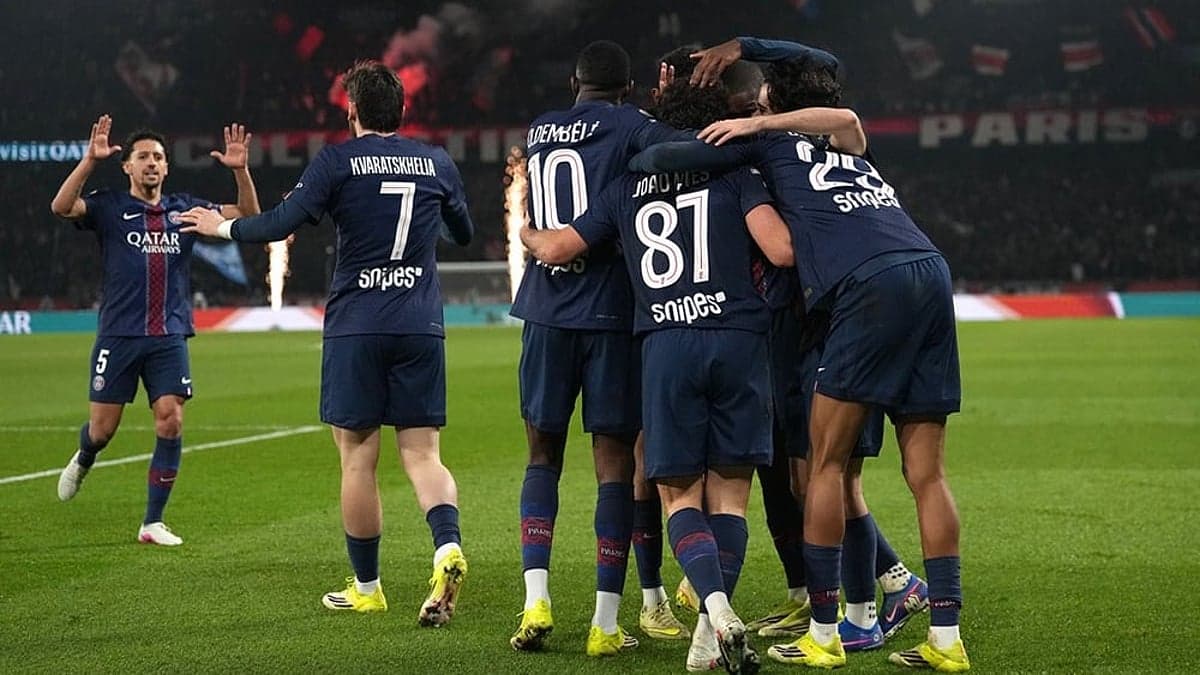
PSG Completes Comeback Against Monaco in Champions League
On a frenetic Champions League Round of 32 night at Stade Louis II, Paris Saint Germain overturned a two-goal deficit to beat Monaco 3–2 and underline the gap in European pedigree between the sides. Folarin Balogun’s early brace had Sebastien Pocognoli’s team dreaming, but a decisive display from substitute Désiré Doué and a second-half red card for Aleksandr Golovin swung the tie emphatically towards Enrique Luis’s visitors. The result reinforces PSG’s position among the competition’s leading contenders, while Monaco, already outside the top 20 in the overall standings, see their margin for error shrink.
First-half analysis
Monaco made a dream start. With barely a minute played (1'), Balogun struck the opener, finishing after service from Golovin to shock a PSG side still settling into the contest. The hosts doubled their lead on 18', Balogun again the scorer, this time supplied by Maghnes Akliouche, capitalising on Monaco’s early efficiency in the final third.
The two-goal cushion forced PSG into an early rethink. On 27', Enrique Luis withdrew Ousmane Dembélé, sending on Désiré Doué in an attacking like-for-like switch that would transform the match. Monaco, meanwhile, began to feel the strain defensively: Wout Faes was booked for a foul on 21', followed by a yellow card for Denis Zakaria on 29', signs of the pressure PSG’s possession was starting to generate.
Within moments of Zakaria’s booking, PSG found a route back. On 29', Doué, barely on the pitch, halved the deficit with a goal assisted by Bradley Barcola. The visitors were now firmly on the front foot, and the equaliser arrived before the break. On 41', Achraf Hakimi levelled at 2–2, finishing after being set up by Doué, whose impact off the bench had completely flipped the momentum by half-time.
Second half and tactical shifts
The restart brought the game’s pivotal disciplinary moment. A VAR intervention on 47' for Golovin’s challenge resulted in a card upgrade, and by 48' the Monaco playmaker had been sent off for a foul. Reduced to ten men with more than forty minutes to play, Pocognoli’s side were forced into damage-limitation mode, reshaping around a deeper block and quicker transitions.
Monaco’s first change came on 58', with Akliouche making way for Krépin Diatta. The switch, midfielder for midfielder, suggested an attempt to restore some balance and work-rate in wide areas after the red card, rather than to chase the game expansively.
PSG’s territorial dominance finally told again on 67'. Doué, at the heart of everything, struck his second of the night to make it 3–2, this time assisted by Warren Zaïre-Emery. With the visitors now in front for the first time, Enrique Luis continued to refresh his attacking options: Khvicha Kvaratskhelia was replaced by Lee Kang-In on 69', a creative midfield profile for a forward, hinting at a desire to control tempo and possession rather than play purely in transition.
Pocognoli responded almost immediately with a double change on 70'. Vanderson went off for Aladji Bamba, and Simon Adingra was replaced by Mamadou Coulibaly, both midfielders coming on as Monaco sought fresh legs and defensive solidity on the flanks to cope with PSG’s waves of attacks. The visitors, still pushing, introduced Gonçalo Ramos for Barcola on 81', adding a penalty-box striker to lock Monaco deeper.
Two minutes later, on 83', Balogun, Monaco’s double goalscorer, was withdrawn for Mika Biereth. With ten men and chasing the game, the change reflected fatigue as much as tactics, leaving Monaco to search for an equaliser without their most clinical outlet. PSG managed the closing stages without further incident, protecting their narrow but deserved advantage.
Statistical deep dive
The numbers underline how extreme Monaco’s task became after the red card. PSG controlled 80% of the ball, completing 737 of 801 passes at a slick 92% accuracy. Monaco, by contrast, had just 20% possession and 198 total passes, with a respectable but comparatively modest 73% completion. The visitors dictated where and how the game was played; Monaco were largely confined to counters and isolated phases.
In attack, PSG’s volume was overwhelming: 30 total shots, 10 on target, and an expected goals figure of 2.51. Converting three goals from that platform reflects solid, if not ruthless, finishing. Monaco produced only 7 shots, 4 on target, from an xG of 1.19, meaning Balogun’s brace represented a highly efficient use of limited opportunities. Philipp Köhn’s 7 saves kept the scoreline competitive, while Matvey Safonov was called into action only twice.
Discipline further illustrates the pattern. Monaco committed 11 fouls and collected two yellow cards plus Golovin’s red, a reflection of constant defensive firefighting. PSG, by contrast, conceded just 4 fouls and avoided any bookings, maintaining control both with and without the ball.
Standings and implications
In the broader Champions League table, the result reinforces existing hierarchies. PSG, ranked 11th with 14 points and a +10 goal difference (21 scored, 11 conceded), continue to look like a side equipped for the latter stages, their away record now featuring two wins from four and a positive goal balance on the road. Monaco, sitting 21st on 10 points with a -6 goal difference (8 for, 14 against), remain in the playoff mix but with clear warning signs: defensively fragile overall, despite a previously unbeaten home record in this campaign (now 1 win, 3 draws before this defeat). This loss tightens the pressure on Pocognoli’s team as they seek to stay in contention against Europe’s elite.