PSG Edges Bayern in Thrilling 5–4 Semi-Final
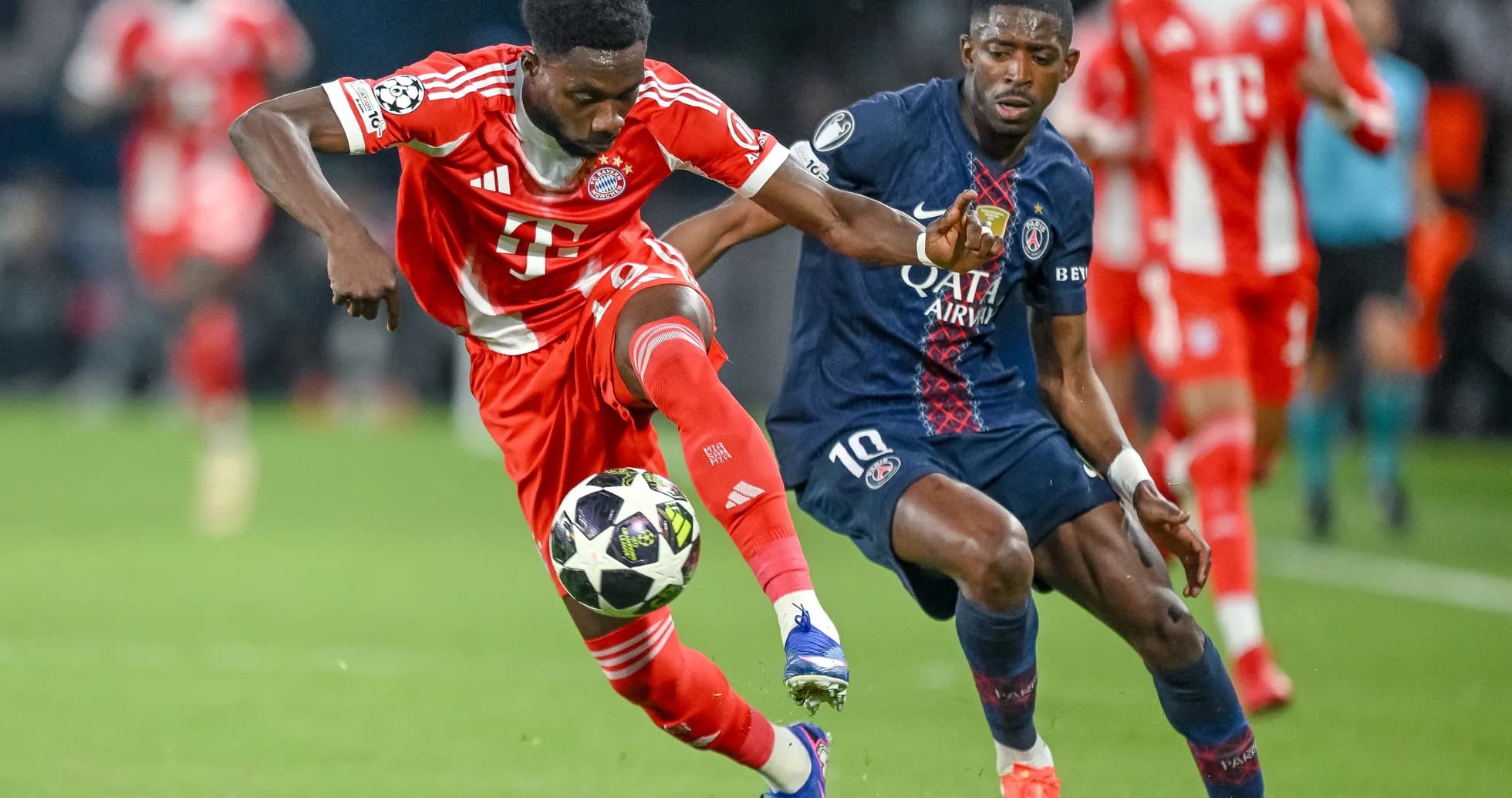
Paris Saint Germain edged a nine-goal semi-final thriller 5–4 over Bayern München at Parc des Princes, overturning a possession deficit with ruthless attacking efficiency. By 45' the hosts had already built a 3–2 lead, and they extended it to 5–2 before surviving a late Bayern surge. Despite having only 43% of the ball and generating 1.91 xG against Bayern’s 2.51, PSG’s front line, led by K. Kvaratskhelia and O. Dembele, punished almost every structural crack in Bayern’s 4-2-3-1. Bayern’s higher volume of shots on target (8 to 5) and territorial control could not compensate for defensive instability and a rare off-night for M. Neuer, who finished with zero recorded saves.
First Half
The scoring opened on 17' when H. Kane converted a penalty for Bayern, punishing early PSG defensive looseness. PSG responded through K. Kvaratskhelia on 24', finishing a move assisted by D. Doue, before J. Neves struck on 33' from an O. Dembele assist to flip the tie. M. Olise’s 41' goal, fed by A. Pavlovic, briefly dragged Bayern back to 2–2, but the half turned on a penalty for PSG: after a VAR review at 45+3' confirmed the decision involving Ousmane Dembélé, O. Dembele converted from the spot (45') to make it 3–2 at the literal 45' mark. That defined the halftime scoreline.
Second Half
After the break, PSG accelerated. K. Kvaratskhelia struck again on 56' from an A. Hakimi assist, and O. Dembele added his second from another D. Doue delivery on 58', stretching the lead to 5–2. Bayern’s response was structural as well as individual: A. Davies (OUT) made way for K. Laimer (IN) at 46', shifting the balance of their left side. The comeback attempt began with D. Upamecano’s 65' goal from a J. Kimmich set-up, then L. Diaz scored on 68' from a Kane assist, a goal confirmed by VAR at 70' as part of the same scoring sequence, closing the gap to 5–4.
Disciplinary Control
Disciplinary control tilted against PSG. Marquinhos took the first yellow card on 12' for a foul, an early signal of Bayern’s capacity to stress the back line. In the second half, Fabián Ruiz was booked on 77' for a foul shortly after coming on, and Achraf Hakimi saw yellow on 80' for argument, reflecting PSG’s growing emotional strain as Bayern pushed. Bayern, by contrast, finished without a single card despite committing 10 fouls to PSG’s 12, underlining a more controlled approach in duels.
Tactical Story
Substitution patterns told the tactical story. For Bayern, Kompany’s first change at 46'—K. Laimer (IN) for A. Davies (OUT)—suggests a move from a classic overlapping full-back to a more conservative or hybrid presence on the left, likely to reinforce central stability while still allowing width from higher players. The second switch on 79'—L. Goretzka (IN) for J. Musiala (OUT)—traded creativity between the lines for extra power and vertical running from deeper zones as Bayern chased the game. The final change at 90+3'—N. Jackson (IN) for A. Pavlovic (OUT)—was a late attacking gamble, adding a second forward profile ahead of or around Kane for direct balls and penalty-box presence.
Luis Enrique’s PSG used their bench to manage energy and shore up a fragile structure once the lead was built. The first change on 64' saw F. Ruiz (IN) come on for W. Zaire-Emery (OUT), adding a calmer passing profile and positional discipline to the midfield. At 70', B. Barcola (IN) replaced D. Doue (OUT), swapping an assist-rich wide runner for fresher legs to attack space in transition and help defend Bayern’s right flank. On 84', a double move underlined the shift from expansion to consolidation: S. Mayulu (IN) for K. Kvaratskhelia (OUT) and L. Hernandez (IN) for N. Mendes (OUT). Removing Kvaratskhelia cost PSG their most direct threat but protected him physically and introduced a more defensively reliable wide presence, while Hernandez’s entry over Mendes tilted the left side toward pure defensive solidity.
Structural Analysis
Structurally, PSG’s 4-3-3 was opportunistic rather than controlling. With only 371 passes to Bayern’s 506 and 43% possession, they accepted long spells without the ball. The midfield trio of J. Neves, Vitinha and W. Zaire-Emery (later Ruiz) focused on compactness between lines, inviting Bayern into central spaces and then springing wide through Kvaratskhelia, O. Dembele and D. Doue. The fact that PSG produced 10 of their 12 shots from inside the box speaks to the quality of their attacking spacing and timing: they rarely settled for long-range efforts, instead targeting moments when Bayern’s full-backs and double pivot were stretched.
Bayern’s 4-2-3-1, with Kimmich and Pavlovic as the double pivot and Musiala, Olise and Diaz behind Kane, controlled territory but paid for aggressive positioning. Their 57% possession and 84% pass accuracy show a side comfortable circulating under pressure, yet the defensive transitions were repeatedly exposed. With only 1 blocked shot and 0 recorded goalkeeper saves, Bayern’s last line rarely managed to get bodies in front of clear chances; when PSG broke through, they tended to finish.
Goalkeeping Performance
In goal, M. Safonov’s 2 saves against 8 Bayern shots on target highlight a high-volume workload and a mixed defensive shield in front of him. The negative goals-prevented figure (-2.39) for both keepers, combined with the xG numbers (PSG 1.91, Bayern 2.51) and a final score of 5–4, underscores that this was a match where finishing and defensive fragility outweighed shot quality models. Neuer, with 0 saves and 5 conceded, had almost no positive statistical impact, whether due to the clarity of PSG’s chances or slight positioning errors on key actions.
Statistical Summary
Statistically, Bayern’s overall form in this match—more possession, higher xG, more shots on target, more corners (5 to 2), and cleaner disciplinary record (0 cards)—suggests a side that structurally “won” many phases. Yet PSG’s defensive index, while imperfect (12 fouls, 3 yellows, 8 shots on target conceded), was just resilient enough in the box, and their attacking efficiency was decisive. With 5 goals from 5 shots on target and 10 efforts inside the area, PSG maximized their limited volume. Bayern’s inability to translate their 2.51 xG and territorial dominance into a level scoreline reflects a vulnerability in penalty-box defending and a lack of last-line interventions, ultimately deciding a chaotic semi-final in Paris.