Paris Saint Germain Clinches 2–0 Victory Over Liverpool in Champions League Quarter-Final
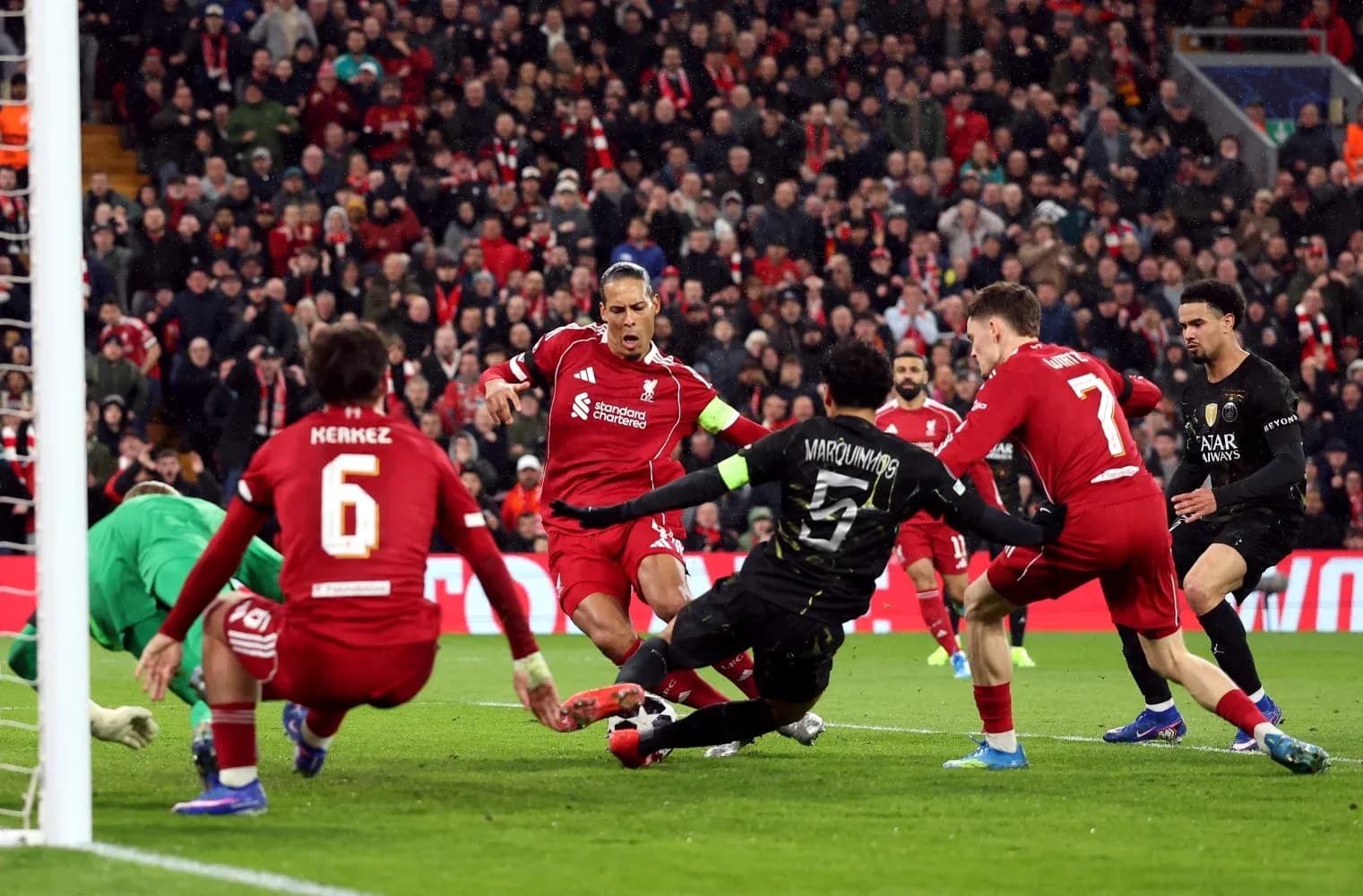
Anfield under the lights, a Champions League quarter-final, and two clubs built for the sharp end of Europe. Following this result, the story is of a Paris Saint Germain side that arrived with a clear identity and left with a 2–0 win, and a Liverpool team whose usual European ferocity never quite translated into incision.
I. The Big Picture – DNA vs. Refinement
Liverpool came into this tie as one of the competition’s most aggressive front-foot outfits. Overall this campaign they had played 12 Champions League matches, winning 7 and losing 5, without a single draw. At home they had been prolific: 15 goals scored at Anfield at an average of 2.5 per game, conceding 8 at an average of 1.3. That high-variance profile – heavy wins, but also a 1–4 home defeat among their worst results – set the tone: a side that lives on the edge.
Paris Saint Germain, by contrast, arrived with a more balanced but still explosive record. Overall they had played 14 matches, winning 9, drawing 3, and losing just 2. On their travels they had scored 18 goals at an average of 2.6, conceding 7 at an average of 1.0. The 2–7 away win that stands as their biggest away victory in the data is not an outlier in style, only in scale: this is a team that trusts its attacking structure to travel.
In the standings heading into this game, Liverpool sat 3rd in the overall Champions League table with 18 points and a goal difference of 12 (20 scored, 8 conceded). Paris Saint Germain were 11th with 14 points and a goal difference of 10 (21 scored, 11 conceded). Both had already shown they could punch at this level; the question was whose game model would hold under quarter-final pressure.
II. Tactical Voids – Absences and Discipline
Liverpool’s squad sheet was shaped by absences in key structural zones. Alisson’s muscle injury removed their first-choice goalkeeper, placing G. Mamardashvili in goal. That change doesn’t just alter shot-stopping; it changes Liverpool’s build-up rhythm and high-line security. The absence of W. Endo (foot injury) and S. Bajcetic (hamstring) stripped out natural holding options, pushing Arne Slot toward a double pivot of R. Gravenberch and D. Szoboszlai in the 4-2-3-1.
C. Bradley’s knee injury and the inactive status of H. Davies and R. Williams reduced depth in the defensive unit, making the starting back four of J. Frimpong, I. Konate, V. van Dijk and M. Kerkez almost non-negotiable. It meant Liverpool’s ability to chase the game with fresh defenders or shift shape late on was constrained.
For Paris Saint Germain, the missing pieces were more rotational than structural. Q. Ndjantou (muscle injury) and F. Ruiz (knee injury) were absent, but Enrique Luis could still roll out his preferred 4-3-3 with a first-choice spine: M. Safonov in goal, Marquinhos and W. Pacho at centre-back, J. Neves, Vitinha and W. Zaire-Emery in midfield, and a front three of D. Doue, O. Dembele and K. Kvaratskhelia.
Disciplinary trends added another layer. Heading into this game, Liverpool’s yellow cards were spread but peaked between 46–60 minutes at 25.00%, suggesting a team that often ramps up physicality right after half-time. Paris Saint Germain, meanwhile, showed a late-game edge: 37.50% of their yellows came between 76–90 minutes, with an additional 25.00% between 91–105. Their red-card history was almost entirely concentrated in the 31–45 and 91–105 windows (50.00% in each of those ranges), underlining how emotional spikes can occur just before and just after the interval.
III. Key Matchups – Hunter vs Shield, Engine vs Enforcer
The headline attacking “hunter” was K. Kvaratskhelia. In total this campaign he had 8 Champions League goals and 5 assists in 13 appearances, with 26 shots (14 on target) and a 7.67 rating. He also sat near the top of the assist charts, with 16 key passes and 38 dribble attempts, 19 of them successful. His duel volume (135 total, 65 won) shows a winger who doesn’t just wait for the ball – he drives games.
His primary shields were V. van Dijk and I. Konate, backed by Mamardashvili. Liverpool’s overall defensive record before this tie – 13 conceded in 12 games at an average of 1.1 – suggested solidity, especially given 5 clean sheets in total (3 at home). But the structural risk of a high line without Alisson’s sweeping and with aggressive full-backs like Frimpong and Kerkez always threatened to open the channels that Kvaratskhelia loves.
On the other flank, O. Dembele’s 1v1 threat and D. Doue’s intelligent movement asked continuous questions of Liverpool’s full-backs. Doue had 5 goals and 2 assists in 10 appearances, with 25 key passes and 40 dribble attempts (18 successful). His tendency to drift inside between the lines targeted the space behind Liverpool’s double pivot.
In the engine room, Vitinha was the metronome. Across the campaign he had 6 goals and 1 assist in 14 matches, but his real value lay in 1,463 completed passes at 93% accuracy and 16 key passes. He also contributed 23 tackles, 1 blocked shot and 14 interceptions. Opposite him, D. Szoboszlai was Liverpool’s creative heartbeat: 5 goals, 4 assists, 30 key passes and 722 completed passes at 87% accuracy, plus 23 tackles and 2 blocked shots. This “Engine Room” duel – Vitinha’s control and press-resistance versus Szoboszlai’s verticality and shooting threat – framed the midfield narrative.
Behind them, J. Neves and W. Zaire-Emery added bite and legs for Paris Saint Germain, while A. Mac Allister’s role as a connective 10 in Liverpool’s 4-2-3-1 was to find pockets between Paris Saint Germain’s lines and release F. Wirtz and H. Ekitike around A. Isak.
IV. Statistical Prognosis and Tactical Verdict
From a statistical standpoint, Paris Saint Germain entered as the more efficient attacking machine. Overall they averaged 2.7 goals per game, with 2.6 on their travels, and conceded just 1.2 overall and 1.0 away. Their clean-sheet count on the road (3) matched Liverpool’s at Anfield (3), but their failure to score away had happened only once, compared to Liverpool failing to score at home once and away three times.
Liverpool’s overall profile – 2.0 goals for and 1.1 against per game – is strong, but the absence of a natural holding midfielder and first-choice goalkeeper tilted the balance. With both teams perfect from the penalty spot in total (each with 1 scored and 0 missed), the margins were always likely to come from open play structure rather than dead-ball variance.
Paris Saint Germain’s consistent 4-3-3 (used in all 14 matches) gave them automatisms Liverpool were still refining across multiple shapes. Liverpool’s most-used 4-2-3-1 (7 matches) can be devastating when the press bites and the No.10 connects, but against a side that can play through pressure with Vitinha, Zaire-Emery and Neves, the risk of being played around and then run at in transition was high.
Following this result, the 2–0 scoreline at Anfield feels like the logical expression of those trends. Paris Saint Germain’s away attacking average and structural cohesion translated into clinical moments, while their defensive record on their travels held firm against a Liverpool side that, for once in Europe, could not turn Anfield’s chaos into goals.