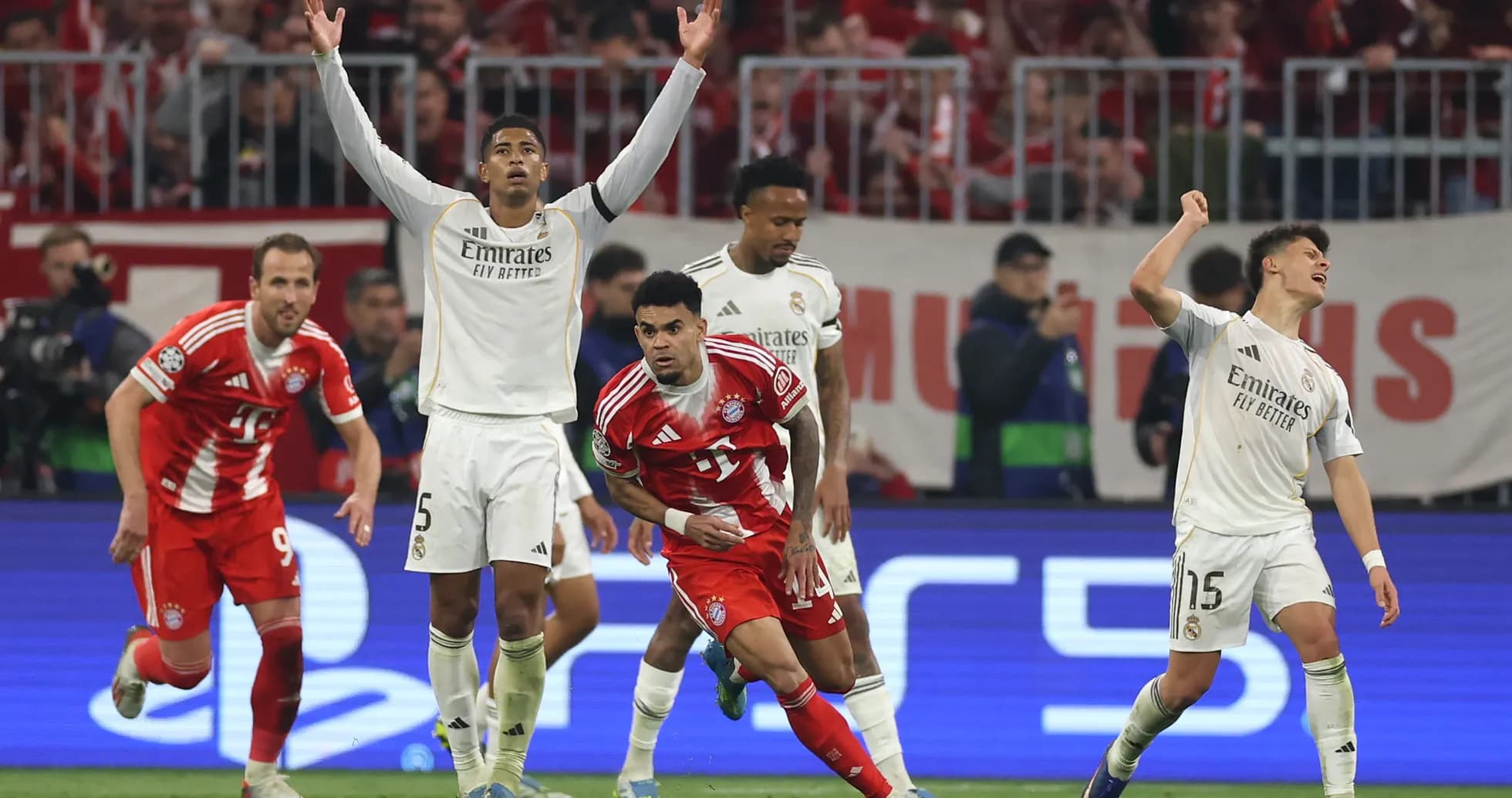
Bayern München Overcomes Real Madrid in Thrilling 4–3 Quarter-Final Clash
Bayern München and Real Madrid produced a quarter-final classic at Allianz Arena, with Bayern overturning a 2–3 half-time deficit into a 4–3 win in regulation time. The match was defined by Bayern’s territorial and possession dominance (69% of the ball, 640 passes at 88% accuracy) against Madrid’s vertical threat and early efficiency. Despite Real edging xG 2.25 to 2.14, Bayern’s structural control and late-game management against ten men tilted the tie. Manuel Neuer made 2 saves to Andriy Lunin’s 4, but the decisive margins came from Bayern’s attacking rotations in a 4-2-3-1 against Madrid’s 4-4-2, and Real’s disciplinary collapse via Eduardo Camavinga’s late dismissal.
The scoring opened immediately: at 1', Arda Güler struck for Real Madrid, exploiting Bayern’s slow defensive organisation. Bayern responded at 6', Aleksandar Pavlović arriving from deep to finish, assisted by Joshua Kimmich’s service from midfield. The first card came at 29', Josip Stanišić booked for argument, reflecting Bayern’s frustration at conceding transitions. Seconds later at 29', Güler scored again, reasserting Madrid’s counter-punching threat.
Harry Kane levelled at 38' for 2–2, finishing after Dayot Upamecano’s involvement in the build-up, a key moment where Bayern’s centre-backs stepped into midfield. At 40', Éder Militão was cautioned for a foul, the first sign of Real’s back line being stressed by Bayern’s positional play. At 42', Kylian Mbappé, assisted by Vinicius Junior, restored Madrid’s lead to 3–2, punishing Bayern’s high line.
Second Half
The second half began with a structural tweak: at 46', Alphonso Davies (IN) came on for Josip Stanišić (OUT), adding width and ball-carrying from left-back. At 61', Jamal Musiala (IN) replaced Serge Gnabry (OUT), injecting central creativity. Real responded at 62', Eduardo Camavinga (IN) came on for Brahim Díaz (OUT), shifting their midfield balance.
Discipline then deteriorated for Madrid. Antonio Rudiger was booked for argument at 70', as Bayern increased pressure. Camavinga received a yellow for a foul at 78', then a second yellow for time wasting at 86', immediately followed by a red card, reducing Madrid to ten and fundamentally altering the closing phase.
Bayern capitalised quickly. At 89', Luis Díaz scored for 3–3, assisted by Musiala’s influence between the lines. Real made late changes at 90': Franco Mastantuono (IN) came on for Arda Güler (OUT), and Thiago Pitarch (IN) replaced Trent Alexander-Arnold (OUT), but these were largely reactive. At 90', Michael Olise, assisted by Kane, completed the 4–3 comeback, Bayern’s sustained pressure finally breaking a tired Madrid block.
Tactically, Bayern’s 4-2-3-1 was built on a double pivot of Kimmich and Pavlović, with Laimer nominally at left-back but often stepping inside, allowing Davies (after 46') to provide true width. Neuer’s role was largely about circulation rather than shot-stopping; his 2 saves underline how Bayern’s defensive structure limited clear Madrid looks despite conceding three.
Upamecano and Jonathan Tah were aggressive in stepping into midfield, particularly on goal kicks and settled possession, compressing the pitch and pinning Madrid’s forwards. This aggression was double-edged: it sustained Bayern’s 69% possession and 21 total shots (15 inside the box), but exposed them to early vertical balls, which Güler and Mbappé exploited.
In the attacking band, Olise, Gnabry (then Musiala), and Luis Díaz constantly rotated around Kane. Kane’s goal at 38' and assist at 90' encapsulate his dual role: penalty-box finisher and link player. Pavlović’s early goal at 6' highlighted Bayern’s use of the second line to attack the edge of the box when Madrid’s midfield was dragged wide.
Musiala’s introduction at 61' was the key tactical hinge. Moving from Gnabry’s more direct wing profile to Musiala’s interior playmaker role allowed Bayern to overload central zones, stretch Rudiger and Militão horizontally, and better attack the half-spaces. Díaz’s 89' goal, assisted by Musiala, was a direct product of this, with the Colombian exploiting the left half-space against a retreating, numerically reduced Madrid.
Real Madrid’s 4-4-2 was transition-oriented. With Valverde and Güler as key conduits, and Bellingham more of a connector than a pure 10, Madrid looked to bypass Bayern’s press with early balls into Mbappé and Vinicius. Their 12 shots (7 inside the box) from only 31% possession reflect a game plan based on efficiency rather than volume. Güler’s brace and Mbappé’s goal came from exploiting Bayern’s high line and aggressive full-back positioning, particularly before Davies’ introduction stabilised the left flank.
Lunin’s 4 saves were significant, especially as Bayern ramped up shot volume late. However, with Madrid conceding 9 shots on target and facing sustained box entries, the goalkeeper was overexposed. Defensively, Madrid’s back four struggled once Bayern began to pin both full-backs deep, leaving Valverde and Bellingham with heavy defensive workloads.
Disciplinarily, Bayern finished with 1 yellow card (Stanišić for argument at 29') and no reds, indicating controlled aggression. Real Madrid accumulated 6 yellow cards and 1 red: Militão (foul, 40'), Rudiger (argument, 70'), and Camavinga’s two yellows (foul at 78', time wasting at 86') leading to his dismissal, plus further cautions embedded in the total count. The red card was decisive in shifting the momentum of the final minutes.
Statistically, Real’s xG edge (2.25 vs 2.14) suggests their chances were marginally higher quality, but Bayern’s 21 shots to 12, and 9 corners to 2, underline territorial dominance. Bayern’s passing volume (640 to 294) and accuracy (88% vs 78%) illustrate a controlled-possession approach that, over 90 minutes, wore down Madrid’s defensive and emotional resilience. Bayern’s Overall Form on the night was that of a proactive, high-possession side, while their Defensive Index was mixed: structurally sound in settled phases but vulnerable in early and transitional moments. Real Madrid’s Overall Form showed clinical attacking in transitions but a declining Defensive Index, especially after Camavinga’s dismissal, as they failed to manage game state and discipline in the decisive closing stretch.