Atletico Madrid vs Barcelona: Quarter-Final Tensions Unfold
Under the Madrid lights at Metropolitano Stadium, a quarter-final that always promised friction delivered a tight, nervy 90 minutes. Atletico Madrid fell 1–2 to Barcelona, a scoreline that mirrored both the broader arc of their European campaigns and the contrasting identities of these two sides.
I. The Big Picture – Clashing Identities, Diverging Trajectories
Following this result, Atletico remain the rugged outsider of this UEFA Champions League season. In total this campaign, they have played 14 matches, winning 7, drawing 2 and losing 5. The numbers at home are stark: 7 fixtures, 5 wins, no draws and 2 defeats, with an attacking surge of 21 goals at home at an average of 3.0 per game, and 10 conceded at 1.4 per match. The Metropolitano has mostly been a fortress, but Barcelona’s visit exposed the thin line between ferocity and fragility.
Barcelona arrive from a different tier of the continental hierarchy. In total this campaign they have played 12 Champions League fixtures, winning 7, drawing 2 and losing 3. On their travels, they have been efficient rather than spectacular: 6 away games, 3 wins, 2 draws, 1 loss, scoring 12 and conceding 11, an away scoring average of 2.0 and conceding average of 1.8. It is not dominance, but it is enough to travel with confidence.
The standings snapshot underlines the same story. Atletico sit 14th in the overall Champions League table with 13 points and a goal difference of 2 (17 goals for, 15 against in total group and knockout tracking), their path defined by volatility – form line “LDWWW”. Barcelona, by contrast, stand 5th with 16 points and a goal difference of 8 (22 for, 14 against), their form “WWWLD” before this tie signalling a side that usually finds solutions on the big nights.
II. Tactical Voids – The Absences That Bent the Game
Diego Simeone’s 4-4-2 was shaped as much by who was missing as by who started. Atletico were without P. Barrios (muscle injury), J. M. Gimenez and D. Hancko (both injured), and M. Pubill suspended for yellow cards. That stripped depth and aerial dominance from the back line and reduced Simeone’s options for late-game defensive recalibration. In their place, R. Le Normand and C. Lenglet anchored the defence ahead of J. Musso, flanked by N. Molina and M. Ruggeri. It was a back four built more for structure than intimidation.
Ahead of them, the midfield of G. Simeone, M. Llorente, Koke and A. Lookman had to stretch itself in two directions: protect the improvised defence and feed the elite front two of A. Griezmann and J. Álvarez. Given Atletico have kept just 1 clean sheet in total this Champions League run, Simeone’s solution was to lean into controlled aggression rather than sit in a deep shell.
Barcelona were also forced into adjustments. Hansi Flick was without M. Bernal (ankle injury), A. Christensen (knee injury), P. Cubarsí (suspended via red card) and Raphinha (thigh injury). The absence of Christensen and Cubarsí in particular forced a reshaped defensive axis, handing responsibility to Eric García and G. Martin at centre-back, with J. Cancelo and J. Kounde wide. J. Garcia in goal sat behind a back line that, in total this campaign, has conceded 20 goals overall and has not managed a single clean sheet home or away.
In midfield, Flick trusted the technical core of Gavi and Pedri, with Lamine Yamal, D. Olmo and Fermín supporting F. Torres as the lone forward. This was a selection that doubled down on fluidity between the lines rather than pure penalty-box presence, leaning on the creative weight of Lamine Yamal and Fermín – both among the Champions League’s most productive attacking midfielders.
Disciplinary patterns framed the emotional tone. Heading into this game, Atletico’s yellow card distribution peaked between 46–60 minutes, where 29.17% of their cautions arrived – a classic Simeone side, most combustible just after the restart. Barcelona, meanwhile, carried a different risk profile: 26.09% of their yellows came between 31–45 minutes, and their red cards were clustered, with 66.67% shown in the 31–45 range and another 33.33% between 76–90. Flick’s side can lose control in the hinge moments of each half.
III. Key Matchups – Hunter vs Shield, Engine vs Engine
The headline duel was always going to be J. Álvarez against Barcelona’s reshuffled back line. Álvarez entered this quarter-final as one of the competition’s elite forwards: 9 goals and 4 assists in 13 appearances, with 32 shots (20 on target) and 33 key passes. He is not just a finisher but Atletico’s creative hinge in the final third. His penalty record in total this campaign – 2 scored from 2, with Atletico’s overall penalty tally at 2 scored from 2 and 0 missed – made any box contact a looming threat.
Opposite him, Eric García came into this tie with a more nuanced defensive profile. In total this season he has made 15 tackles, 2 successful blocks and 11 interceptions, winning 43 of 74 duels. But his disciplinary record carries an edge: 1 red card in the Champions League, and a penalty conceded. Barcelona’s entire defensive unit has yet to keep a single clean sheet in total this campaign; their shield is more about managing chaos than eliminating it.
On the flanks, the most intriguing battle was A. Lookman and M. Llorente against J. Cancelo and J. Kounde. Atletico’s home scoring average of 3.0 goals per game in total this season suggested that wide overloads and cut-backs would be central to their plan, especially with G. Simeone tucking in to form a narrow four. But Barcelona’s full-backs, particularly Cancelo, are as much playmakers as defenders, inviting transition chaos if Atletico overcommitted.
In the “Engine Room”, Koke and M. Llorente were tasked with disrupting the rhythm of Gavi and Pedri. Barcelona’s midfield threat was amplified by Fermín and Lamine Yamal. Fermín’s Champions League line – 6 goals and 4 assists in 11 games, with 21 shots and 12 on target – is that of a late-arriving scorer who punishes loose second balls. Lamine Yamal, with 6 goals and 4 assists in 10 appearances, 24 shots (15 on target), 24 key passes and 82 attempted dribbles (45 successful), is a constant one‑v‑one stress test. He also walks a disciplinary tightrope: 4 yellow cards in this competition, making him both Barcelona’s most dangerous and most combustible outlet.
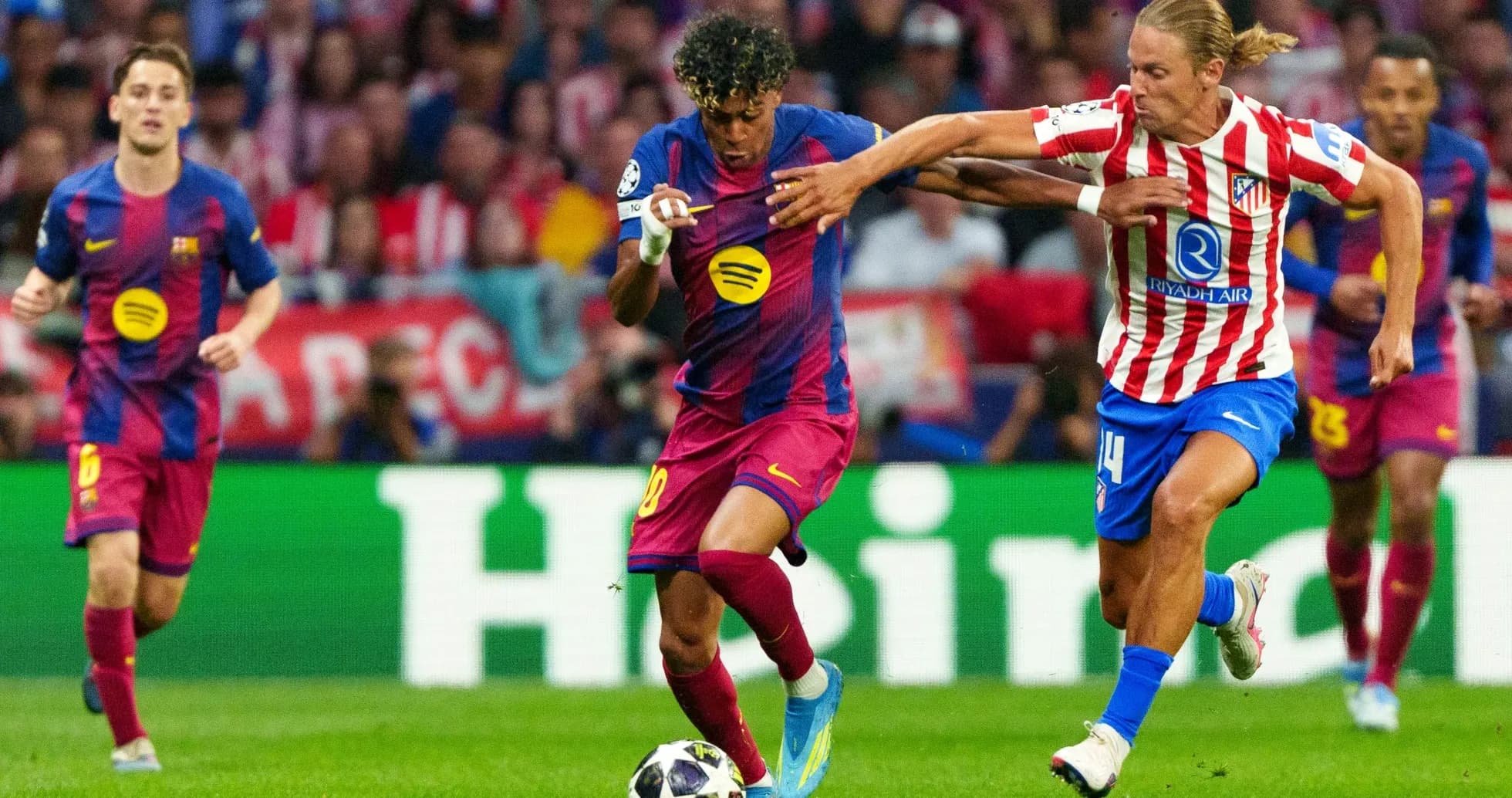
The duel between Lamine Yamal and M. Ruggeri on Atletico’s left channel was thus a structural pivot point. Whenever Lamine drifted inside, he pulled a centre-back with him, opening lanes for Fermín’s late runs and F. Torres’ diagonal movements. Atletico’s inability to fully suppress that rotation ultimately told on the scoreboard.
IV. Statistical Prognosis – xG Shapes, Defensive Cracks, and What This Result Says
While raw xG figures are not provided, the season-long statistical profiles allow a tactical reading of how this 1–2 fits the pattern.
Atletico’s overall goals for average of 2.4 per game, against 1.9 conceded, tells of a side whose matches tilt towards high event counts. At home, the gap is even more extreme: 3.0 scored versus 1.4 conceded. Their goal difference in the standings – 2, from 17 scored and 15 conceded – underscores that their attacking edge is often offset by defensive looseness, especially on transitions and set pieces.
Barcelona’s overall attacking average of 2.7 goals per game, with 3.3 at home and 2.0 on their travels, positions them as one of the competition’s most potent forward units. Conceding 1.7 goals per match overall, with 1.8 on their travels, they are far from watertight, but they typically outgun opponents. Their goal difference of 8 (22 scored, 14 conceded) captures that balance.
In a quarter-final context, those numbers almost script the narrative: Atletico likely to generate enough chances to score once, Barcelona likely to carve out multiple high-quality opportunities and trust their superior individual talent to convert. The absence of any penalties missed for either side in total this campaign removed one of the great randomisers; both are perfect from the spot so far, with Atletico scoring 2 of 2 and Barcelona 4 of 4.
Defensively, the clean sheet data is damning for both, but especially for Barcelona’s supposed vulnerability. In total this season, they have not kept a single clean sheet home or away. Yet in a knockout tie, it was Atletico who blinked first, their makeshift back line unable to fully contain the rotations of Lamine Yamal, Fermín and F. Torres.
Atletico’s yellow card peak between 46–60 minutes (29.17%) hinted that the game would become fractured just after half-time – precisely when Barcelona, with their technical midfield, are best placed to exploit broken rhythms. Barcelona’s own late‑game card spike between 76–90 minutes (21.74% of yellows, plus a red-card risk in that window across the season) suggested that if Atletico could drag the tie into a frantic final quarter-hour, chaos might favour the hosts. Instead, Barcelona managed the final stretch with a maturity that belied their disciplinary record.
Following this result, the tactical verdict is clear. Atletico’s front line, led by J. Álvarez and supported by Griezmann and the wide runners, remains good enough to trouble any defence in Europe, especially at home. But with just 1 clean sheet in total this campaign and a tendency to concede in the very periods when their aggression peaks, their margin for error in knockout football is razor-thin.
Barcelona, for all their defensive imperfections and enforced absences at the back, continue to ride the wave of their attacking structure. The blend of Lamine Yamal’s one‑v‑one brilliance, Fermín’s penalty‑box timing and the control of Gavi and Pedri gives them a repeatable path to chances, even in hostile venues.
In the cold arithmetic of Champions League football, the 1–2 in Madrid is less an upset than a crystallisation of both teams’ seasonal DNA: Atletico as the valiant, high‑octane side whose defensive cracks appear at the worst moments; Barcelona as the flawed but ruthless giant, whose offensive ceiling remains just high enough to keep their European journey alive.