
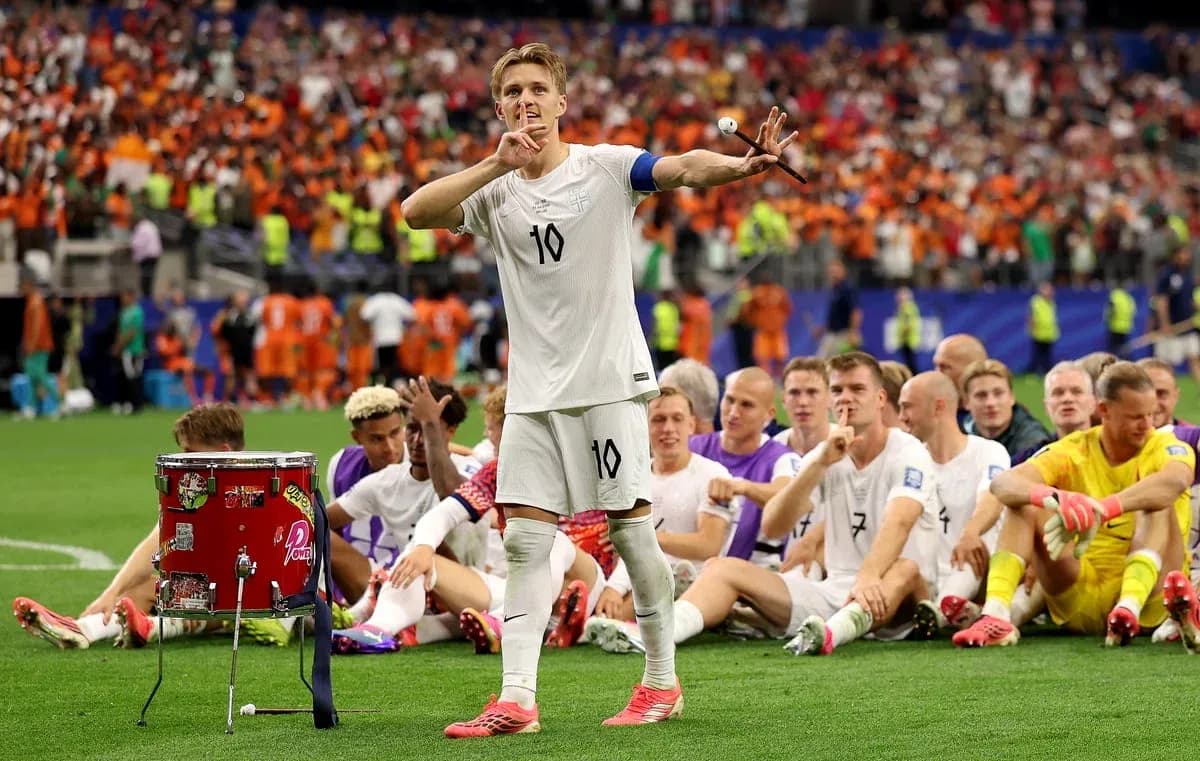
Norway vs Brazil: A Historic World Cup Clash
Norway stand on the brink of something they have never done before. One game. Beat Brazil, and a first-ever World Cup quarter-final is theirs.
The setting is the New York/New Jersey Stadium, the stakes unmistakable. Both sides arrive with late drama still clinging to them: Brazil left it late to see off Ivory Coast, Norway did the same against Japan. Now there is no margin for delay. Or error.
Brazil, guided by Carlo Ancelotti, came through Group C on top, finishing ahead of Morocco. Norway, back on the global stage after almost three decades away, had to settle for second in Group I behind France. That alone tells you the scale of the climb. The winner here earns a shot at either co-hosts Mexico or England in the last eight.
For Norway, this isn’t just a tie. It’s a test of an entire generation.
The last line: Nyland’s moment
In goal stands Orjan Nyland, a familiar name to English fans from spells at Aston Villa, Norwich, Bournemouth and Reading. He arrives as Norway’s undisputed No1 yet without a club, recently released by Sevilla when his contract expired.
There is a certain edge to that. A goalkeeper between jobs, with the world watching, trying to hold off Brazil’s forwards with his future as open as the pitch in front of him. If Norway are to survive, Nyland will almost certainly need the game of his life.
Patchwork defence with Premier League steel
The back line has been patched, reshaped and tested already.
Marcus Holmgren Pedersen started this World Cup as the back-up right-back. Circumstances changed quickly. An injury elsewhere elevated his importance and he responded with a crucial goal in the 3-2 win over Senegal. Now he walks into this tie not as cover, but as a genuine weapon on the flank.
Next to him, Kristoffer Ajer brings Brentford muscle and familiarity with one of his likely opponents. He could be staring across at club team-mate Igor Thiago, a personal duel wrapped inside the wider chaos of a World Cup knockout. Ajer’s aerial presence and reading of the game will be vital against a Brazil side that rarely gives centre-halves a quiet night.
The big question mark hangs over Julian Ryerson. The Borussia Dortmund full-back has missed Norway’s last two matches and remains the major injury doubt. When fit, he is the template of the modern full-back: aggressive, quick, relentless in transition, and constantly linked with moves to clubs of Liverpool’s stature. His absence would strip Norway of drive on one side; his presence would change the way they can attack and defend in wide areas.
Torbjorn Heggem offers versatility across the back line, now at Bologna after a spell with West Brom. He may not carry the star power of some team-mates, but these are the players knockout football so often leans on – the ones who quietly plug gaps and allow the stars to shine.
On the left, David Moller Wolfe has already shown resilience. Relegation with Wolves could have dragged him down; instead, he has channelled that disappointment into a steady, composed World Cup campaign. Brazil will probe his side relentlessly. How he holds up could dictate how high Norway can push their defensive line.
Odegaard’s stage, at last
If there is a heartbeat to this Norway side, it belongs to Martin Odegaard.
Arsenal’s Premier League title-winning captain arrives off a frustrating, injury-affected season, yet at this World Cup he has looked entirely at home. The rhythm is back. The vision is sharp. He has recorded an assist in each of his three appearances in North America, threading passes into spaces most players don’t even see.
Against Brazil, he becomes more than just a creator. He is Norway’s tempo, their calm under pressure, the one player capable of turning a clearance into a counter-attack with a single touch. When the game starts to race, Odegaard will try to slow it to his own beat.
Around him, Sander Berge brings heft and presence. The midfield powerhouse must cover ground, win duels and still find the composure to use the ball well. Dominating Brazil in the centre is a huge ask; resisting them, disrupting them, might be enough.
Patrick Berg, a key figure for a Bodo/Glimt side that has rattled European opponents in recent seasons, adds intelligence and balance. He understands how to manage space, how to close passing lanes, how to make a game ugly when it needs to be. Against Brazil’s technicians, that knack could be priceless.
Firepower up front: Haaland and his supporting cast
Then comes the part that changes everything: the attack.
Alexander Sorloth’s story is one of reinvention. Once of Crystal Palace, where he struggled to make an impact, he rebuilt himself at Trabzonspor, then Villarreal, and now Atletico Madrid, where his numbers sit just shy of a goal every other game. He can lead the line, drift off the right, bully centre-backs and run in behind. Norway no longer see him as a Plan B. He is central to their threat.
And yet, of course, all eyes tilt to Erling Haaland.
Manchester City’s record-breaking No9, a striker often described as the best in the world, even if Harry Kane might dispute that claim. Haaland brings a brutal, ruthless edge to Norway’s play. He does not need volume; he needs moments. Half-chances become goals. Scraps become headlines. Against Brazil, every Norwegian clearance, every turnover, will be scanned for one thing: can it find Haaland early?
Behind and around him, the future is already arriving.
Antonio Nusa, now at RB Leipzig, carries the label of “one of Europe’s most exciting young talents” and has done little to contradict it. A failed medical prevented a move to Brentford in 2024, Tottenham have tracked him, and his fearless dribbling offers something different. Give him space, and he will run at defenders who would much rather he didn’t.
Oscar Bobb offers another creative spark out wide. Developed at Manchester City alongside Haaland, he chose a January move to Fulham to chase regular minutes. That decision has sharpened him. On his day he is an electric winger, direct and incisive, and this tournament is set to give him the extended stage he has been waiting for.
Jorgen Strand Larsen waits in the wings as Haaland’s understudy. Six goals in 29 games might not leap off the page, but his presence matters. He moved from Wolves to Crystal Palace in January and has quietly become one of the better Premier League strikers, a reliable focal point when called upon. If this tie stretches into extra time, or if Norway need a different profile up front, his number could be the one raised.
A night that can rewrite a generation
Norway have waited nearly 30 years to return to this level. They arrive with a goalkeeper between clubs, a potentially patched-up defence, a midfield that must go toe-to-toe with Brazil’s artistry, and a forward line headlined by one of the most feared strikers on the planet.
It is imperfect. It is dangerous. It is exactly the kind of night the World Cup was built for.
Beat Brazil, and this team stops being a promising story and becomes something else entirely.



