England Faces Mexico at Azteca: A World Cup Challenge
England step into the storm at the Azteca on Sunday night knowing this World Cup is about to get real.
Mexico, co-hosts and riding a wave of emotion, have spent three weeks turning this city into a pressure cooker. The Estadio Azteca, already a byword for football mythology and thin air, will turn up the volume and turn down the oxygen for Thomas Tuchel’s side in a last-16 tie loaded with jeopardy, noise and needle.
Azteca: altitude, history and hostility
England have dealt with VAR drama, tactical scrutiny and stuttering form this summer. None of that quite compares to what awaits at 7,220ft above sea level.
The Azteca is not just a stadium, it’s an environment. At that altitude, every sprint bites a little harder, every recovery takes a little longer. Players breathe more heavily, but take in less oxygen. Legs that feel light in training can suddenly feel leaden after half an hour of chasing shadows.
Tuchel knows all this. His staff have spent days drilling the squad on how to manage their energy, when to press, when to sit. Mexico, by contrast, live in this air. They revelled in it in their last-32 win over Ecuador, where a weather delay only heightened the sense of chaos before Julian Quinonez and Raul Jimenez landed the decisive blows. Two clinical moments, two haymakers, and Ecuador were out on their feet.
England walk into that same cauldron, with the same risk of disruption hanging in the sky.
Lightning, kick-off chaos and a furious Neville
This tie has been shadowed by confusion before a ball is even kicked.
Fifa considered dragging the game forward by six hours because of the threat of stormy weather and lightning in Mexico City, a move that would have completely changed the conditions and preparation for both teams. Then, just as quickly, the plan was scrapped.
The governing body’s handling of the situation drew a sharp, public rebuke from Gary Neville on ITV Sport. He called it “disruptive” for players and a “sporting disadvantage to England”, pointing out the gulf between playing at midday in Mexico and an evening kick-off.
“Conditions are huge for England, playing at 12pm in Mexico vs playing at 6pm, it's very different, for our players, it's worse, let's be clear,” Neville said, questioning the “sporting integrity” of even contemplating such a shift so close to the game.
He pointed to established procedures for lightning delays – players leaving the pitch, sheltering, waiting it out – and was blunt about Fifa “just willy nilly making it up and moving a game”. For a man who has seen postponements and rearrangements at every level, his verdict was simple: he had “never seen that at any level of football ever” two days out from kick-off.
The storm might yet come. The storm off the pitch already has.
Security tightened, emotions high
England’s arrival in Mexico City has unfolded under heavy scrutiny and heavier security.
Earlier in the tournament, Ecuador’s squad had their sleep shattered by local fans armed with loudspeakers, horns and motorbikes outside their hotel. That episode prompted the Mexican authorities to act. When Tuchel’s team bus pulled up, members of the Mexican National Guard were waiting, forming a protective ring around the squad’s base.
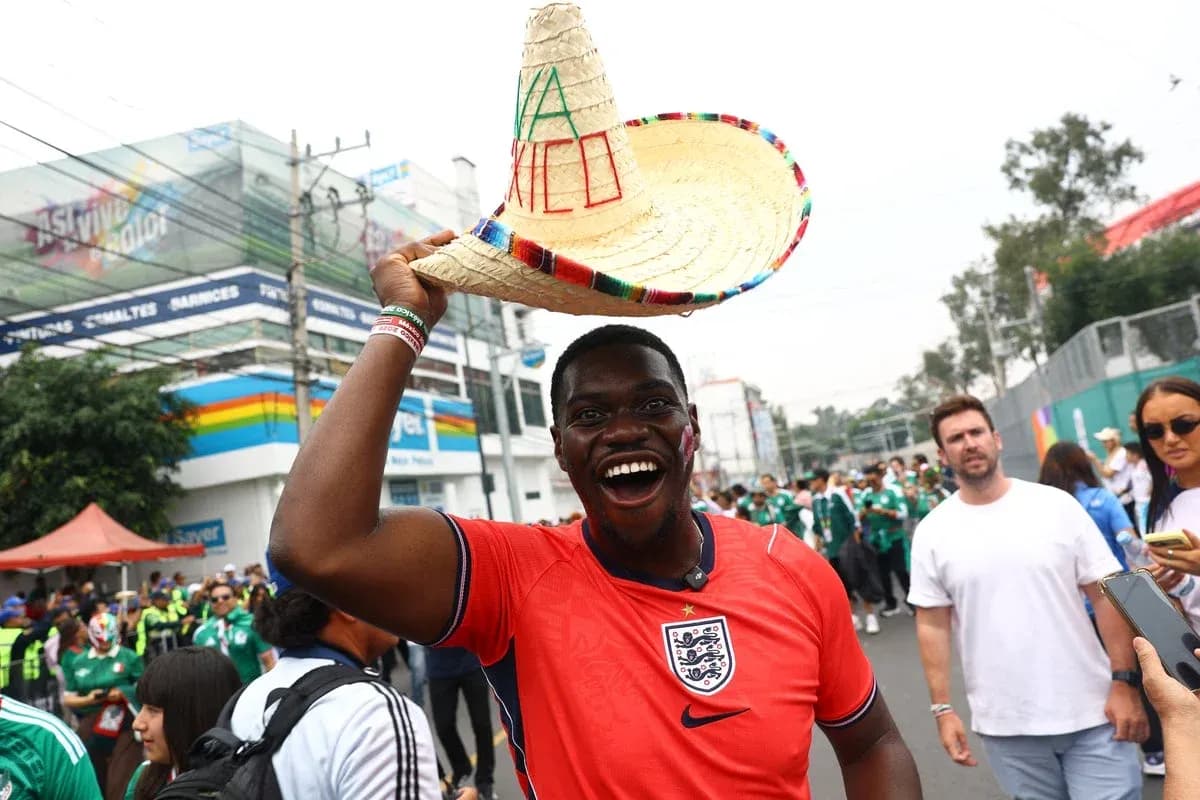
The atmosphere outside has been edgy. Crowds greeted England with boos and jeers, and more than 100 riot police in bullet-proof vests have been deployed to guard the hotel. The message from the UK’s top football police chief to travelling supporters has been blunt: be sensible, because you will be “massively outnumbered” in Mexico City.
Inside the camp, though, Tuchel has spoken of a respectful, emotional welcome and insisted England have faced “no issues” personally. The hostility is real, but so is the sense of occasion. This is Mexico at a home World Cup, and England have walked straight into the heart of it.
Tuchel’s right-back riddle and the Quansah gamble
If the backdrop is volatile, so is England’s team sheet.
Declan Rice’s fitness is a major boost; the midfielder has been declared fully ready, a vital anchor in conditions where concentration and structure can fray late on. The real headache lies out wide.
Right-back has turned into Tuchel’s problem position. Injuries and niggles have stripped away his options. Djed Spence is a doubt with a muscle issue, Reece James is only edging closer to the matchday squad rather than ready to start, and the balance of the back four suddenly looks fragile.
That is why all signs point to Jarell Quansah being thrown in from the start on the right. It is a bold call. The young defender is naturally a centre-back, and while his athleticism and composure have impressed, this is a different test entirely: a World Cup knockout tie, at altitude, in front of a partisan crowd desperate to expose any weakness.
Gary Neville did not sugar-coat it on ITV Sport. “That means he didn't want to bring Stones at centre-back,” he said, reading Tuchel’s thinking between the lines. “It's a big game for him, he's got to do the job, it's not ideal.”
The alternative would be a change of shape. With right-back resources stretched, Tuchel has at least flirted with the idea of moving to a back three, using wing-backs to share the load and protect the flanks. The strain in that position might yet push him into a tactical switch, but for now Quansah looks set to carry the responsibility.
Mexico’s moment, England’s test
While England wrestle with selection and logistics, Mexico are riding a different kind of wave.
On Sunday morning, cycling star Tadej Pogacar gifted victory on the second stage of the Tour de France to his Mexican teammate Isaac Del Toro, who then spoke with raw pride about what it meant for his country. Del Toro, still buzzing, urged “El Tri” to “rip it up” against England later in the day, calling the national team’s World Cup form “amazing”.
It was a small moment, far from the Azteca, but it captured the wider mood. Mexican sport is having its time, and football sits at the centre of it.
Back in Mexico City, fans are already flooding towards the stadium hours before kick-off, turning the streets into a procession of green shirts, flags and flares. For those following from the UK, the game falls in the early hours; for locals, it feels like the culmination of a month-long festival.
England, as ever, bring their own expectations and their own scars. They have seen World Cups tilt on fine margins, on refereeing calls, on missed chances. Here, the margins shrink further. Oxygen is scarce, time on the ball even scarcer, and the crowd will roar every English mistake like a goal.
Tuchel’s team have talked all week about embracing the challenge, about respecting the history of the Azteca without being cowed by it. Talk is one thing. Ninety minutes at 7,220ft, against a co-host in full voice, is another.
When the whistle finally goes and the lightning – meteorological or metaphorical – hits, we will find out if this England side can breathe in the rarefied air, or whether Mexico’s mountain proves too steep to climb.