
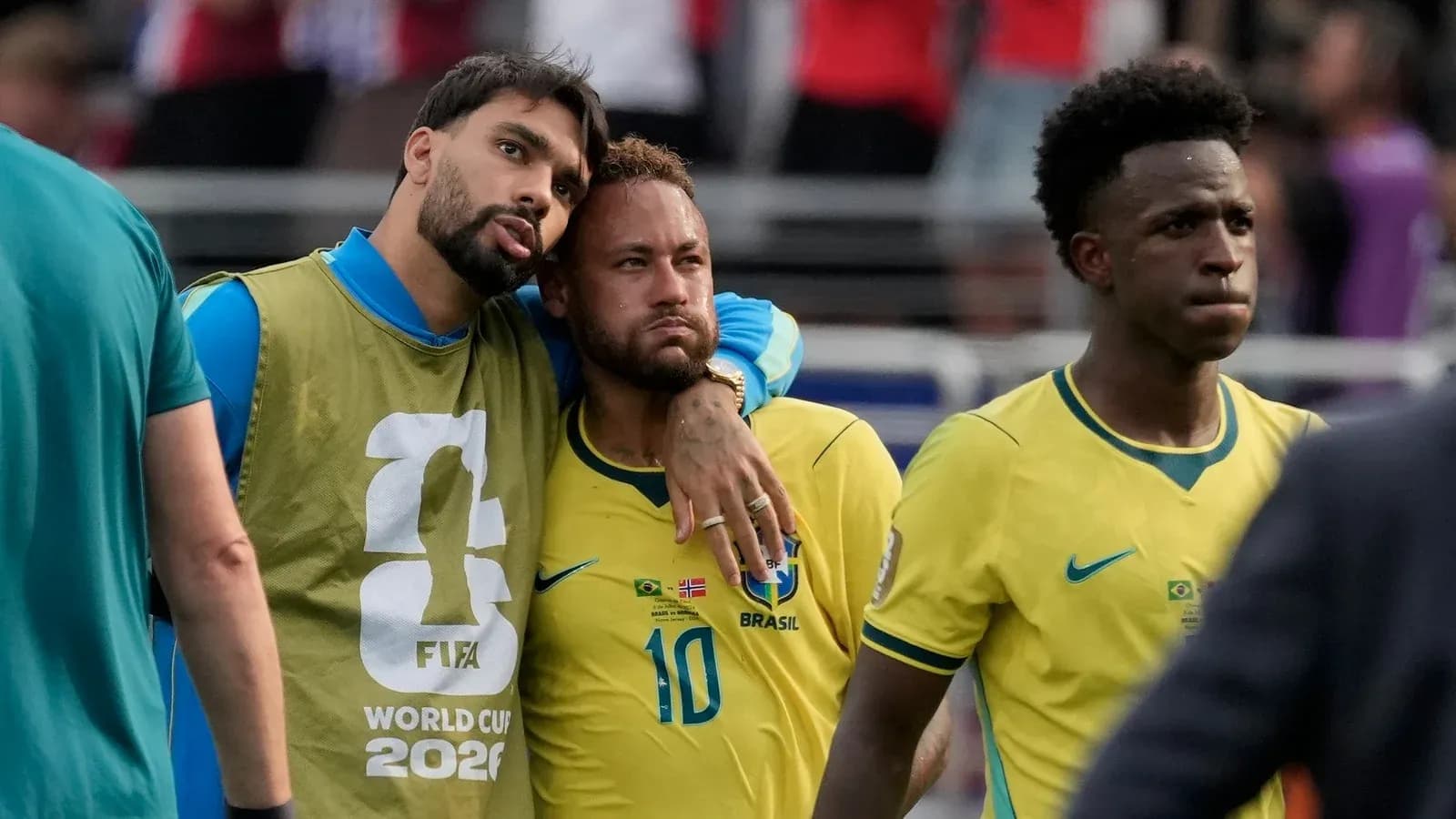
Neymar's Heartbreaking Exit from World Cup 2023
Neymar walked off the World Cup stage where it all began for him, and this time he knew it was the end.
Under the lights of MetLife Stadium in New Jersey, the 34-year-old scored what will stand as his final goal for Brazil – a stoppage-time penalty that could not save them from a 2-1 defeat to Norway and a round-of-16 exit. Two goals from Erling Haaland had already done the damage, condemning Brazil to their earliest World Cup elimination since 1990.
When the whistle went, Neymar crumpled to the turf, face buried in the grass, tears flowing. Teammates gathered, some kneeling beside him, others standing over him, but the image was unmistakable: the end of an era in Brazilian football.
“I tried, I tried. Now it's over,” he told Globo, his voice cracking. “I started here, I finished here.”
He meant it literally. Neymar’s international story began at this very stadium back in August 2010, a friendly against the United States where a teenage prodigy scored his first goal for Brazil. Sixteen years later, the circle closed in the same arena, under far heavier weight.
In between, the numbers stacked up in a way that will define his legacy. Eighty goals for his country, more than any Brazilian man before him, three clear of Pelé. Only Pelé and Neymar have scored in four different World Cups for Brazil. His 130 caps place him second on the all-time appearance list, behind only Cafu’s 142.
Those statistics tell one version of his story. The other is written on his body.
Repeated injuries over recent years have chipped away at his explosiveness and his availability. Every comeback seemed to carry a little more doubt, every fall a little more fear. The penalty against Norway – coolly taken, sent past the goalkeeper in added time – felt like one last assertion of class from a player who has spent a career living with expectation on his shoulders.
Brazil pushed late, chasing an equaliser that never came. Norway held, Haaland’s brace standing as the difference. For a nation conditioned to think in terms of semi-finals and finals, the round of 16 is a brutal line to fall at.
On the touchline, Carlo Ancelotti wore the look of a man who has seen almost everything in the game, yet still felt the sting. After the defeat, the Brazil coach spoke of what comes next.
“What I say is that we continue to do our jobs and look for new ideas,” he said. “It is a very disappointing result and all of us are really saddened. But this was a great group and I have to thank my players, they worked really hard. I don't think we deserved to lose, but we have to accept it.
“That is football for you, that is sports. Sometimes you have to manage the sadness and bitter taste of a defeat. I am very used to that, but we are going to take this defeat and use it as fuel for the new cycle.
“Everyone is profoundly sad, as the fans are. This is normal to have those feelings, but what we have to do is react correctly.”
A “new cycle” means a new Brazil, one built without the man who has carried their attacking identity for more than a decade. For years, every World Cup conversation around the Seleção started with one name. Now, they must learn to start somewhere else.
Neymar leaves the international stage as a record-breaker, a lightning rod, a symbol of both hope and heartbreak for a football-obsessed nation. His final act in yellow was not a trophy lift, not a parade, but a lonely walk off the pitch in New Jersey, head bowed, having scored in vain.
The next Brazil will rise without him. The question is whether they can do it quickly enough to escape the shadow he leaves behind.



