Colombia vs Ghana: World Cup Round of 32 Match Analysis
Arrowhead Stadium in Kansas City staged a World Cup Round of 32 tie that always promised contrast: Colombia, group winners from Group K, against a Ghana side that had edged through Group L with a more fragile record. By full time, Colombia had justified their status with a controlled 1-0 victory, a scoreline that mirrored their broader seasonal identity: measured, defensively immaculate, and increasingly ruthless when it matters.
Heading into this game, Colombia’s campaign had been built on solidity. Overall they had played 4 matches, winning 3 and drawing 1, with 5 goals scored and only 1 conceded. Their overall goals-for average stood at 1.3, while their overall goals-against average was just 0.3. The group-stage table had already underlined that defensive edge: in Group K, Colombia finished 1st with 7 points, a goal difference of 3 derived from 4 goals scored and 1 conceded across 3 matches. Ghana, by contrast, arrived with a more precarious profile. In Group L they finished 3rd with 4 points, a goal difference of 0 from 2 goals scored and 2 conceded in 3 matches, and their overall tournament numbers before this knockout tie showed just 2 goals scored and 3 conceded in 4 games.
I. The Big Picture – Shapes and Seasonal DNA
Nestor Lorenzo stayed loyal to Colombia’s defining structure: a 4-3-3 that has been used in all 4 of their matches. It is a system that spreads responsibility across the pitch and leans on a back four that had already delivered 3 clean sheets at home venues this tournament. In this match, C. Vargas anchored that unit behind a defence of D. Munoz, D. Sanchez, J. Lucumi, and J. Mojica. Ahead of them, the midfield trio of G. Puerta, J. Lerma, and J. Arias acted as the hinge between Colombia’s patient buildup and their front line of J. Rodriguez, J. Cordoba, and L. Diaz.
Carlos Queiroz answered with a 4-1-4-1, a shape Ghana had already used 3 times in the competition. L. Ati Zigi was protected by a back four of M. Senaya, D. Luckassen, J. Opoku, and G. Mensah, with T. Partey as the single pivot. In front of him, a line of four – I. Williams, C. Yirenkyi, K. Sibo, and A. Semenyo – tried to bridge to lone forward J. Ayew. The structure was conservative by design, reflecting a side that, overall, had averaged only 0.5 goals for per game and 0.8 goals against, and had already failed to score in 2 of their 4 matches.
II. Tactical Voids – Discipline and Margins
With no official list of absentees, both coaches could lean on their core identities. Colombia’s disciplinary profile hinted at an edge of aggression: overall they had collected yellow cards across the full 90, with a clear late-game spike – 33.33% of their yellows arriving between 76-90 minutes and another 16.67% between 91-105 minutes. That pattern suggested a team willing to foul to protect leads when matches became stretched.
Ghana’s yellow-card distribution told a similar story of rising tension as games progressed. Overall, 33.33% of their bookings had come between 46-60 minutes, with another 16.67% in each of the 61-75, 76-90, and 91-105 minute windows. In a knockout context, that trend risked leaving their defensive line exposed just as Colombia’s creative players – particularly J. Rodriguez and L. Diaz – sought spaces between the lines.
One individual loomed especially large in this disciplinary landscape: Caleb Marfo Yirenkyi. As a Ghana midfielder, he arrived among the tournament’s leading card collectors, with 2 yellow cards overall. His statistical profile – 7 fouls committed and 3 fouls drawn, alongside 2 blocked shots and 3 interceptions – painted him as an aggressive presser and a necessary disruptor against Colombia’s rhythm.
III. Key Matchups – Hunter vs Shield, Engine Room
The most intriguing duel was conceptual rather than purely individual: Colombia’s attacking trident versus Ghana’s low-scoring, structurally cautious side. Overall, Colombia’s away goals-for average of 3.0 hinted at how explosive they could be when given space, while their home average of 0.7 showed that in tighter games they were prepared to win by fine margins. Ghana, with an away goals-for average of just 0.3 and an away goals-against average of 1.0, entered this tie needing to be perfect without the ball.
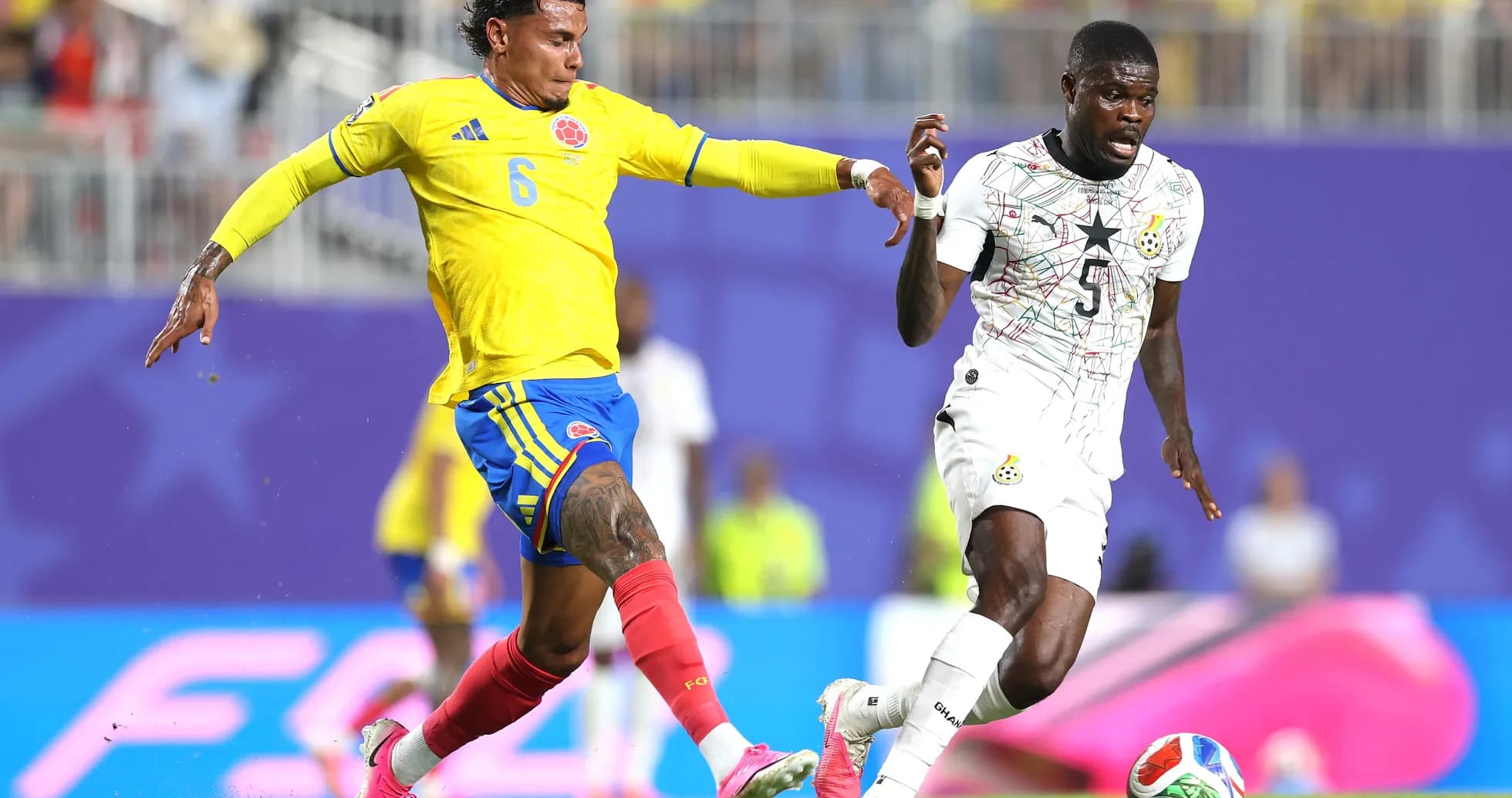
In the “Hunter vs Shield” axis, Colombia’s front three asked different questions. L. Diaz stretched the left flank, forcing M. Senaya and D. Luckassen to defend wide and deep. J. Cordoba pinned the centre-backs, while J. Rodriguez operated as a hybrid forward-playmaker, drifting into pockets where Ghana’s pivot, T. Partey, and the deeper-lying of the Ghana midfielders, such as K. Sibo, had to track him. Any lapse in Ghana’s compactness risked exposing the channels between full-back and centre-back, zones that Diaz and Cordoba are built to exploit.
The “Engine Room” battle was equally decisive. For Colombia, J. Lerma and G. Puerta provided the double function of screen and springboard. Lerma’s presence allowed J. Arias to step higher and support Rodriguez between the lines. On the other side, Partey was asked to do almost everything: shield the back four, progress the ball, and connect to the advanced quartet. Yirenkyi’s role as a runner from midfield, with 70 passes overall at 88% accuracy and 3 interceptions, made him Ghana’s key conduit in transition. Yet his disciplinary risk meant that one mistimed challenge could tilt the midfield balance Colombia’s way.
IV. Statistical Prognosis – Why the 1-0 Made Sense
Following this result, Colombia’s broader arc in the tournament remains consistent with their statistical profile. They continue to be unbeaten, and their defensive numbers – only 1 goal conceded overall before this tie, and another clean sheet here – confirm a side built from the back. Their 3 overall clean sheets prior to this match, all at home venues, foreshadowed exactly the kind of controlled, low-scoring victory they produced at Arrowhead Stadium.
For Ghana, the defeat also aligned with the numbers. A team that had failed to score in 2 of 4 matches and averaged just 0.5 goals per game overall again struggled to create enough clear chances. Their defensive resilience – 2 overall clean sheets – could not mask the attacking shortfall, especially against a Colombia side whose overall goals-against average of 0.3 made them one of the tournament’s hardest teams to break down.
In tactical terms, the match felt like a slow tightening of a vice. Colombia’s 4-3-3, honed over 4 tournament outings, suffocated Ghana’s 4-1-4-1, gradually pinning back the wide midfielders and isolating Ayew. Without penalty opportunities to tilt the balance – neither side had taken a spot-kick in the tournament, and both carried a record of 0 penalties scored and 0 missed – Ghana were forced to create from open play against one of the most secure defensive structures in the competition.
The 1-0 scoreline, then, was less a surprise than a logical extension of both teams’ seasonal truths: Colombia as a methodical, defensively watertight contender, Ghana as a disciplined but blunt opponent whose margin for error in the Round of 32 was always going to be painfully thin.