Newcastle's Path Forward: Selling to Sustain Growth
Newcastle United’s hierarchy has delivered the bluntest message yet of this new era on Tyneside: if the club want to keep growing, some of their biggest names will have to be sold – and missing out on the Champions League will only sharpen that reality.
Chief executive David Hopkinson set out the landscape with a clarity that will unsettle plenty inside St James’ Park. The days of assuming Saudi Arabia’s Public Investment Fund can simply absorb every financial hit are over. Newcastle, he stressed, must start behaving like an elite, self-sustaining football club.
And that means accepting that stars can, and will, be cashed in.
Isak sale sets the tone
The benchmark, in Hopkinson’s eyes, is Alexander Isak’s move to Liverpool last summer. Supporters hated it. Eddie Howe publicly bristled at losing his leading striker. But from the boardroom, a different verdict.
“To me, Isak was a good sale,” Hopkinson said, looking back on the £125 million deal that took the Swede to Anfield. He was not at the club when the transfer was pushed through, yet he sees it as the template.
“Going forward our strategy is to buy well and sell well. Buying well does not necessarily mean spending the most money. It means working in the market place for the players that generate the most value for this club rather than the fee paid for them.”
That line cuts to the heart of Newcastle’s next phase. The club that once spent aggressively to accelerate the project is now pinned in by financial regulations, both in the Premier League and in Europe. Every major decision is now weighed against profitability and sustainability rules.
And if Champions League money does not return next season, the pressure tightens.
Big names on the watchlist
The implications are obvious. When Hopkinson talks about “buying and selling well”, the football world looks at the squad list and joins the dots.
- Sandro Tonali, signed to be a midfield centrepiece.
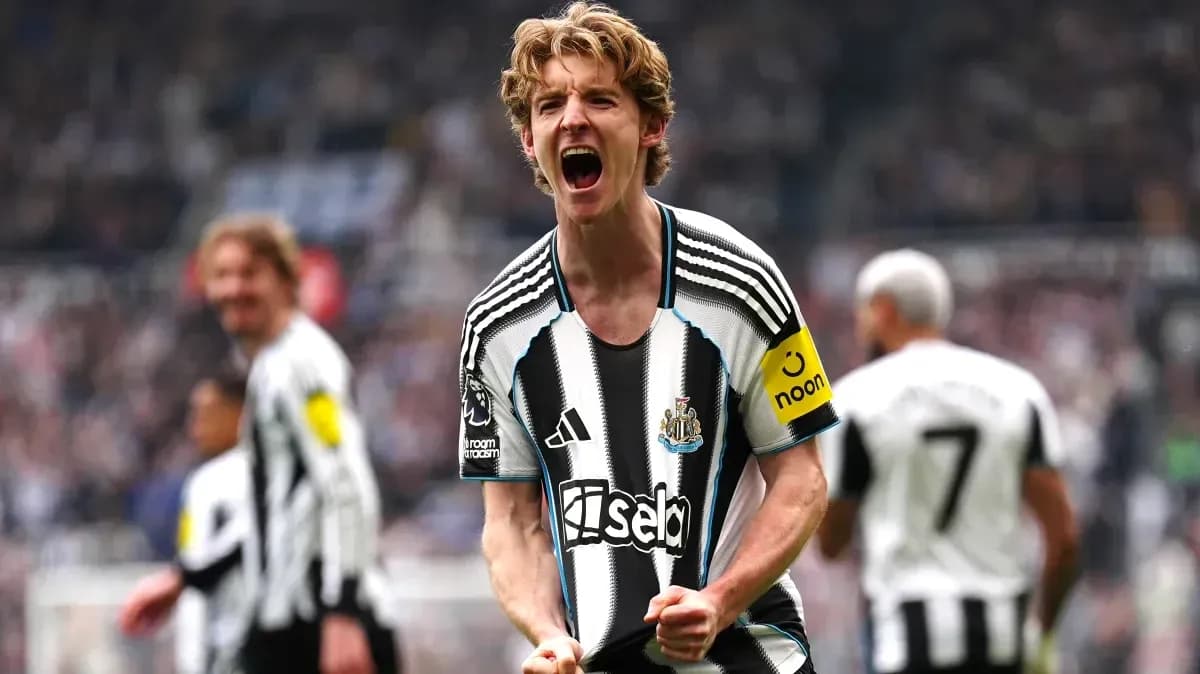
- Anthony Gordon, one of the most improved forwards in the country.
- Bruno Guimarães, the heartbeat of Howe’s side.
- Tino Livramento, a young full-back with enormous upside.
All have been linked with potential exits. All are valuable assets in a squad that may soon need to balance ambition against the hard ceiling of the rulebook.
Hopkinson refused to be drawn on specific names. “We are not ready to answer that,” he said when asked directly about possible departures. But the parameters are clear enough.
“We can make a box-office signing but we might not be able to do that without selling somebody. What I do know is that players that leave this club will need to do so on our terms.”
Newcastle want to remain aggressive in the market. They also want to stay inside the lines. That is the tightrope.
Champions League or compromise
The club’s owners want a modern, commercially sharp institution, not a vanity project. That philosophy is starting to bite.
Newcastle’s accounts for the year ending June 2025 – a season without European football but capped by a Carabao Cup win – show progress. Turnover climbed by £15 million to £335.3 million. Commercial income jumped 44 per cent. Post-tax profit came in at £34.7 million.
Those are the numbers of a club moving in the right direction off the pitch. Yet they also underline how much Champions League revenue matters. Miss out again, and the gap to the established elite widens. To close it, Newcastle may have to sell one of the very players who helped drag them into contention in the first place.
This is the new paradox of the project: to grow, they may have to let go.
Howe under scrutiny, but still in place
Hovering over all of this is the figure of Eddie Howe. The derby defeat at home to Sunderland cut deep on Tyneside and intensified the noise around the head coach. For a fanbase that had rediscovered its swagger under Howe, losing that fixture in that manner was a jolt.
Hopkinson did not pretend otherwise. “The derby loss hurt. We take it seriously. There’s nothing within us that thinks, ‘Well, it’s just three points and on we go.’ It has resonated.”
He revealed he has already sat down with Howe, a one-on-one lunch that ranged across “a multitude of things”, including that derby. The message from the chief executive was firm but measured: no vote of no confidence, but no grand, long-term endorsement either.
“I would not frame it that way,” he said when asked if Howe’s future was open. “We are not looking to make a change at the moment. We are not having those conversations. We are still in the midst of the season.
“Right now we are focused on the seven matches we have remaining and not distracting ourselves with speculation about what we may or may not do in the summer. Right now, all of us have only got so much bandwidth and we are focused on this season and finishing strongly.
“I don’t have a stance on his future. Eddie’s our manager. I expect to have a great run to the end of the season here and we’ll talk about the future when it’s time.”
The backing is present, but it is pointedly short-term. Howe knows the stakes. So do his players.
Seven games to salvage European football. Seven games that will shape not only the mood on the terraces, but who is still wearing black and white when the next season kicks off.