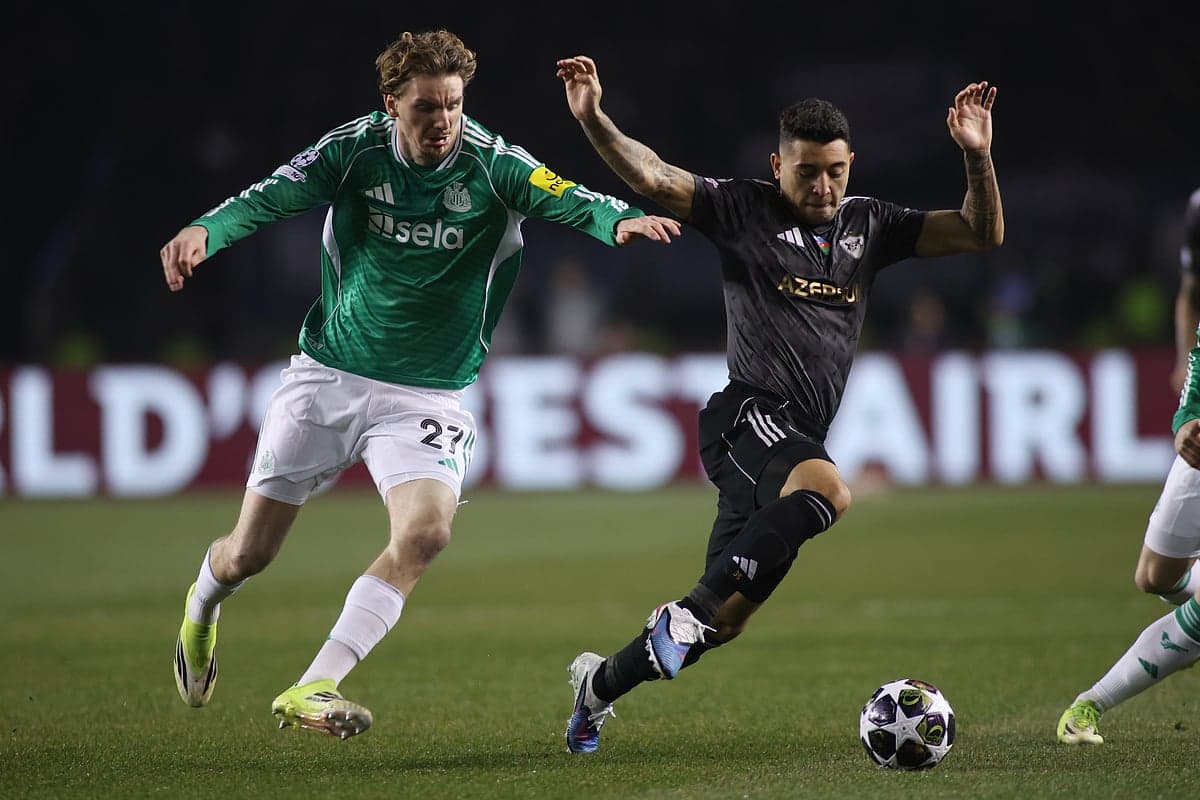
Newcastle Crush Qarabag 6–1 in Baku to Strengthen Champions League Position
Newcastle produced a ruthless away performance at Tofiq Bəhramov in Baku on 18 February, racing into a five-goal half-time lead and ultimately crushing Qarabag 6–1 in their UEFA Champions League Round of 32 tie. Eddie Howe’s side, already well-placed in the standings, underlined their credentials with a display of clinical finishing and control, while Qurban Qurbanov’s Qarabag were overwhelmed despite a spirited second-half response. The result reinforces Newcastle’s strong position in the competition’s playoff picture and deepens concerns about Qarabag’s defensive frailties at this level.
First-half analysis
The tone was set almost immediately. On 3', Anthony Gordon opened the scoring for Newcastle, finishing after a contribution from Dan Burn. Qarabag never recovered from that early blow, and the visitors quickly doubled their advantage: on 8', centre-back Malick Thiaw made it 2–0, converting from a situation created by Kieran Trippier.
Qurbanov reacted early, withdrawing Bahlul Mustafazada for Dani Bolt on 22' in an attempt to stabilise a defence already under siege. It did little to stem the tide. A VAR check on 30' confirmed a penalty for Newcastle, with Harvey Barnes involved in the incident. On 32', Gordon converted from the spot for his second of the night, and astonishingly, he completed his hat-trick just a minute later on 33' with another open-play strike to push the score to 4–0.
The onslaught continued right up to the interval. In first-half stoppage time, another penalty opportunity arrived; Gordon stepped up again on 45', dispatching his second spot-kick to make it 5–0 before the break. Qarabag reached half-time having conceded five, with no cards shown but their defensive structure in tatters.
Second half and tactical shifts
Qarabag emerged from the interval seeking damage limitation and a route back into the tie. Qurbanov made an immediate adjustment on 46', replacing attacking midfielder Leandro Andrade with defender Bədavi Hüseynov, effectively moving to reinforce the back line and add experience at the heart of defence.
The hosts finally found a moment to cheer on 54'. Left-back Elvin Jafarguliyev struck to pull one back, assisted by Abdellah Zoubir, trimming the deficit to 5–1. A VAR review on 56' confirmed the goal, offering Qarabag some validation for their improved intent after the restart.
Howe then turned to his bench in a triple change on 68', clearly managing minutes with the tie seemingly secure. Hat-trick hero Gordon made way for William Osula, Anthony Elanga was replaced by Jacob Murphy, and Joe Willock came off for Jacob Ramsey. Those moves maintained Newcastle’s attacking balance while injecting fresh legs rather than altering the 4-2-3-1 structure.
The impact was swift. On 72', Murphy, one of the new arrivals, added Newcastle’s sixth with a normal-play goal, restoring the five-goal cushion at 6–1. The only booking of the game followed on 76', with Thiaw shown a yellow card for a foul, a rare disciplinary blemish in an otherwise comfortable evening for the visitors.
Howe continued to rotate, withdrawing Trippier for Joelinton on 77', a change that added midfield solidity and allowed Newcastle to see out the contest without overexerting their first-choice right-back. Qarabag responded with late attacking changes: Zoubir was replaced by forward Emmanuel Addai on 85', and Joni Montiel made way for playmaker Kady Borges at the same minute, signalling a desire to salvage further pride.
Newcastle’s final switch came on 87', with Barnes making way for forward Sean Neave, while Qarabag completed their changes on 88' as lone striker Camilo Durán was replaced by Musa Qurbanlı. By then, however, the contest was long decided.
Statistical deep dive
The numbers underline Newcastle’s authority. Howe’s side controlled 58% of the ball, using that share to construct a far more incisive attacking performance than Qarabag, who were limited to 42% possession. Newcastle’s passing was notably crisp: 484 total passes with 431 completed, an 89% accuracy rate, compared to Qarabag’s 350 passes at 84% accuracy. That technical edge allowed the visitors to dictate tempo and territory for long stretches.
In attack, the contrast was stark. Newcastle fired 22 total shots, with a remarkable 14 on target, reflecting both volume and precision. Their expected_goals figure of 5.56 closely matched the six goals scored, illustrating that this was no freak outcome but a sustained creation of high-quality chances, particularly inside the box where they registered 18 efforts. Qarabag mustered eight shots, only two on target, and an expected_goals of just 0.46, suggesting their opportunities were sporadic and low probability.
Defensively, both sides committed 10 fouls, and only one yellow card was shown, to Thiaw, indicating a game that was more about structural mismatches than overt physicality. Qarabag’s goalkeeper made eight saves, underlining the relentless pressure, while Newcastle’s Nick Pope was rarely tested, needing just one save across the contest.
Standings and implications
In the broader Champions League picture, this result reinforces the gap between the sides. Newcastle, who came into the tie ranked 12th with 14 points and a +10 goal difference (17 scored, 7 conceded), strengthen an already impressive campaign marked by only two defeats in eight matches. Their form line of DWDLW now has another emphatic win added in spirit, underscoring their momentum in the playoff rounds.
Qarabag, ranked 22nd with 10 points and a -8 goal difference (13 for, 21 against), see their defensive concerns exacerbated. With a record of three wins, one draw and four losses before this match, and a goals-against column already heavy, a 6–1 home defeat raises questions about their ability to compete defensively against elite attacking units as the knockout phases intensify.