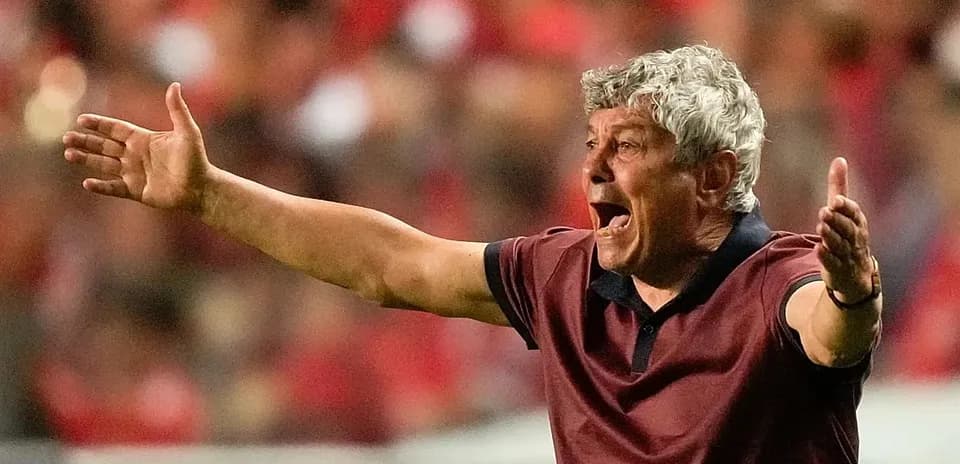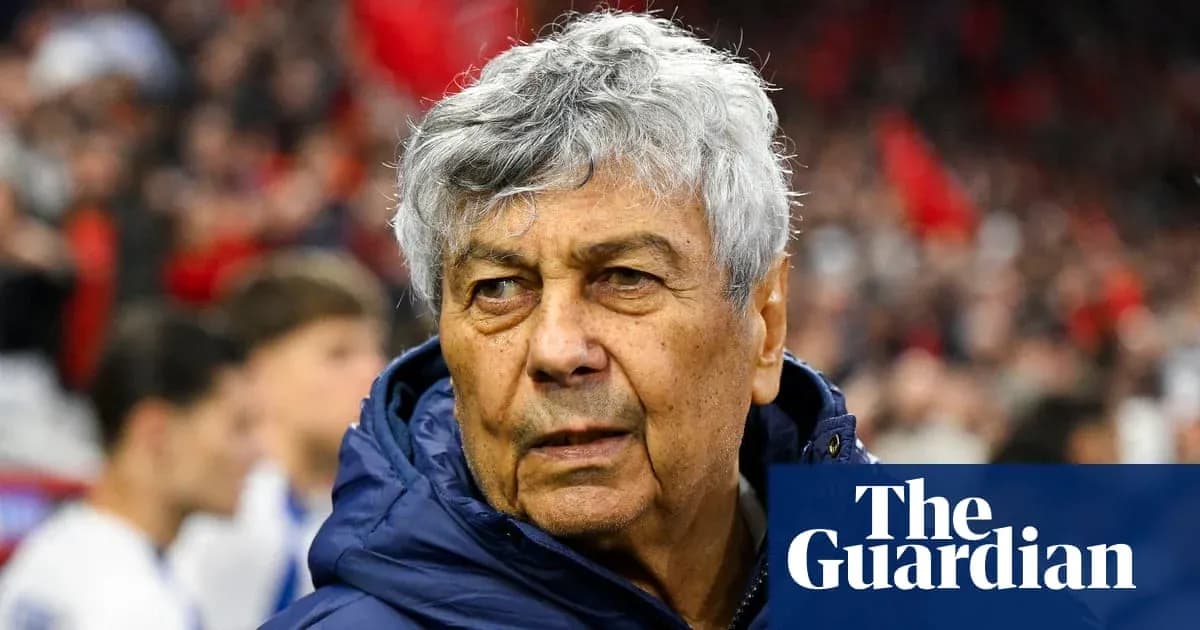
Mircea Lucescu, the relentless architect of teams and trophies across four decades, has died aged 80, leaving Romanian football without its defining figure and Europe without one of its great old masters.
The Bucharest university emergency hospital confirmed his death on Tuesday. He had been admitted on Friday morning after reportedly suffering a heart attack. Only days earlier, he had still been on the training pitch, still working, still chasing one more qualification.
“Mr Mircea Lucescu was one of the most successful Romanian football coaches and players, the first to qualify the national team for a European Championship, in 1984,” the hospital said. “Entire generations of Romanians grew up with his image in their hearts, as a national symbol.”
For Romania, Lucescu was more than a coach. He was the thread running through their modern football history. As a player he won 64 caps, captained his country at the 1970 World Cup and set the standard for those who followed. As a manager he twice took charge of the national team, his first spell beginning in 1981 and culminating in that landmark qualification for Euro 84, achieved from a group that included Italy, Sweden and Czechoslovakia.
He returned to the job almost four decades later, an 80-year-old still driven by obligation rather than comfort. His second spell ended only last Thursday, when he stepped down after falling ill during training. Three days before that, Romania’s bid to reach the 2026 World Cup had fallen at the final hurdle with a 1-0 playoff defeat to Turkey. Even in those last weeks, he refused to hide behind his age or his health.
In March, speaking as he prepared for the playoff semi-final against Turkey, Lucescu laid bare the sense of duty that kept pulling him back. “I’m not in my best shape so I would have stepped away if there was another option available,” he said. “But I insist: I can’t leave like a coward. We must believe in our chance to qualify.
“I felt it was my duty to take charge of the team,” he added. “It was my duty for everything that Romanian football has ever given to me. I was indebted. It was never about money, never about another medal. I have enough trophies.”
He really did. Lucescu’s club career became a tour of Europe’s football cultures, and wherever he stopped, silverware usually followed.
In Turkey, he carved out a legacy on both sides of the Bosphorus. With Galatasaray he lifted the Uefa Super Cup in 2000, then the league title in 2001-02. He crossed the divide to Besiktas and promptly won the championship there the following season, a rare figure celebrated by two of Istanbul’s fiercest rivals.
The most enduring chapter came in Ukraine. In May 2004, Shakhtar Donetsk turned to Lucescu and handed him the keys to a club with ambition and resources but a fragile European identity. Over 12 years he turned them into a powerhouse: eight league titles and, in 2009, the Uefa Cup, a triumph that announced Shakhtar to the continent and sealed his status as a European heavyweight.
The tributes on Tuesday reflected that bond. “Thank you for everything, Mister. Your name is forever written into the history of world football,” Shakhtar posted on X. Galatasaray followed: “We extend our deepest condolences to Mircea Lucescu’s family, loved ones, and the football community. We will never forget you.”
His passport filled with stamps and medals. After Shakhtar he led Zenit Saint Petersburg, then Dynamo Kyiv, adding another fierce rivalry to a career built on walking into the hottest of environments and cooling them with results. He also coached the Turkish national team, one more stop in a life spent at the sharp end of international and club football.
Italy knew a different version of Lucescu, the builder more than the collector. He worked at Pisa, Reggiana and Inter, but it was at Brescia that he left his deepest imprint, winning Serie B in 1991-92 and assembling the “Brescia Romeno” side that still stirs affection among supporters. Four Romanians, including Gheorghe Hagi, gave that team its identity and flair, a little piece of Bucharest transplanted into Lombardy.
For all the medals and milestones, the image that endures is of a coach who simply refused to let go of the game. He kept returning to the touchline, to the training field, to the pressure of qualification campaigns, driven by a conviction that he still owed football something.
In the end, it was Romanian football that felt indebted to him.