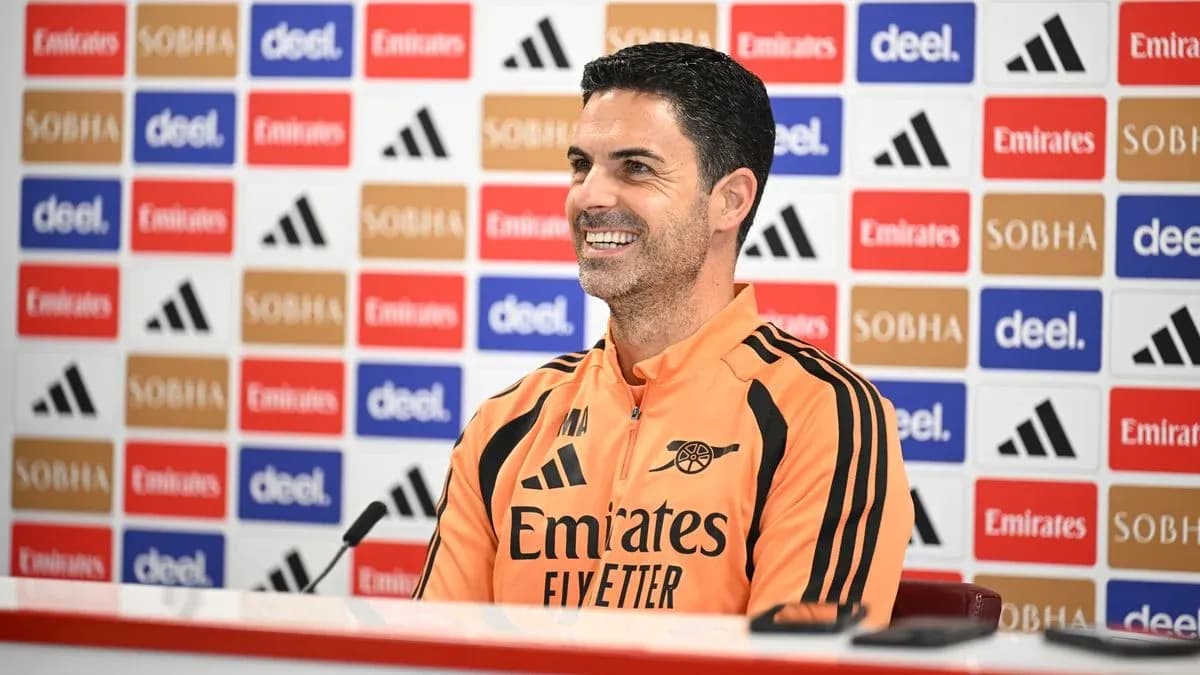
Mikel Arteta Prepares Arsenal for Brighton Clash
Mikel Arteta walked into the press room before Arsenal’s trip to Brighton with his team winning, his squad filling up again, and the noise around referees still humming in the background. He handled all of it with the same clipped clarity that has come to define him.
Injury boost and Brighton test
On the fitness front, it was almost all green lights. Asked first about Ben White, Arteta was upbeat.
“All good,” he said, before explaining that one more training session stood between his players and selection. That applied not just to White, but to Jurrien Timber, Cristhian Mosquera and Piero Hincapie as well. All three are pushing to be involved.
“We have another session,” he said. “They are willing to be part of it and we have another session to try to make sure they are fit.”
Brighton arrive as the latest obstacle in what could be a piece of club history. Victory would make it eight wins from eight in all competitions to start the season, something Arsenal say has not happened since 1903.
Arteta didn’t bite on the record talk.
“We’ve got a really tough opponent tomorrow so we’re going to have to earn the right to win the game,” he said. “But certainly that will be the mindset of the players and the team.”
He also expects a spectacle.
Brighton boss Fabian’s past comments about Arsenal’s style and time-wasting were raised, along with the apology that followed.
Arteta brushed off any tension. “I have huge respect for Fabian, what he’s done and what Brighton has done as a club. It’s just remarkable, and tomorrow is going to be a beautiful game to watch, I’m sure.”
Referees, power and Pro Ref talks
Arteta was pushed on Jamie Carragher’s claim that he now carries a Sir Alex Ferguson-style influence over referees, especially after his outspoken reaction to the Sunderland fallout and subsequent talks with Pro Ref.
He rejected the comparison outright.
“I think I’m here to try to give my opinion, to defend my club, to give the very best to our players,” he said. “We need to respond in the most direct way and fair way. I will make mistakes sometimes, but I will try to be as fair as possible.”
On the Pro Ref conversations, he shut the door quickly.
“This is a conversation that will remain private as usual and they have to keep that one.”
Manchester United have received an apology from officials for a recent incident. Arteta was asked if he wanted one too.
“It’s not about the apology,” he replied. “It’s just agreeing that the decision should have been different or not. Maybe they have a different opinion and try to improve and move forward together.”
Contract calm and a new international rhythm
His own future is never far from the agenda. With Arsenal keen to extend his contract and the manager himself happy to continue, the international break has been floated as a natural window for an announcement.
Arteta sounded utterly relaxed.
“I think we are all very much aligned. Whenever the time is right, we’ll get that done. There is nothing to be concerned about.”
Asked if the timing might mirror his last extension, which landed around a similar break, he shrugged off the significance.
“I don’t know if the time will be the same or different. I think we both have the same ambition and the same will. So whenever we have time, we’ll get that resourced.”
The new, longer international break is another unknown in a season already reshaped by scheduling changes.
“Let’s see, it’s something that we’ll have to experience,” he said. Different national teams are handling squad sizes differently, and for Arteta, the key will be communication.
“It’s going to be really important to have good communication with them so they understand where our players are, what we expect, what they expect as well. And work together, that’s the best way always.”
The question of momentum naturally followed. Could fewer but longer breaks actually help club form?
“Let’s see how it pans out,” he replied. Some national teams will barely travel, others will be flying around the world for two and a half weeks. Only after that, he suggested, will the real impact be clear.
Talk of “Invincibles” arrived next, with Arsenal chasing a perfect league start.
He shut that down instantly.
“We just have enough on the plate today to prepare the game against a really good Brighton tomorrow. And we know how tough that’s going to be and then the right to win it, that’s it.”
Away days and mentality
This Brighton trip will be Arsenal’s fourth consecutive away game. For many managers, that would be an excuse. Arteta sees it as a test of identity.
“That’s one of the challenges of the schedule, and the team has responded so well,” he said. “Playing with such dominance, it doesn’t really matter if we play at home or away; we want to be the same team. We want to cause the same kind of problems to the opposition.”
Three away wins from three so far. One more stands between them and a perfect block of fixtures.
Leadership, kids and the Gabriel effect
Arteta lit up when asked about a small moment in the cup: Gabriel racing over to Marli Salmon after a mistake to pick up the 16-year-old and push him on.
“You cannot cause that. You have it, or you don’t, because it’s a split second,” he said. “It’s just a very emotional reaction when you’re in the middle of the game, and I absolutely loved it because we’ve all been there.”
For a teenager, that support is priceless.
“Just encouraging the confidence that it gives to a 16-year-old to go again and deliver in the next action, it’s huge,” he added. “It’s good to see that bond, that connection within the team to try to help each other.”
That same chemistry is evident at the back, where new signing Ezri Konsa has slotted in alongside Gabriel.
Arteta said he had heard “great things” about Konsa before the move, but daily work has underlined just how big a signing he is.
“Not only the player, but the person,” Arteta stressed. He highlighted Konsa’s presence around the training ground and his instant connection with Gabriel. “It seems like they’ve been here for a long, long, long time together, which is great because that’s a partnership that, in my opinion, is extremely important on the field.”
His attributes, Arteta added, “really make us better.”
Bruno’s role and tactical flexibility
On Bruno Guimaraes, Arteta was asked whether he sees him primarily as a left-sided midfielder, given he has often played on the right at Newcastle.
“He can play on the left, on the right, in the middle, he can rotate from there,” Arteta said. “He’s such a dynamic, versatile player that he can deliver great moments in any position.”
His exact role will hinge on what Arsenal need on the day, how he combines with the other midfielders and what the opposition offer.
David Raya’s rise and recruitment pride
The story of David Raya’s journey from non-league football to Arsenal and a claim to be the best goalkeeper in the world clearly resonates with Arteta.
“That’s a great story,” he said. “For any kid as well to look at trajectories and pathways and how you can reach the highest level in football.”
For Arteta, Raya’s mentality has been the key, layered on top of his natural quality.
“He has overcome a lot of difficulties and a lot of challenges to reach this point,” Arteta said. “When he reached this point, it wasn’t easy at the beginning. He really has to dig in and improve himself.”
He reserved special praise for goalkeeper coach Iñaki and the wider group around Raya, but he did not shy away from the scale of the Spaniard’s impact.
“He has the right to be one of the best now,” Arteta said. Asked if Raya might be his best signing, he refused to rank him, but left no doubt about his importance.
“He’s been a tremendous signing. There’s no question about that,” he said. “We are so happy to have him. I think he has elevated the team, the club to a different level and now we need to maintain that level.”
Viktor’s fight for rhythm
Attention turned to Viktor, who faces one of his former clubs this weekend and has yet to fully ignite in the Premier League.
Arteta rejected the idea that the striker is short on confidence.
“Especially in the Premier League, he hasn’t played that many minutes,” he pointed out. Viktor did, though, impress away to Napoli last week. “I think that’s about moments as well.”
The manager knows what he has.
“We need to give him all the support and confidence that he needs to deliver because we know the player that we have, the capacity that he has to score goals and what he can give to the team.”
The adaptation is still evolving, on both sides.
“The team is doing certain different things this season as well,” Arteta said. “It’s a bit of both, but it’s nothing unique for Viktor; it’s for everybody. That’s a constant evolution, player and team.”
He backed the idea that a change of environment with Sweden could help, as Graham Potter has suggested, but stripped it down to basics.
“Especially for a striker, you know what, they need minutes and they need goals,” he said. “We have a game tomorrow and hopefully he can deliver that.”
Eze, Tzolis and the left flank
With Martinelli and Trossard gone, the left wing has been reshaped. All of Eze’s minutes this season have come from that side, and Arteta likes him there.
“He’s always played there,” he said. “His biggest moments in his career and the highlights of his career have come [there]. I think it’s a place that he feels very, very comfortable.”
Eze can move into different spaces from that flank, but that zone is where he has produced big moments for previous clubs.
He now shares that role with Tzolis. So what makes an “Eze game” versus a “Tzolis game”?
Form, the opponent, and the chemistry in that unit, Arteta said. “There are a lot of factors.”
Max Dowman and the academy pipeline
Max Dowman’s name keeps coming up for a reason. His performance at Ipswich, capped with two goals, has cranked up the volume around his first-team prospects.
Arteta was clear: this is exactly how a young player should force the issue.
“That’s the best way to knock on the door: to do it on the pitch, not in the office,” he said. “When a player delivers constantly on the pitch every single day in training, that’s the best signal for the manager. That’s the best signal for his teammates as well. They will demand that player playing.”
He praised Dowman and the rest of the fringe players who seized their chance in the cup. “It was really impressive,” he said.
Dowman’s growth is not just technical.
“Obviously, when you see how those players behave daily, the level of attention they put to any detail, the way they look after themselves, the standard that they set, if you become part of that environment, that’s only going to raise your level,” Arteta said.
When that environment becomes normal, he argued, the player hits another level. “That’s where Max is at the moment.”
That ties into a broader strategic push. With Per Mertesacker moving on, Pascal coming in, Viktor signed in January and Andria Bartishvili recently announced, the club’s youth structure is being aggressively sharpened.
“We know that if we want to constantly maintain this level and have the pathway already in-house, which is the best way, obviously, to bring players from the academy or from the youth teams to us, they need to be one of the best in the world at recruiting,” Arteta said.
That means the best talent in England and abroad. It also means fighting to keep it.
Across his near seven years at the club, Arsenal have lost some promising youngsters such as Chido, Ayden and Nduka, while managing to keep others like Max and Marli.
“That is challenging because there are a lot of parties there,” he admitted. The system makes it complex, with key decision points along the way. “Sometimes not only what we want to do is what the player or the agent or the family wants to do at times as well. And that’s not easy. But we’re going to try, for sure, to keep the best talent in-house.”
Seven wins, unknowns and the next step
Seven straight wins after a World Cup would test any squad’s resilience. Arteta knows exactly how hard that is.
“We know how complicated it is to win a football match at this level,” he said. “So to win seven, it tells the story.”
He admitted there were “a lot of unknowns” after the tournament. There was no time to work with the group properly, but he liked what he saw immediately.
“From day one, I think the attitude and what I was seeing, I was really impressed with,” he said. Performances followed, some luck helped, and here they are: seven wins, chasing an eighth.
There was no big-picture rhetoric. No grand statement.
Just Brighton away, another hostile ground, another chance to impose their game.
And if Arsenal come through again, what does that say about where this team is really heading?