Mexico's Tactical Masterclass in World Cup Opener Against South Africa
Under the lights of Estadio Azteca, Mexico’s World Cup campaign opened with the kind of controlled, statement victory that reshapes a group. The 2-0 win over South Africa in Group A was not just three points; it was a tactical manifesto from Javier Aguirre, and a warning to the rest of the section that Mexico’s blend of structure and flair is already humming.
I. The Big Picture – Mexico’s structure, South Africa’s resistance
Following this result, Mexico sit 1st in Group A with 3 points and a goal difference of 2, their overall record a clean 1 win from 1 match, with 2 goals scored and 0 conceded. The numbers echo what the eye saw: a side comfortable in its 4-1-4-1, dominating territory and rhythm, and rarely looking stretched defensively.
South Africa, by contrast, are 4th with 0 points and a goal difference of -2. Overall they have played 1 match, lost 1, scored 0 and conceded 2. Their 5-3-2 in Mexico City was designed for survival, not expansion: a back five anchored by Nkosinathi Sibisi and I. Okon, wing-backs K. Mudau and A. Modiba pinned deep, and a midfield trio that spent long spells chasing shadows.
The tone was set by Mexico’s spine. R. Rangel in goal was protected by a back four of I. Reyes, C. Montes, J. Vasquez and J. Gallardo, with É. Lira as the single pivot in front. Ahead of him, a line of four – R. Alvarado, B. Gutiérrez, A. Fidalgo and J. Quiñones – orbited around lone striker R. Jiménez. The shape looked almost textbook on paper; on the pitch, it was anything but static.
South Africa’s 5-3-2, with R. Williams behind a line of Mudau, Sibisi, Okon, M. Mbokazi and Modiba, and a midfield of T. Mokoena, Y. Sithole and J. Adams, tried to compress the central lanes. Up front, L. Foster and I. Rayners were left to feed on transitions that rarely came.
II. Tactical Voids and Discipline – where the game tilted
There were no pre-game absences to distort either squad, so the “voids” emerged from in-game discipline and tactical mismatch.
For Mexico, the card profile across the tournament so far is intriguing: overall they have 1 yellow card, and their red-card data shows a single dismissal in the 91-105 minute range. That red belongs to C. Montes, whose overall line – 90 minutes, 65 passes at 92% accuracy, 6 duels with 3 won – underlines how central he is to Mexico’s build-up and aerial control. Losing a defender of that composure late in a match is a warning sign for Aguirre: Mexico’s aggression in defensive duels must be managed better as the tournament intensifies.
South Africa’s discipline is more alarming. Overall, their yellow-card profile is split evenly: 1 yellow in the 16-30 minute range (50.00% of their yellows) and 1 between 61-75 (50.00%). More telling is the red-card distribution: one red between 46-60 (50.00%) and another between 76-90 (50.00%). Those dismissals are embodied by S. Sithole and T. Zwane, both sent off. Sithole’s numbers tell a story of strain: 49 minutes, 19 passes at 89% accuracy, 8 duels but only 1 won, and 3 fouls committed before his red. Zwane, on for 23 minutes, committed 1 foul and saw red as well. A side already under territorial pressure cannot afford to finish with nine; structurally, it turned a deep 5-3-2 into a desperate 5-2-1.
The cumulative effect is clear: while Mexico’s overall clean-sheet count stands at 1 from 1 match, South Africa have failed to score overall and have yet to record a clean sheet. Discipline is no side note here; it is the hinge on which their defensive plan collapsed.
III. Key Matchups – Hunter vs Shield, and the Engine Room
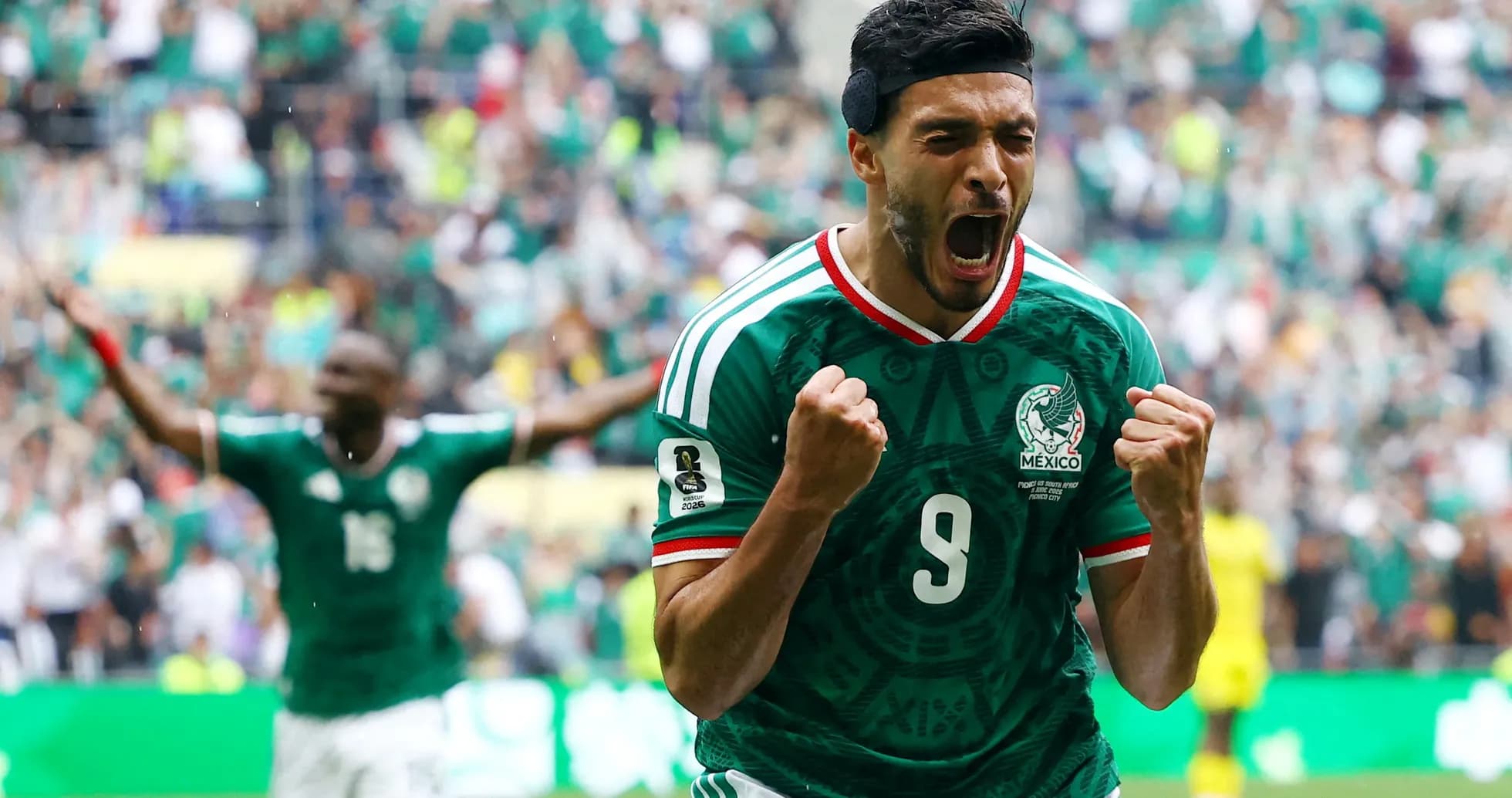
Hunter vs Shield was embodied by R. Jiménez against South Africa’s central trio of Sibisi, Okon and Mbokazi. Jiménez’s overall World Cup line so far is quietly ruthless: 1 goal from 3 shots (2 on target), 19 passes with 2 key passes, 10 duels with 6 won, and a rating hovering in the high 7s. He did not just finish; he pinned. His movement between Sibisi and Okon dragged the back line deeper, creating the half-spaces that J. Quiñones and R. Alvarado repeatedly invaded.
Sibisi, South Africa’s defensive reference, completed 50 passes at 82% accuracy and made 1 interception, but was drawn into uncomfortable territory by Mexico’s rotations. With no goals conceded in total by Mexico so far, and 2 conceded in total by South Africa on their travels, the Hunter vs Shield duel was decisively tilted in green.
In the Engine Room, É. Lira was the quiet conductor. Across his 76 minutes, he completed 45 passes at 93% accuracy, won all 4 of his duels, added 1 tackle and 1 interception, and crucially delivered 1 assist. His work without the ball – screening passing lanes into Foster and Rayners – ensured that South Africa’s forwards were isolated. On the other side, T. Mokoena tried to be South Africa’s enforcer: 42 passes at 92% accuracy, 2 interceptions, 7 duels with 4 won. But with Sithole struggling in duels and Adams largely pinned, Mokoena’s efforts were containment, not control.
Around Lira, the Mexican line of four added layers of threat. J. Quiñones, with 1 goal, 4 shots (2 on target), 33 passes at 84%, 6 dribbles attempted with 5 successful and 7 duels won from 10, played like a wide 10, constantly breaking lines. R. Alvarado mirrored that on the opposite flank: 35 passes at 91% accuracy, 2 key passes, 2 successful dribbles from 2 attempts, 4 tackles and 8 duels won from 13, plus 1 assist in the assists data set. The symmetry of their output made Mexico extremely difficult to tilt or trap on one side.
IV. Statistical Prognosis – what this performance projects
Following this result, Mexico’s overall attacking profile is lean but efficient: 2 goals in total, with an overall average of 2.0 goals for and 0.0 against per match. They have not yet taken or missed a penalty; their penalty record stands at 0 taken, 0 scored, 0 missed. The clean-sheet count of 1 overall, combined with their ability to limit South Africa to half-chances, points to a defensive structure that, red-card wobble aside, is tournament-ready.
South Africa, overall, have 0 goals for and 2 against, with an overall average of 0.0 scored and 2.0 conceded. They have failed to score in their only match so far, and their biggest defeat overall – 2-0 away – is precisely this fixture. The disciplinary profile, with 2 reds across the 46-60 and 76-90 minute ranges, suggests a side that becomes increasingly ragged as they chase the game.
In xG terms – even without explicit numbers – the shot and chance creation data strongly imply that Mexico’s expected goals would comfortably outstrip South Africa’s. Jiménez’s 3 shots, Quiñones’ 4, plus the creative outputs of Alvarado and Gutiérrez (3 key passes) build a picture of sustained, high-quality chance generation. South Africa’s attacking players, by contrast, leave only faint statistical traces: E. Makgopa and O. Appollis came from the bench, each playing 13 minutes, combining for modest pass totals and no shots recorded.
The tactical verdict is clear. Mexico’s 4-1-4-1, anchored by Lira and amplified by the dual threat of Quiñones and Alvarado behind a complete centre-forward in Jiménez, looks scalable to stronger opposition. Their main risk lies in late-game discipline and the occasional overcommitment in duels, as symbolised by Montes’ red card in the wider card data.
South Africa’s 5-3-2, as deployed here, is structurally sound for the first hour but unsustainable under persistent pressure, especially with a midfield that loses its duels and a disciplinary record that fractures the block. Unless Hugo Broos can either stiffen the temperament of his enforcers or shift to a more proactive shape that relieves pressure, the numbers suggest more nights of suffering than of ambush.
At Estadio Azteca, Mexico did more than win a group opener. They established a template: measured possession, wide creativity, a dominant pivot, and a striker who turns half-chances into goals. For a tournament defined by fine margins, this was the kind of controlled authority that can carry a side deep into June.