Mexico Dominates Ecuador 2–0 in Round of 32
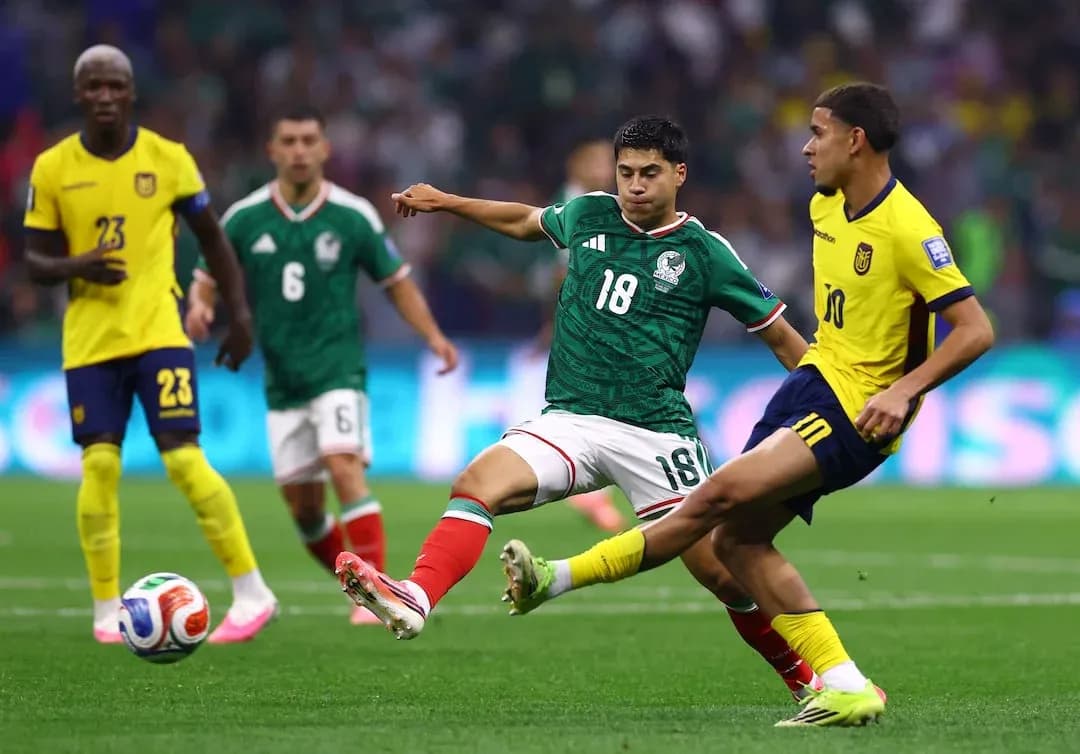
Under the lights of Estadio Banorte in Mexico City, the Round of 32 became a statement of intent. Mexico, already the standard-setters of Group A, translated group-stage dominance into knockout control, dismantling Ecuador 2–0 in a performance that felt both inevitable and meticulously engineered.
This was Mexico’s fourth win in four World Cup matches this season, extending a perfect record that already read 4 victories from 4 fixtures overall, with 8 goals scored in total and none conceded. Ecuador arrived as a more fragile proposition: 1 win, 1 draw, and 2 defeats overall, with only 2 goals scored and 4 conceded. On paper it was a clash between a side that had not yet been breached and one that had failed to score in 3 of 4 outings. On the pitch, the gap in clarity of ideas was even starker.
I. The Big Picture – Structures and Season DNA
Javier Aguirre doubled down on Mexico’s tournament identity, rolling out the familiar 4-3-3 that has been their primary shape, used in 3 of their 4 lineups this season. R. Rangel stood behind a back four of J. Gallardo, J. Vasquez, C. Montes and J. Sanchez. In front of them, the midfield trio of L. Romo, E. Lira and G. Mora formed a compact, hard-running triangle designed to suffocate transitions and recycle possession quickly.
Ahead of that base, the front three was loaded with form and end-product. On the right, R. Alvarado arrived as the competition’s leading creator for Mexico, with 3 assists and 10 key passes in total, while on the opposite flank J. Quinones carried the goal threat of a top scorer: 3 goals and 1 assist overall, with 9 total shots and 5 on target. Between them, R. Jimenez offered a central reference point.
Ecuador, under Sebastian Beccacece, matched up with a 4-4-2 that has been their staple, used in 3 of 4 lineups. H. Galindez anchored a back line of P. Hincapie and W. Pacho centrally, flanked by A. Franco and P. Hincapie’s left-sided aggression. In midfield, M. Caicedo and P. Vite sought to stitch phases together, with J. Yeboah and N. Angulo offering width behind the strike duo of G. Plata and E. Valencia.
Yet the season’s statistical fingerprints hinted at the imbalance. Heading into this game, Mexico had scored 5 goals at home and 3 on their travels, averaging 1.7 at home and 3.0 away, with 2.0 in total, while still not conceding a single goal overall. Ecuador, by contrast, had managed 2 goals at home and none away, averaging 1.0 at home and 0.0 on their travels, for 0.5 in total, while conceding 4 in total at 1.0 per match overall. It was an attack in full flow against a side that struggled to create and suffered when pushed back.
II. Tactical Voids – Discipline and Margins
The disciplinary trends for both sides framed the emotional tone of the tie. Mexico’s season card profile showed yellow cards clustered in the 16–30 and 61–75 minute windows, each accounting for 50.00% of their total yellows, and a single red card in the 91–105 minute band. They are generally controlled, but capable of late volatility.
Ecuador, by contrast, carried more combustible edges. Across the season, their yellow cards were spread from 31–45 minutes (25.00%), 46–60 (25.00%), 61–75 (12.50%), 76–90 (12.50%) and 91–105 (25.00%), with a red card also in the 91–105 window. Two of their defenders, A. Franco and P. Hincapie, sat near the top of the tournament’s disciplinary charts. Franco had already committed 7 fouls and collected 2 yellows, while Hincapie combined 1 yellow and 1 red with 5 fouls committed and 12 tackles. This back line lives on the edge, and against Mexico’s dribblers and combination play that edge became a risk zone rather than a weapon.
III. Key Matchups – Hunter vs Shield, Engine Room vs Enforcer
The defining duel was always likely to be Mexico’s wide forwards against Ecuador’s aggressive full-backs and centre-backs.
On the left, J. Quinones – officially listed as a midfielder but operating as an advanced wide forward – attacked the channel between A. Franco and J. Ordonez. With 3 total goals, 1 assist and 6 successful dribbles from 8 attempts this season, he is a relentless “hunter” who forces defenders into uncomfortable decisions: step out and risk being beaten, or drop and concede territory. Franco’s profile – 8 tackles, 1 blocked shot, 4 interceptions but 7 fouls and 2 yellows – told the story of a defender who likes to engage. Against Quinones’ change of pace, that aggression tilted towards danger.
On the opposite flank, R. Alvarado’s creative radar was Mexico’s other scalpel. His 3 total assists and 140 completed passes at 82% accuracy made him the primary conduit into the final third. His duel with P. Hincapie was a nuanced battle: Hincapie is a proactive defender, with 12 tackles, 2 blocked shots and 4 interceptions, and 24 duels won from 47. But his disciplinary line – 1 yellow, 1 red – suggested that when stretched horizontally and forced to defend big spaces, his timing can betray him. Alvarado’s 4 successful dribbles from 4 attempts and 10 key passes were perfectly suited to exposing that.
Central to it all was the “engine room” clash. For Mexico, L. Romo and E. Lira provided the screen that has underpinned 4 clean sheets in 4 matches overall, while G. Mora linked play vertically. On Ecuador’s side, M. Caicedo and P. Vite tried to resist that press and launch counters. But Ecuador’s season data – just 2 total goals and 3 matches without scoring – underlined a midfield that struggles to convert possession into real threat, especially when outnumbered and forced to build under pressure.
Behind Mexico’s line, R. Rangel was the quiet guardian of a perfect defensive record: 0 goals conceded in total this campaign, backed by a structure that rarely allows clear shots. For Ecuador, H. Galindez faced a different reality: a team that concedes 1.0 goals per match in total, with only 1 clean sheet overall and a defence that bends under sustained pressure.
IV. Statistical Prognosis – Why 2–0 Felt Logical
Mexico’s season arc made a clean sheet and multiple goals feel like the most probable script. With 8 goals scored in total and 0 conceded, plus 4 straight wins, their underlying balance of attack and control has been consistent. Ecuador’s overall profile – 2 goals for, 4 against, 1 win, 1 draw, 2 losses – suggested that once they conceded first, their limited attacking output would struggle to drag them back.
The absence of penalties for both sides this season (no penalties awarded, none scored, none missed in total) meant the tie was always likely to be decided in open play and set pieces, where Mexico’s structured 4-3-3 and superior wide quality held a clear edge.
Following this result, Mexico’s defensive perfection through the Round of 32 remains intact, while Ecuador’s campaign closes with familiar themes: honest work, rugged defending, but too little incision and too many fraught moments at the back. In the end, Mexico’s hunters – Quinones and Alvarado – found the gaps, and Ecuador’s shields, Franco and Hincapie, simply had too much fire to put out.