Manchester United Women: Defying the Odds in 2025-26 Season
“Defy the odds.”
It was meant to be a rallying cry. Instead, it has become a mirror.
Manchester United Women launched their 2025-26 season under that slogan, a punchy instruction forged in the club’s upper corridors as they stepped into a pivotal year: first taste of European football, a push to cement themselves among Arsenal, Chelsea and Manchester City, and a demand to act like contenders, not tourists.
But inside the camp, the phrase has taken on a different edge. The odds they are being asked to defy, several figures close to the team argue, are not just external. They are, in part, built into the club that pays their wages.
A night that exposed the fault lines
For 79 minutes in Munich on Wednesday, United tried to make the slogan make sense.
Melvine Malard’s early goal dragged the Champions League quarter-final level on aggregate at 3-3 against Bayern Munich, an eight-time quarter-finalist with years of European muscle memory. United had arrived under-strength and overworked, yet again leaning on that tight-knit, siege-mentality spirit that has carried them further than their resources suggest they should go.
At half-time, the dream still felt alive. Six shots, four on target, a front-foot performance that rattled Bayern.
Then the legs went.
United re-emerged with a deeper midfield and a squad stretched to breaking point. Only four outfield players sat on the bench, one of them 18-year-old Jess Anderson, who had only just made her Women’s Super League debut days earlier. Bayern, by contrast, came out with a surge of attacking energy United could neither match nor disrupt.
The numbers told the story. United finished the second half with one shot, an xG of 0 and 24 per cent of the ball. Bayern fired nine shots, generated 1.45 xG and camped in United’s half. Corner followed corner. Eventually, the dam burst.
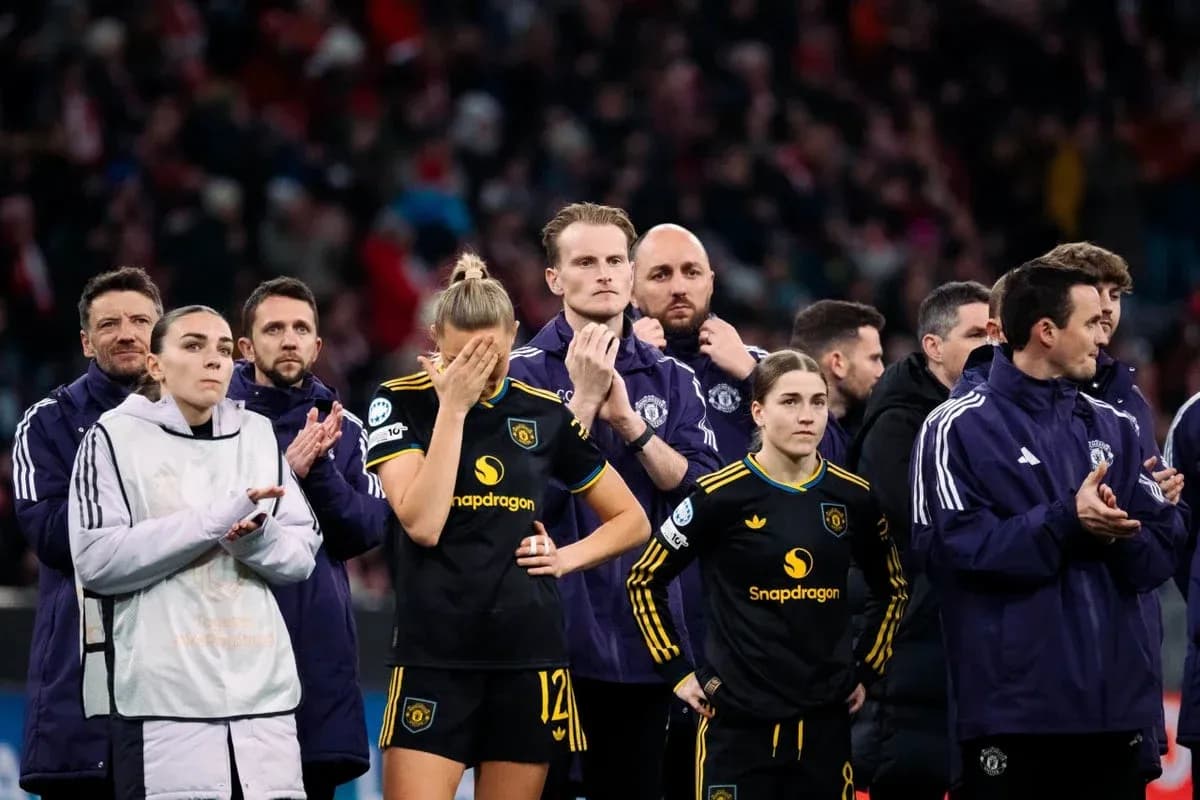
Bayern scored from their 12th and 13th corners of the match, two late set pieces in the final 10 minutes that sealed a 5-3 aggregate defeat and ended United’s debut Champions League campaign.
You can hold the line for only so long. You cannot defy gravity forever.
Out of cups, out of Europe – and out of excuses?
So where does this leave Manchester United Women?
They are out of the Champions League. Out of the FA Cup. Beaten by Chelsea in the League Cup final. With three WSL matches left, they are scrapping for a top-three finish and a return ticket to Europe.
Inside the women’s hierarchy and across the wider executive team, a set of blunt questions has echoed all season: what is the plan to make Champions League qualification normal, not a miracle? How do you build a side that doesn’t need to “defy the odds” just to compete?
Those conversations intensified last summer. United signed Jess Park, Fridolina Rolfö and Julia Zigiotti Olme, but were outbid on two other targets. That reality forced a new line of thinking: if the internal budget could not keep pace, could external investment bridge the gap?
The arrival of INEOS and Sir Jim Ratcliffe’s minority stake in December 2024 sharpened that debate. Ratcliffe admitted in 2024 that the men’s operation had consumed his attention and delayed his involvement with the women’s project. Meanwhile, the women’s squad carried the weight of a four-front campaign on a threadbare roster.
A March meeting was earmarked as pivotal. Senior figures from the women’s setup and the club’s executives sat down to discuss investment options, including selling a stake in the women’s team to an outside backer.
The idea went nowhere. Club sources insist the possibility of external investment was quickly dismissed and no concrete proposal emerged. Yet multiple people familiar with the talks say internal discussions have not stopped, and final recommendations still need to land on the boardroom table.
A rebrand of the women’s team, with subtle tweaks, has even been floated in those conversations, though senior leadership have no plans to act on it.
The market moves, United hesitate
United are not alone in exploring new money for women’s football.
Alexis Ohanian, Reddit co-founder and Angel City co-founder, bought around 10 per cent of Chelsea Women last May for £20million, valuing their women’s side at more than £200m. Everton Women confirmed a minority investment from GED Investments in December. Sunderland Women, as reported in March, entered advanced talks to sell a majority stake to U.S. firm Sixth Street via its Bay Collective platform.
This is the landscape in which United are trying to stand still and move forward at the same time.
Multiple sources say United have struggled to keep pace with rising wages and transfer fees, hemmed in by budget constraints. Club voices push back, framing it as a commitment to sustainability rather than a lack of ambition.
Yet the consequences are visible. At least two January signings were deals United had originally targeted in the previous summer window. One planned addition for the upcoming off-season remains unconfirmed because the recruitment budget has not been finalised by those controlling the club’s overall finances.
Throughout the campaign, staff have sent messages up the chain urging more support. One included a screenshot of a bench stripped bare by injuries for a key WSL game.
The injury list is long and brutal: Dominique Janssen, Ellen Wangerheim, Anna Sandberg, Leah Galton, Elisabeth Terland, Ella Toone. Against Bayern, Simi Awujo limped off with what looked like a hamstring problem. Training has been dialled back to tactical walkthroughs, analysis and recovery, with a constant fear of adding another name to the treatment room.
Investment – but not enough?
To paint United as starved of all investment would be wrong. Under head coach Marc Skinner, now in his fifth year, the club have made 37 signings. The operating budget has more than doubled, from just under £5m in 2021-22 to £10.7m in 2024-25.
On paper, that looks like growth. In the context of the WSL’s elite, it looks like half-measures.
Last season, United’s wage bill sat at £5.88m, a little over half of Arsenal’s £11.3m. Manchester City, who finished fourth, reported operating expenses of £14m, around £4m more than United. Chelsea’s latest accounts are not yet public, but their previous season – when they lifted a fifth straight WSL title and reached the semi-finals of both the FA Cup and Champions League – showed an operating budget north of £20m. Double United’s.
Inside and outside the camp, a distinction has formed: there is investing sustainably, and there is investing enough to compete with serial winners.
Skinner’s record reflects that tension. Under him, United have finished fourth, second (a club high), fifth and third in the league. They have reached four major finals, winning one – the 4-0 FA Cup demolition of Tottenham Hotspur in 2023-24 – and losing three to Chelsea by a combined 6-0.
Against the league’s powerhouses, the numbers are harsher. Across the past two seasons, Skinner has overseen three wins in 17 matches in all competitions against Chelsea, Arsenal and City. United have beaten Chelsea once in their last 19 attempts, that FA Cup semi-final in 2023-24. Skinner’s own record versus the west Londoners stands at one win and one draw in 15 games.
The coaching debate
The scrutiny has not stopped at the boardroom door. It has landed squarely on the manager and his staff.
Some close to the squad question whether Skinner is the right coach to nurture emerging talent. They argue he favours established, experienced players and offers limited minutes to younger prospects. The numbers back up part of that view: before 16-year-old Layla Drury’s WSL debut on 15 February, United had given just 90 league minutes all season to players under 21. Those came in a 3-0 defeat to Manchester City in November, when 21-year-old Wales goalkeeper Safia Middleton-Patel stepped in after Phallon Tullis-Joyce fractured an eye socket.
There are also concerns about what happens on the touchline. Some players feel they receive minimal in-game instruction, particularly in attack, and are left to improvise patterns in the final third. Skinner rarely leads technical sessions himself, delegating much of the on-pitch coaching to his staff while he juggles other responsibilities.
In training, those staff members are sometimes drafted in to play in drills – partly to make up numbers amid the injury crisis – or to referee, rather than to coach actively.
Others inside the club offer a very different picture. They praise Skinner’s willingness to shield players and staff from public criticism and describe him as more tactically nuanced than his detractors allow, especially given the constraints. They credit him with organising a disciplined defensive structure and highlight his communication, both in media settings and in regular one-to-one meetings with players.
Some footballers enjoy the freedom he grants them on the pitch. Against the very best, that same freedom can feel like exposure. The second half in Munich, where United offered almost nothing going forward as Bayern pinned them back, felt like a harsh case study.
Set pieces have been another flashpoint. United’s fragility from corners and free kicks has been a theme all season. The departure last summer of long-serving goalkeeping coach Ian Willcock, who also oversaw defensive set pieces and helped United set a WSL clean-sheet record in 2022-23, has been keenly felt. His replacement, Joe Potts, arrived from Liverpool Women.
The results have been painful. A 2-1 FA Cup exit to Chelsea in the fifth round, decided by a corner in extra time. Two late goals from corners in Munich. The pattern is hard to ignore.
“We were knocked out in all our games from a set piece, in the FA Cup and now here,” captain Maya Le Tissier told Disney after the Bayern defeat. “It’s something we need to work on.”
Skinner’s positional calls have also raised eyebrows. Terland, a striker by trade, has been used as a No 10 in the League Cup final against Chelsea. Wangerheim, signed in January from Hammarby as a centre-forward, has often been deployed on the wing.
In February, during the League Cup final media day, Wangerheim told The Athletic she had been informed in negotiations she would play as a No 9. United then signed Lea Schüller from Bayern. Wangerheim admitted she needed “some training sessions and games” to adapt to her new wide role, but the congested schedule left little room for non-competitive bedding-in. A club source maintains she was told from the outset she would sometimes operate on the flank.
A race that is closing in
For all the emotion of that Champions League exit, United’s season is not dead. It is simply on a knife-edge.
Three league matches remain: Tottenham Hotspur, Brighton & Hove Albion and, on the final day, Chelsea. A return to Europe almost certainly requires United to beat Chelsea for just the second time in 20 attempts, and to navigate Spurs and Brighton without slipping.
The pressure is not only from above. It is rising from below.
Senior figures at three WSL clubs currently behind United have, in conversations with The Athletic, identified United as the side they intend to overhaul next season. They point not just to United’s comparatively modest transfer budget, but to what they see as a lack of surrounding infrastructure – the scaffolding that turns a good team into a relentless one.
Skinner, for his part, has not hidden from the wider picture.
“I’m incredibly proud of what my players are doing on resources we have,” he said after the Bayern defeat. “Because we wear Manchester United’s badge, everybody expects us to be the very best team in the world. We have that expectation too. Yet we’ve got to grow because we’re eight years old.
“You (can) give me all the flack. That’s no problem, that’s my job. But if we want to compete at this latter stage, we’ve seen what we’ve got to do, as a club. And then it’s our choice now, isn’t it?”
The slogan on the wall says “Defy the odds”. The question, as this season reaches its breaking point, is whether Manchester United are finally ready to change them.