Manchester United Target Nico Schlotterbeck to Strengthen Defense
Manchester United did not set out to make centre-back a headline issue this summer. Harry Maguire’s looming contract extension eased the immediate pressure, Ayden Heaven has emerged with authority, and Leny Yoro is viewed as a pillar of the future as much as the present.
Yet the market has a way of reshaping plans.
Injuries to Matthijs de Ligt and Lisandro Martinez have reminded United how fragile their defensive core can be across a long season. With more games on the horizon and ambitions stretching across multiple competitions, the club is again scanning Europe for value and reliability at the back.
One name has cut through the noise: Nico Schlotterbeck.
A bargain hiding in plain sight
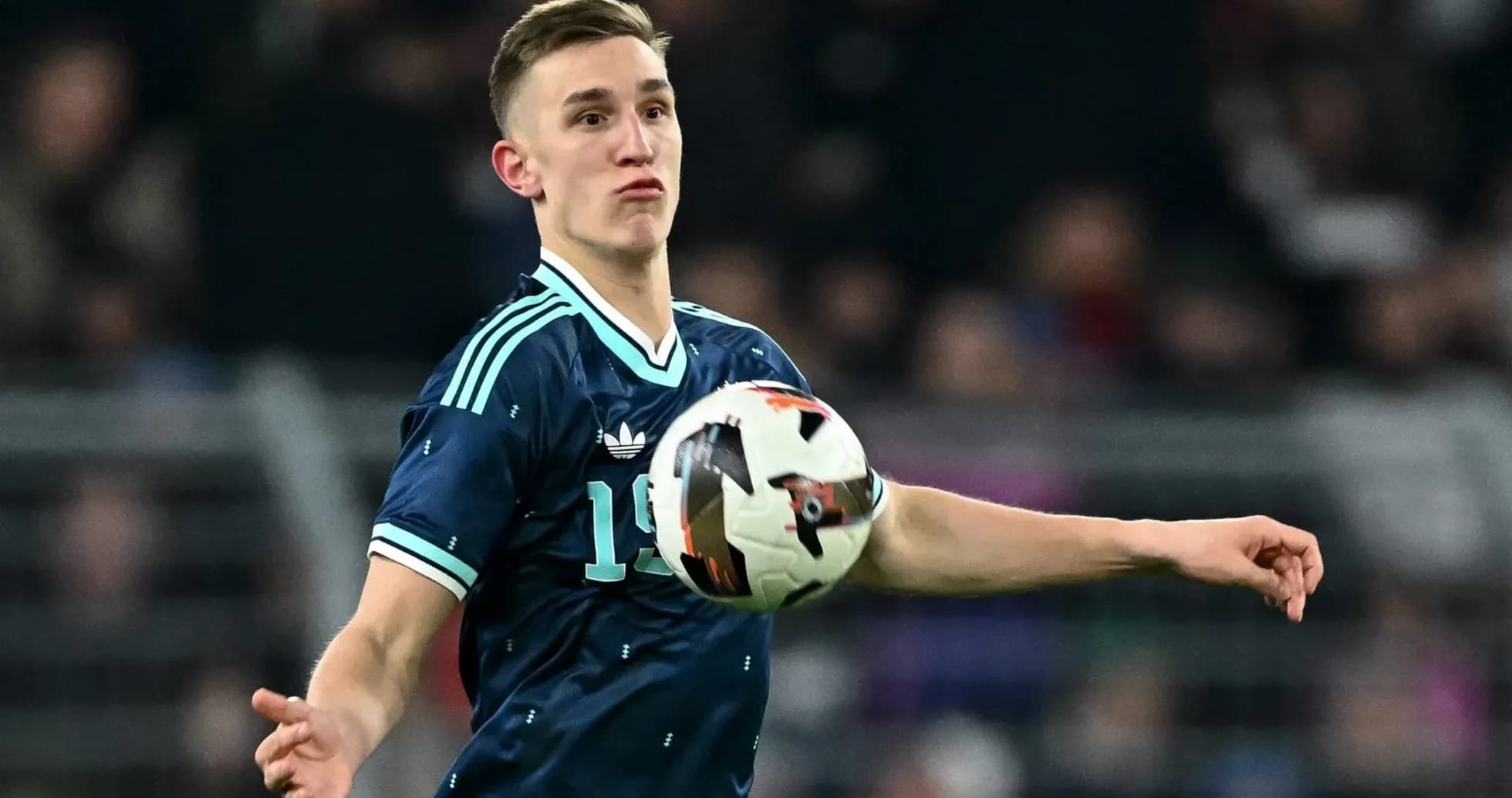
The Borussia Dortmund and Germany defender has moved firmly onto United’s radar. Speaking on Sky Sports Germany, reporter Florian Plettenberg stated that United are interested in Schlotterbeck and outlined the potential numbers involved: if the 24-year-old does not extend his contract in Dortmund, he could be available this summer for around €30m–€35m, roughly £26m–£30m.
At that price, for a starting-calibre international defender in his prime years, it is the kind of opportunity top clubs rarely ignore.
United’s recruitment team knows exactly what that fee represents: not a luxury signing, but a strategic one. A player who can start, rotate, and stabilise a back line that has too often been reshuffled by necessity rather than design.
Pace, presence, and a left foot United can use
Schlotterbeck’s reputation is not built on hype. It is built on attributes that translate directly to the Premier League.
He is a left-footed centre-back, comfortable building from the back and stepping into midfield with the ball. That alone makes him particularly relevant to United, where Martinez has been the only natural left-sided central defender at the required level. When the Argentine is fit, the defence looks balanced. When he is not, everything shifts and compromises creep in.
Schlotterbeck offers a clean solution. He can mirror many of Martinez’s structural benefits while bringing his own profile to the role.
Then there is the speed. Clocked at 33.91 km/h, Schlotterbeck can live with some of the quickest forwards in the game. In a league where one long ball can expose a high defensive line, that kind of recovery pace is not a luxury; it is insurance.
Germany form underlines his case
If United needed recent evidence of his readiness for a bigger stage, they received it during the March international break. While several United players impressed for their countries, Schlotterbeck did the same for Germany in a 2-1 win over Ghana.
His performance there highlighted what scouts already know: assured positioning, strong defensive instincts, and, above all, high-level passing. His distribution is a major strength, whether breaking lines into midfield or switching play with accuracy from the back. For a United side that often looks at its centre-backs to initiate attacks, that trait carries real weight.
This is not a speculative project. It is a defender already performing on the international stage, with the temperament to handle pressure and the technical base to fit into a possession-oriented back line.
The Bundesliga connection
Inside United’s football structure, one figure could prove particularly influential in this pursuit: Christopher Vivell. The German executive’s expertise and relationships within the Bundesliga give the club a sharper edge in conversations of this kind.
If Dortmund hesitate over a renewal and Schlotterbeck keeps his options open, United will want to be first in line, armed with detailed knowledge of the player’s character, training habits, and long-term potential. Vivell’s familiarity with the league and its decision-makers could help turn interest into a realistic pathway.
A changing of the guard on the left side?
The question hanging over all of this is Lisandro Martinez. The Argentine remains a favourite with supporters and staff alike, but persistent injuries test even the most loyal hierarchies. At some point, sentiment gives way to planning.
Schlotterbeck would not arrive as a squad filler. At his age and level, he comes to compete for the left-sided role, not to simply cover it. United could find themselves with two high-level left-footed centre-backs in Schlotterbeck and Heaven, a pairing that could anchor that flank for years.
For a club operating under a defined budget — even one as large as £200m — value matters. A defender of Schlotterbeck’s calibre for £26m–£30m is not just attractive; it is the kind of deal that allows resources to be pushed into other problem areas without weakening the spine.
Centre-back might not have been the headline priority when the summer plans were sketched out. But if Nico Schlotterbeck really is on the market at that price, United may find that the smartest windows are the ones that adapt when opportunity knocks.