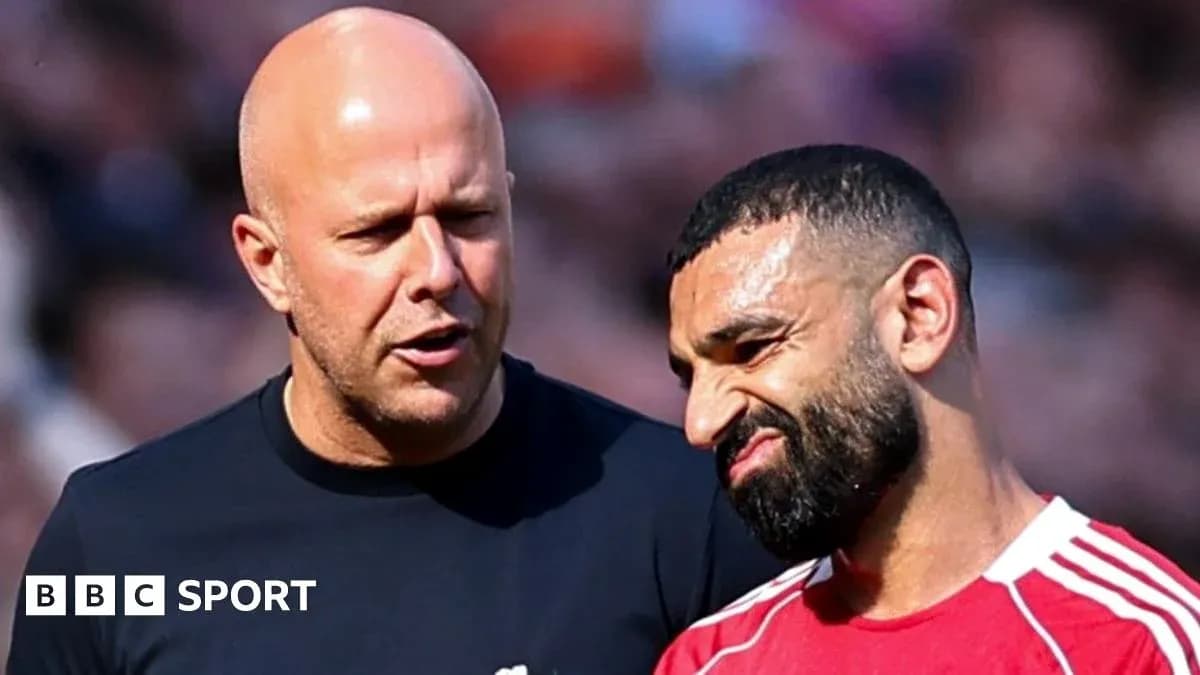
Liverpool's Crossroads: Salah's Legacy and Slot's Vision
Twelve months ago, Anfield was dressing for a coronation. The Kop was ready to watch Liverpool lift the Premier League trophy in front of their own supporters, a culmination of years of relentless, turbo-charged football.
Now, as Brentford arrive for the final game of a bruising season, the mood is very different. The title is a memory. Champions League qualification is still not mathematically secure. Discontent has crept into the stands. And the club’s greatest modern goalscorer is walking out of the door with a parting shot that cuts straight to the heart of the debate over what Liverpool are – and what they want to be.
Slot’s Liverpool, Salah’s Liverpool
Arne Slot did not bother dressing it up this week. He knows what he has watched. He knows what the fans have watched.
“We have to find a way to evolve the team and play a brand of football I like,” the Liverpool head coach said. “And if I like it, the fans will like it too because I haven’t liked a lot of the ways we've played this season.”
That is a remarkable admission from a manager under pressure, but it also underlines how far the club has drifted from its own recent identity. The football has been flat, the results worse. Twenty defeats in all competitions have stripped away the aura that once made Anfield a place to fear.
Slot insists this is a transition, not a dead end. He talks about evolution “now, over the summer and the next season” as the route back to success. He is adamant he can turn it around and said last week he has “every reason to believe” he will still be in the dugout when next season starts.
Yet while Slot talks about what comes next, Mohamed Salah has chosen this moment – with one week left of his Liverpool career – to remind everyone what he believes the club should never stop being.
Salah’s Parting Blast
Salah does not often use his own social media to speak at length. When he does, it tends to matter. This time, it landed like a flare in a darkened stadium.
“Us crumbling to yet another defeat this season was very painful and not what our fans deserve,” he wrote after the loss at Aston Villa. “I want to see Liverpool go back to being the heavy metal attacking team that opponents fear and back to being a team that wins trophies.”
He went further, framing that style as non-negotiable.
“That is the football I know how to play and that is the identity that needs to be recovered and kept for good. It cannot be negotiable and everyone that joins this club should adapt to it.
“Winning some games here and there is not what Liverpool should be about. All teams win games.”
This is not just nostalgia from a departing star. Salah has lived the full arc: 257 goals, Champions League and Premier League titles, the journey from “doubters to believers, and from believers to champions”. When he says qualifying for the Champions League is “the bare minimum”, it carries the weight of someone who helped set that standard.
He will leave after Sunday’s game against Brentford. He will not be part of whatever Liverpool become under Slot. Yet his words – amplified by likes and comments from team-mates such as Curtis Jones and Hugo Ekitike – show he is not shouting into the void. The dressing room has heard him. So have the stands.
Rooney: “I’d Have Him Nowhere Near the Stadium”
Not everyone has sympathy for Salah’s timing.
Wayne Rooney, speaking on his own show, did not mince his words. The former Manchester United striker called it “sad” that a player who has done so much for Liverpool chose this moment to “aim another dig at Slot”.
“He wants to play heavy metal football, so he's basically saying he wants Jurgen Klopp football,” Rooney said. “Now I don't think Mo Salah can cope with that type of football any more. I think his legs have gone to play at that high tempo and high intensity.
“If I was Arne Slot, I'd have him nowhere near the stadium in the last game.”
Rooney even drew on his own experience, recalling how Sir Alex Ferguson left him out of his final Old Trafford squad after a disagreement. In his view, Salah has “almost just dropped the grenade”, undermining Slot and leaving next season’s core players to deal with the fallout.
It is a harsh reading, but it reflects a wider tension: how does a club honour its icons while allowing a new manager to impose his authority and his ideas?
Slot Stays on Message
Slot, for his part, refused to be dragged into a public spat.
“I don't think it is that important what I feel about it,” he said when asked directly about Salah’s social-media statement. “What it is important is that we qualify for the Champions League on Sunday, and I prepare Mo and the rest of the team to be ready for the game in the best possible way. That is what matters.”
He admitted he was “very disappointed” after the defeat at Aston Villa, which would have sealed Champions League qualification. Now everything rests on the final 90 minutes.
“There is one game to go and it's a vital one for us as a club,” he said.
On whether Salah’s words had affected the group, Slot again kept his focus narrow.
“I don't know if it had an impact on the group. What I have seen is the team have trained really well this week, and we hope to continue really well in the upcoming two days so we are really prepared.
“I think Mo and I have the same interest – we want the best for this club. We want the club to be as successful as possible.”
It is a diplomatic line, but it does not erase the reality that player and coach clearly see the present through different lenses. Salah is looking back at what Liverpool were and demanding a return. Slot is looking at what Liverpool are and talking about evolution.
A Club Between Eras
Strip away the noise and the picture is stark.
Liverpool have lost 20 times in all competitions this season. They still have not secured Champions League football. The football has been described as “languid” by those watching from the stands, and the atmosphere has shifted from defiance to frustration.
Supporters who once roared their team over every hill are now voicing their discontent. The head coach is under scrutiny before he has even completed a full cycle. The star forward is leaving, publicly questioning the team’s identity on his way out.
Slot insists this is not the end of anything, just a painful chapter.
“We want the club to be as successful as last season,” he said. “That is where my main focus is at now because the game on Sunday could give us a really base heading into next season. That is where we should focus.”
He believes he can still be the man to lead that reset. He believes there is enough raw material in this squad to evolve into a side that wins again, and wins in a way that satisfies both his own instincts and the demands of Anfield.
Salah, though, has left a clear marker in the ground. For him, Liverpool’s identity is not something to be gently reshaped. It is something to be recovered, protected, and imposed on anyone who walks through the door.
On Sunday, Liverpool face Brentford with a simple task: secure the Champions League place that Salah calls “the bare minimum” and Slot calls “vital”. Beyond that, the questions grow more complex.
What does “heavy metal” look like in the Slot era? And when the Egyptian king has gone, who will define what Liverpool are supposed to sound like?