Lecce Secures Narrow Victory Against Genoa in Serie A Finale
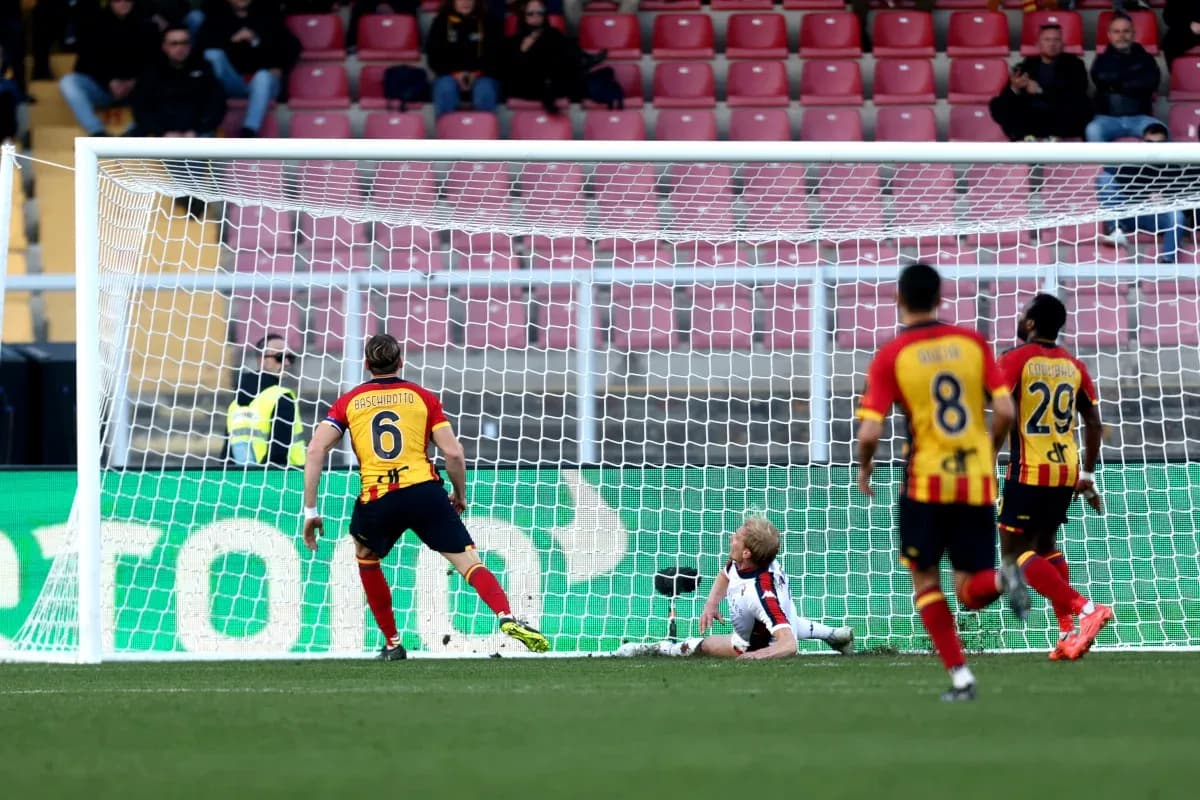
Via del Mare closed its Serie A season with a narrow, nervy 1–0 win for Lecce over Genoa, a result that crystallised the identities of both sides after 38 games. Following this result, Lecce finish 17th on 38 points with a goal difference of -22 (28 scored, 50 conceded), Genoa 16th on 41 points with a goal difference of -10 (41 scored, 51 conceded). It was not a classic, but it was a match that distilled a campaign of struggle, pragmatism and thin attacking margins.
I. The Big Picture – Structure and Seasonal DNA
The formations told the story before a ball was kicked. Eusebio Di Francesco stayed loyal to Lecce’s most-used shape, a 4-2-3-1 that has started 22 league games. Wladimiro Falcone in goal, a back four of Danilo Veiga, Jannik Siebert, Tiago Gabriel and Antonino Gallo, with Ylber Ramadani and Ousmane Ngom as the double pivot. Ahead of them, Santiago Pierotti, Lameck Banda and Lameck’s fellow runner L. Coulibaly floated behind Walid Cheddira as the lone forward.
Across from them, Daniele De Rossi opted for a 3-5-1-1, one of several back-three variants Genoa have cycled through this season. Nicola Leali was shielded by a trio of N. Zatterstrom, S. Otoa and A. Marcandalli. The wide lanes belonged to Stefano Sabelli and A. Martin, with Morten Frendrup, Amorim and P. Masini forming a busy central band. M. E. Ellertsson supported Lorenzo Colombo up front.
The tactical context was shaped by the season-long numbers. Heading into this game, Lecce had been one of Serie A’s least potent attacks: in total this campaign they scored 28 goals in 38 matches, an average of 0.7 goals per game overall, with just 13 at home (0.7 at home). Their defensive record – 50 conceded, 1.3 per game overall – was not disastrous by relegation-battle standards, but it left them with a thin margin for error.
Genoa were more expansive but equally fragile. Overall they scored 41 times (1.1 per game) and conceded 51 (1.3 per game). On their travels they found the net 19 times at an average of 1.0 away goals per match, but shipped 25 at 1.3 away goals conceded. This was a mid-table attack grafted onto a lower-half defence, and the table reflected that imbalance.
II. Tactical Voids – Absences and Discipline
Both coaches had to navigate significant absences, and the voids were particularly stark for Genoa. De Rossi was without a full attacking and creative battery: T. Baldanzi (illness), M. Cornet (muscle injury), J. Ekhator (foot injury), C. Ekuban (injury), Junior Messias (muscle injury), R. Malinovskyi (inactive), J. Onana (injury), L. Ostigard (knock) and Vitinha (suspended for yellow cards). That is a spine’s worth of ball progression, set-piece threat and penalty-area presence removed from the equation.
The knock-on effect was visible in the lineup. Without Malinovskyi’s long-range threat and 6-goal, 3-assist output, Genoa lacked a natural conduit between midfield and attack. Ellertsson and Colombo had to drop deeper to link play, compressing the pitch and making Genoa easier to defend against. The bench, populated by youngsters like F. Carbone, M. Doucoure, J. Grossi and E. Spicuglia, underlined how stretched De Rossi’s options were.
Lecce’s list was shorter but still meaningful. M. Berisha (thigh injury) and R. Sottil (back injury) both missed out, limiting Di Francesco’s ability to rotate his attacking midfield line and forcing heavy responsibility onto Banda and Pierotti.
Disciplinary trends also framed the contest. Lecce have lived on the edge all season. Their yellow-card distribution shows a pronounced late-game spike: 30.43% of their bookings arrive between 76–90 minutes, part of a broader pattern of 61–90’ stress. Genoa’s profile is slightly more front-loaded, with 25.40% of yellows between 61–75 minutes and notable early and mid-half spikes. Both sides have flirted with red: Lecce’s campaign saw red cards for Lameck Banda and Kialonda Gaspar, while Genoa’s season included dismissals spread between 0–15’, 46–60’ and 91–105’. It is no surprise that this fixture, played under end-of-season pressure, was cagey and attritional.
III. Key Matchups – Hunter vs Shield, Engine Room
Without official top-scorer data, the “Hunter vs Shield” battle was less about a single marksman and more about structural tendencies. Lecce’s “hunter” was essentially their collective transition game, led by Banda’s direct running from the left and Cheddira’s willingness to stretch the back line. Against a Genoa defence that concedes 1.3 goals per game on their travels and has its biggest away defeats at 3-1, the plan was clear: isolate the outside centre-backs and attack the channels.
On the flip side, Genoa’s forward pairing of Ellertsson and Colombo had to find cracks in a Lecce rearguard that, for all its struggles, kept 10 clean sheets overall, split evenly between home and away (5 and 5). Di Francesco’s back four, anchored by Siebert and Tiago Gabriel, was supported by one of Serie A’s most combative double pivots.
The true “Engine Room” clash was Ylber Ramadani versus Morten Frendrup. Ramadani’s season numbers are those of a classic enforcer: 37 appearances, 3214 minutes, 91 tackles, 11 blocked shots, 46 interceptions and 10 yellow cards. He is the metronome and the shield, with 1445 passes at 80% accuracy and 59 fouls drawn versus 43 committed. Frendrup, a tireless presser, was tasked with disrupting Lecce’s build-up and preventing Ramadani from setting the tempo.
Behind Ramadani, Danilo Veiga’s duel with Genoa’s left side was another key narrative. Veiga, with 98 tackles, 14 successful blocks and 31 interceptions, is one of the league’s more aggressive right-backs. His willingness to step out and engage Ellertsson or Masini high up the pitch allowed Lecce to compress Genoa’s build-up and keep Colombo away from dangerous zones.
IV. Statistical Prognosis – xG Echoes and Defensive Solidity
The raw numbers suggest a match that would always be decided by fine margins. Lecce’s attack, at 0.7 goals per game overall and with 19 matches failing to score, rarely blows teams away. Genoa’s defence on their travels, conceding 1.3 per game, tends to give up chances but not collapses. In xG terms, this profiles as a low-scoring affair: Lecce grinding out 0.8–1.2 expected goals at home, Genoa hovering around 0.8–1.0 away.
Defensively, Lecce’s season-long solidity in structure – 10 clean sheets overall, a compact 4-2-3-1 used more than any other shape – pointed towards their ability to protect a lead once found. Genoa, with 9 clean sheets in total and a penchant for back-three systems, are harder to break down than their goals-against column alone suggests, but their injury-hit, makeshift XI at Via del Mare lacked the usual balance.
Following this result, the 1–0 scoreline feels like the logical outcome of those underlying trends. Lecce’s narrow win is the embodiment of their season: defensive discipline, a low but sufficient attacking output, and a midfield anchored by Ramadani’s relentlessness and Veiga’s front-foot defending. Genoa, stripped of creative weapons and already living on the edge defensively, could not generate enough threat to tilt the probabilities.
In the end, Via del Mare witnessed a match where the numbers and the narrative aligned: a survival-side Lecce leaning on structure and suffering, a depleted Genoa running out of ideas, and a single goal enough to write the final chapter of their 2025 Serie A campaigns.