Jurgen Klopp's Bold Start as Germany Head Coach
Jurgen Klopp did not ease himself into international management. He kicked the door open.
In his first act as Germany head coach, Klopp named not one but two squads for the upcoming Nations League fixtures, calling up a remarkable 44 players for four matches against the Netherlands, Serbia and Greece.
Sixteen of them have never played for Germany.
Two squads, four games, one experiment
Klopp has split his selections into two distinct groups.
The first squad will tackle the opening double-header: the Netherlands in Amsterdam on Thursday, September 24, followed by Greece in Augsburg on September 27.
The second group takes over for the Serbia game in Munich on October 1 and the return meeting with Greece in Thessaloniki on October 4.
It is a clear sign of how Klopp intends to use the Nations League: as a testing ground and a fast-track introduction for a new generation.
Among the 16 uncapped players are Said El Mala of Koln, Max Rosenfelder, Philipp Treu and Derry Scherhant from Freiburg, and Celtic midfielder Mika Baur. For them, this is a sudden leap from promise to the full glare of the national team.
There is ruthlessness too. Stuttgart forward Deniz Undav has been left out, with Klopp putting that decision down to fitness. No sentiment, no soft landing.
Kimmich’s role settled, ter Stegen confirmed
One long-running debate ended in a single sentence. Joshua Kimmich will play in midfield.
Under Julian Nagelsmann, Kimmich often shifted to right-back. Klopp shut that door, making it clear his captain will be used in the centre of the pitch.
At the other end of the team, the hierarchy is just as clear. Marc-Andre ter Stegen, on loan at Ajax from Barcelona, has been confirmed as first-choice goalkeeper.
There are familiar names returning to the fold. Karim Adeyemi is back. So is Leeds United’s Anton Stach and Brentford forward Kevin Schade. For players on the fringes, this international window suddenly feels like a fresh start.
All of this comes in the shadow of Nagelsmann’s resignation, which followed Germany’s World Cup last-32 elimination by Paraguay. That exit demanded a reset. Klopp has answered with a squad list that looks more like a revolution.
A cap, a message, and a divided country
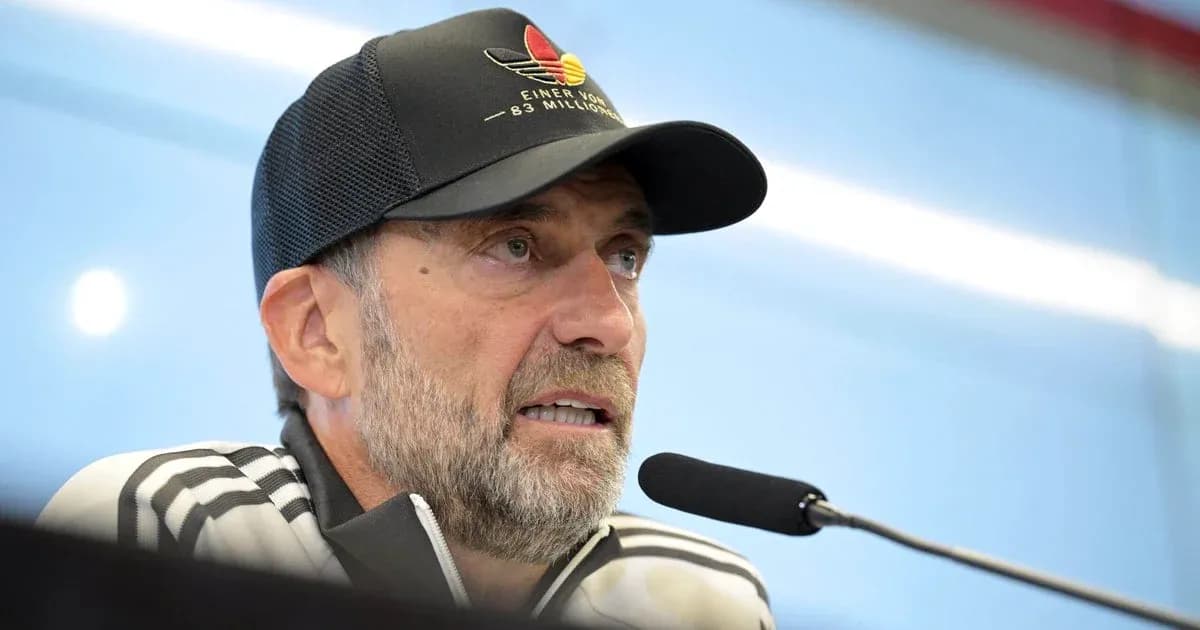
If the football decisions were bold, Klopp’s appearance at the press conference was just as pointed.
On his head: a baseball cap in the colours of the German flag, emblazoned with the words “one of 83 million”.
It was impossible to miss. It was not meant to be.
Germany is in a tense political moment. The far-right Alternative für Deutschland (AfD) recently won more than 43 per cent of the vote and a majority in the Saxony-Anhalt state election, the latest marker in their rise, particularly across parts of East Germany but increasingly beyond it.
Klopp’s cap landed directly in that context.
He used his time in front of the microphones to call for unity. He spoke about wanting to reclaim the flag, about national pride not being left “to the wrong people”, about football as a space that should create a sense of community and make people feel better. He stressed how proud he feels to do this job, and how important it is that people embrace that shared experience.
The symbolism runs deeper than a slogan on a cap. In Germany, questions of patriotism, flags and national symbols remain complicated. The legacy of national socialism hangs over every discussion. As the country becomes more diverse and wrestles with multiculturalism, any expression of national pride can be read in very different ways — or seized upon by those with far darker intentions.
That is the backdrop Klopp walks into: a federal state built from regions with their own identities, now pulling in different directions over what Germany is and what it should become.
So his cap carried a clear significance. It was a quiet but deliberate answer to a louder, harsher political mood — a reminder that the national team, and the flag above it, belong to all 83 million, not just those shouting the loudest.
Now comes the real test: can his football do the same job?