France's World Cup Exit: A Quiet End to an Era
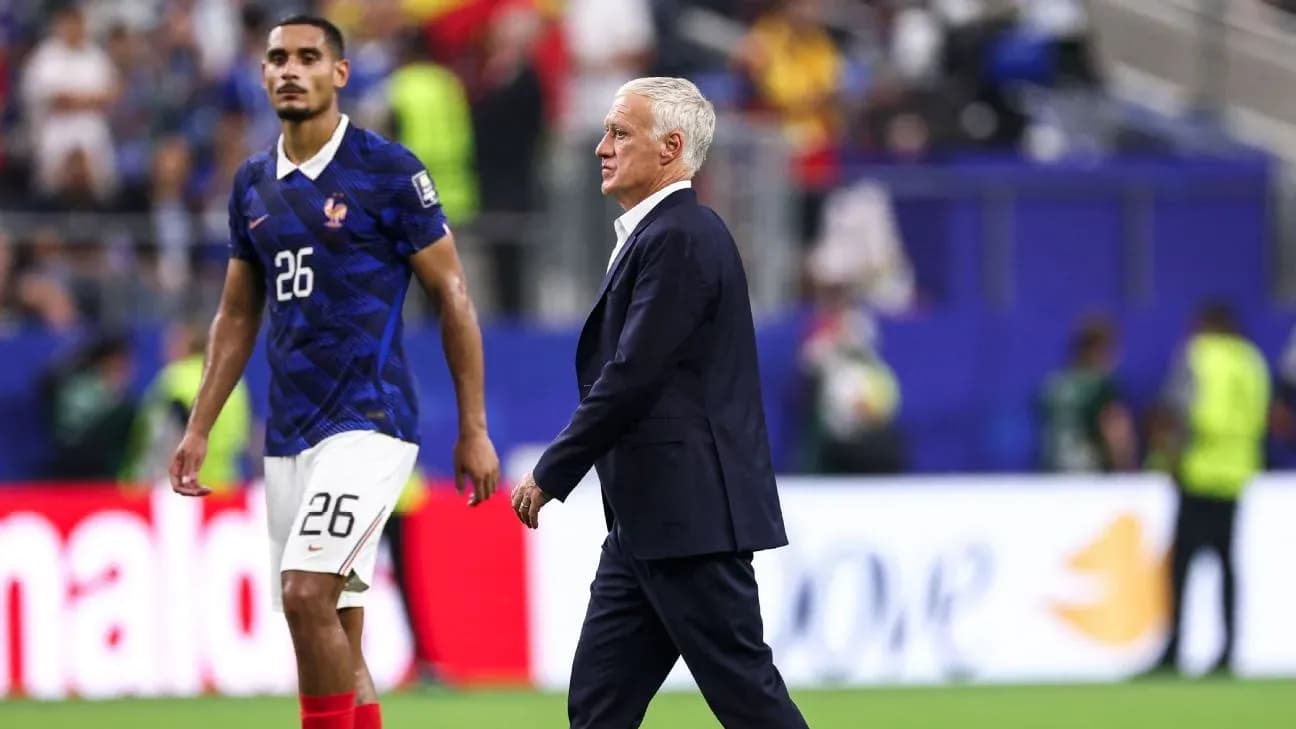
ARLINGTON, Texas — The end came quietly for France. Too quietly for a team this gifted, this heavily backed, this sure of its own superiority.
They arrived at this World Cup as favorites and carried that weight with a certain inevitability, never once trailing in the tournament. Then Spain walked into Jerry Jones’ vast Texas palace, landed the first real punch, and France never stood back up. A 2-0 defeat in the semifinal, but the scoreline felt almost merciful.
It wasn’t just a World Cup run that died here. It was an era.
Fourteen years, 184 games, three major finals and a UEFA Nations League title — Didier Deschamps’ reign with Les Bleus ends with a whimper, not a roar. A man who came within one Randal Kolo Muani miss of joining the most exclusive coaching club of all — two-time World Cup winners — walks away after a performance that left his own supporters counting down the minutes to the Zinedine Zidane chapter.
The most talented squad, the softest exit
Losing to Spain is no disgrace. This Spain side is stacked, drilled, and ruthless. But the way France went out? That’s the bruise that will linger.
Top to bottom, France had the most gifted squad at this World Cup. Yet for 64 minutes, their much-hyped front four produced 0.04 expected goals. That isn’t just poor. It’s almost non-existent. Spain controlled the ball, controlled the tempo, controlled the spaces. France, for all their talent, barely laid a glove.
This wasn’t a one-off tactical ambush either. Luis de la Fuente has now beaten Deschamps three times in three years — at Euro 2024, in the 2025 Nations League thriller that finished 5-4 after Spain had led 5-1, and now here on the biggest stage. At some point, it stops being coincidence and starts looking like a pattern. Bespectacled, bald, bearded kryptonite, if you like.
Spain’s plan was no secret. They would dominate possession, stretch France, and work the ball into dangerous areas. The question was always on the other bench: would Deschamps adapt?
Kylian Mbappé had already flagged the issue. France were effectively playing two against three in midfield. The options were obvious — adjust the shape, add a midfielder, press higher, or sit deeper and counter with more structure. Instead, Deschamps doubled down on the idea that his stars would sort it out. Same shape, same hierarchy, same belief that superior talent eventually bends the game in your favor.
It never did.
When talent doesn’t touch the ball
Deschamps’ managerial philosophy has always been clear and, for the most part, brutally effective. Keep the dressing room happy. Keep the tactics simple. Trust your best players to win the key moments. It worked when he lifted the World Cup as a player in 1998 alongside Zidane, Patrick Vieira and Thierry Henry. It worked again from the bench in 2018 and took him to another final in 2022.
In a low-scoring sport, the logic is sound: overcomplicate things and you risk strangling your own talent. Many coaches subscribe to the same idea.
But that approach has a fatal flaw when you run into a side like Spain. If the opponent takes away the ball and the space, your stars become just names on a teamsheet. When you’re chasing shadows, Michael Olise isn’t a difference-maker; he’s just another body trying to get close to the ball.
That’s the moment a coach has to intervene. To change the angles. To alter the rhythm. To disrupt the opponent’s comfort.
Deschamps never really did. His substitutions — Manu Koné for Adrien Rabiot, Désiré Doué for Bradley Barcola — felt pre-programmed rather than inspired, the tactical equivalent of predictive text. On a good day, that kind of continuity calms a team. On a night like this, it simply extended the suffering.
His loyalty cut both ways. Rabiot, a constant in his plans. Olise, enduring a nightmare but kept on. These are the same instincts that built a decade of stability and success. They also helped usher in this meek exit with arguably the most explosive attacking pool he has ever had.
The tools that made Deschamps the most successful coach in French history ultimately turned against him.
Enter Zidane, with questions attached
Now the conversation turns to Zidane. It always was going to, sooner or later.
His CV glitters: three UEFA Champions League titles, two LaLiga crowns, a résumé forged in the pressure cooker of Real Madrid. He managed superstars, soothed egos, and found ways to keep winning in the harshest spotlight the club game can offer.
But the Zidane France are about to get is not the Zidane who walked into a dressing room every morning at Valdebebas. He hasn’t coached at all for five years. His last trophy came in 2020. And his entire managerial experience has been in one place, at a club that lives by its own rules.
At Madrid, if a player doesn’t fit, you ask for another one. At international level, you live with what your country produces and what your calendar allows. You don’t see your squad every day. You don’t get endless reps on the training pitch. You work in bursts, in windows, in tournaments.
That changes everything.
There is a temptation to assume Zidane will be a slightly more elegant version of Deschamps: a motivator who keeps things simple, trusts the stars, and lets their quality decide the rest. He was Deschamps’ teammate for France and Juventus, and he too avoided tactical pyrotechnics in Madrid.
That’s not necessarily a problem. Deschamps’ “simple but solid” model brought a World Cup and two more finals. But this semifinal should serve as a warning flare for Zidane. There are nights when you can’t just send out your best players, fire them up, and expect the gap in talent to carry you home.
Sometimes balance is the star. Sometimes the structure wins the game.
Zidane knows this better than most. He won a World Cup with Stéphane Guivarc’h leading the line, hardly a galáctico. He thrived in teams where the collective platform allowed individual brilliance to shine at the right moments, not all the time and not everywhere.
The lesson from Arlington
If Zidane was watching from afar, the message from Arlington was stark: when the technical gap between two nations is small, the collective can strangle the individual. Spain didn’t just outplay France; they suffocated them, position by position, zone by zone.
He will inherit a squad overflowing with attacking options and a talent pool that keeps regenerating. He will also inherit the expectations Deschamps helped create — that France should arrive at every major tournament not just as contenders, but as the standard.
Match Deschamps’ record, and Zidane will have done well. Surpass it, and he’ll have redefined what success looks like for a national team already living near the summit.
The next step is his.