Tuchel and Bellingham's Dynamic Ahead of England's Semi-Final
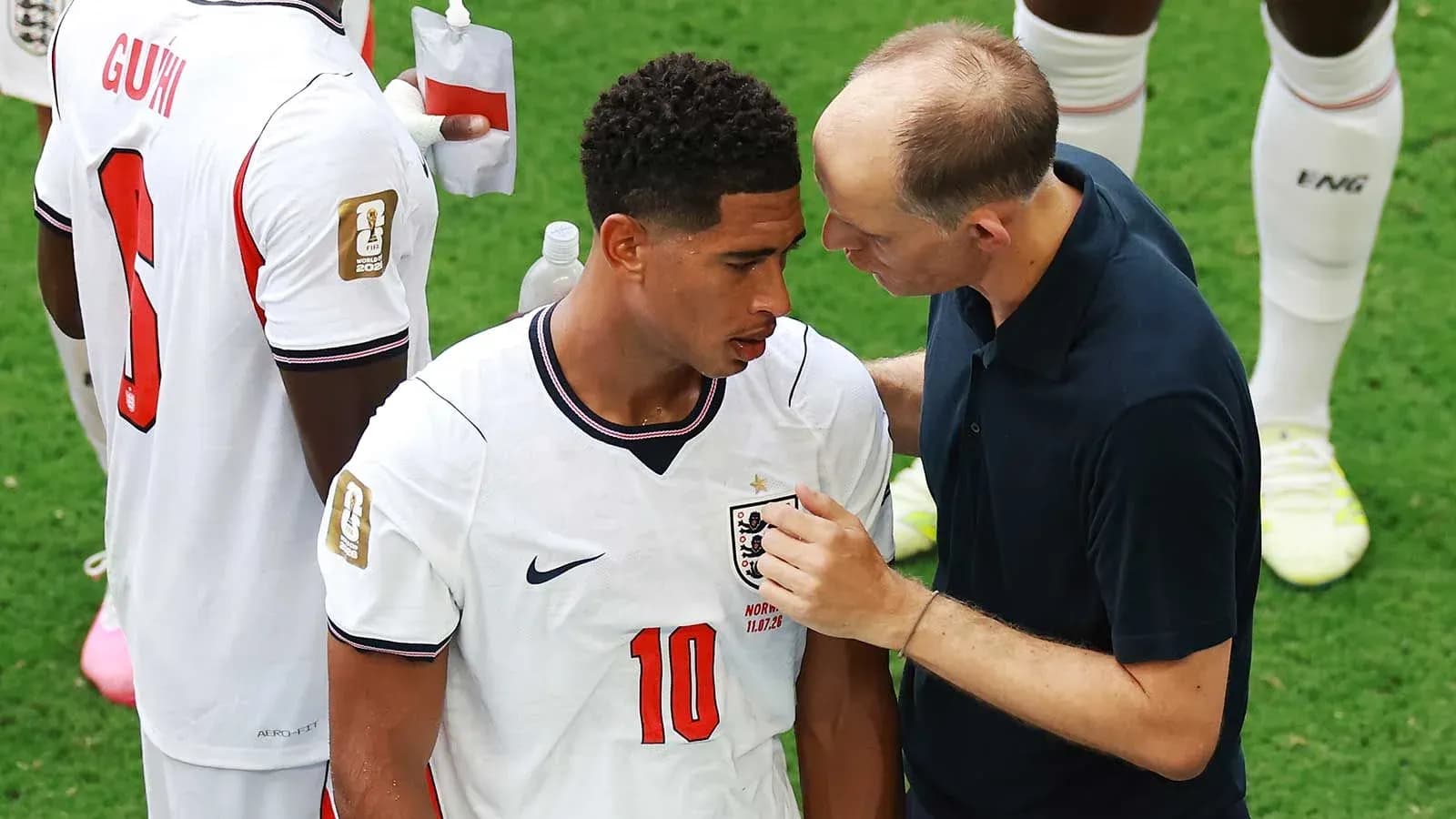
Thomas Tuchel walked into England’s semi-final week with a smile on his face and a storm swirling around his star midfielder.
The German’s relationship with Jude Bellingham has been pored over ever since Tuchel’s mother labelled some of the midfielder’s on-pitch behaviour “repulsive” last summer. An apology followed, the pair pushed on, and the story seemed to die.
It is very much alive again.
After England’s gruelling 2-1 extra-time quarter-final win over Norway, Tuchel cut a frustrated figure. The result was there, the performance wasn’t. He said so. “Not happy with the team performance,” was his blunt verdict, even on a night when Bellingham once again emptied the tank.
Bellingham did not let it slide. He called for more positivity in the aftermath, a pointed response that instantly reignited questions about the dynamic between England’s head coach and his talisman.
Tuchel, aware of the noise, moved quickly.
He gathered the squad the following day, determined to kill the narrative before it grew legs ahead of the semi-final against Argentina. Air cleared, grievances aired, the message was simple: this is not a crisis.
“I wonder who blows these things up, eh?” he told talkSPORT. “There is nothing to blow up and if it’s blown up, it’s blown up in the media, of course.”
The coach did not hang Bellingham out to dry. Far from it. He leaned into the reality of what 120 minutes in a knockout tie does to a player’s body and head.
“What do you expect of a player that just played 120 minutes and gave literally everything,” Tuchel said, before explaining how a few clipped lines can twist the meaning of his post-match assessment. Strip away the praise, highlight the word “sloppy”, and the reaction is almost inevitable.
“If you just cut all this and tell him, ‘oh, your coach said you were sloppy’ what do you expect?” Tuchel asked. “Of course you get the comment that you get and then you try to blow it up and people try to create misunderstandings and cracks where no cracks are.”
That was the theme: same side, same edge, same competitiveness. Tuchel insisted their shared intensity is the very thing that binds them.
“We come from the same place. We come from being competitive and I am a competitive coach. I push this team to the limit and that was my assessment.”
He also took aim at the way the question was framed to Bellingham in the flash interview, suggesting the midfielder was effectively invited to bite back.
“I think the question was unfair in this moment towards Jude because he cut all the compliments out of my assessment and just asked about the critical points, so I can understand. What do you expect of a player that just gave everything and stands there in front of a microphone in a flash interview?”
Bellingham, for his part, had sharpened his own words. In his post-match comments, he appeared to jab at Tuchel’s modest playing career, saying “maybe he doesn’t know what it’s like to play in those kind of conditions” or to face someone of Erling Haaland’s level.
For some coaches, that would sting. For Tuchel, it was another line in a debate he has heard for most of his career: can a man who never played at the elite level truly command a dressing room full of superstars?
He brushed it away.
Tuchel rejected any suggestion that his lack of a glittering playing past weakens his authority. He is adamant the bond with Bellingham, 23 and already the heartbeat of this England side, remains strong despite the exchange.
“It’s just what it is but we’re as close as ever, and close more than ever before,” he said. “You can see that on the field. The energy and mentality in camp is excellent in the last days and we are ready to go for it tomorrow.”
That closeness has been forged on an unlikely journey. Tuchel still speaks like a man slightly surprised to find himself in one of the sport’s most scrutinised jobs.
“I would still like to have a player’s career, that was my dream,” the former Chelsea boss admitted. “I never thought about being a coach, never dreamt about being a coach on that kind of level, so I think this is basically the dream. I just feel also on the sideline very humbled, and from time to time it just strikes me on the sideline right before the match ‘I couldn’t play here on this occasion.’”
The humility does not extend to his tactical conviction. On that, he is unflinching. You do not need to have been a star to understand the game, to shape it, to win at the highest level.
“I don’t think that you have to play [to be a coach],” he said, before reaching for a line he clearly enjoys. “A funny quote, you don’t have to be a horse to be a good jockey!”
So England march towards Argentina with a coach who never made it as a player and a midfielder who looks born for the stage. The friction between them is real, but so is the respect.
The next 90 minutes – or 120 – will show whether that edge becomes England’s greatest weapon or their most dangerous fault line.