France vs England: A Bronze Match Nobody Wanted
Nobody grows up dreaming of the third-place playoff. It is the game both sides spend a month trying to avoid, the consolation prize that only starts to matter once the whistle blows. Yet on Saturday, in the World Cup 2026 bronze match, France and England arrive with pride wounded, reputations bruised, and questions swirling around two of the most scrutinised managers in international football.
France’s favourites tag was torn up by Spain in a controlled 2-0 semi-final in Dallas. A day later in Atlanta, England’s renewed optimism under Thomas Tuchel was stripped bare by Lionel Messi and Argentina in a 2-1 defeat that felt depressingly familiar.
Now they meet again, not for a trophy, but for a reckoning.
Deschamps’ Last Stand
When Didier Deschamps walked out to face Spain, he did so as the man who had just broken the record for most World Cup matches managed. Ninety minutes later, he walked away as a departing coach whose final big call had backfired.
He had been candid in the build-up, publicly labelling Spain as favourites. On the pitch, La Roja lived up to the billing. They summoned echoes of their Euro 2024 and Nations League victories over the French, calmly accepting Deschamps’ challenge and dissecting his side with ruthless clarity.
Mikel Oyarzabal’s precise penalty opened the door. Pedro Porro, one of the tournament’s standout performers, slammed it shut with a crisp finish. France, once bristling with attacking menace, mustered just 0.31 Expected Goals. Kylian Mbappé, shackled and short of inspiration, cut a frustrated figure as Spain’s back line won a contest billed as defence against attack with something close to ease.
Deschamps’ legacy as a World Cup coach remains formidable, but the consensus was brutal: he got this one wrong. Even Mbappé publicly questioned the tactical approach in the immediate aftermath. For a manager who never planned to be on the touchline for a third-place playoff, this is a harsh final assignment.
Yet there is still history to chase. France can secure a third World Cup bronze from four attempts. They beat Belgium 4-2 in 1986 to climb onto the podium and demolished West Germany 6-3 in 1958, when Just Fontaine scored four in one of the great individual World Cup performances. Only in 1982, when they finished fourth behind Poland, did they fall short at this stage.
For Deschamps, it is one last chance to leave with a medal, not just a debate.
England’s Familiar Agony
Across the touchline stands another coach under fire. Thomas Tuchel arrived in this tournament as a fresh start for England, a tactician of Champions League pedigree tasked with pushing the Three Lions into the game’s inner circle. Instead, the semi-final defeat to Argentina reopened old wounds.
England started well. They refused to be dragged into Argentina’s chaos, stayed calm under provocation, and exploited the champions’ vulnerability out wide. Anthony Gordon’s goal, slicing in from the flank, rewarded that plan and briefly lit up English belief.
Then came the retreat.
Tuchel’s side sank into a deep, stubborn block and dared Messi to find a way through. He accepted. The eight-time Ballon d’Or winner slipped into the role of tormentor-in-chief, threading passes for Enzo Fernandez and Lautaro Martinez as Argentina turned the match on its head.
It was a familiar story. Since 2018, England have talked about joining the true elite; the numbers keep saying otherwise. They have now lost all seven of their World Cup knockout ties against nations ranked in the world’s top 10. They also hold an unwanted record: the only team this century to lead in a World Cup semi-final and still go out — and they’ve done it twice, against Croatia in 2018 and now Argentina.
The Football Association’s decision to extend Tuchel’s contract, once seen as a bold show of faith, is suddenly under forensic inspection.
A bronze medal would technically be England’s second-best men’s World Cup finish, behind 1966. Yet their history with this fixture is bleak: beaten 2-0 by Belgium in 2018, edged 2-1 by Italy in 1990. Another fourth place would feel painfully on-brand for a nation that keeps reaching the latter stages, then falling short when the opposition becomes truly elite.
France’s Injuries and One Last Shuffle
France’s preparation for this playoff has been complicated by the sight no French or Arsenal supporter wanted to see. “My back is gone, my back is gone,” William Saliba reportedly said as he limped off in the first half against Spain, his long-standing back issue flaring up at the worst possible time.
No formal medical update has been issued, but the odds of him featuring on Saturday are negligible. Maxence Lacroix, who came on for Saliba in Arlington, is expected to start. Deschamps initially preferred Lacroix to Ibrahima Konaté because Konaté was “not at his best” and less comfortable on the left side of central defence. That equation may change now, with Dayot Upamecano also vulnerable to rotation as Deschamps tweaks his final XI.
There was another scare in training when backup goalkeeper Brice Samba picked up a knock, but Mike Maignan was always set to keep his place in goal.
France are still likely to send out a strong side, with Mbappé leading a front line that has misfired in the knockout rounds but remains capable of detonating at any moment. Young talents such as Warren Zaïre-Emery, Rayan Cherki, Michael Olise and Désiré Doué offer Deschamps a blend of flair and unpredictability for his farewell match.
England’s Defensive Headache and Bellingham Cloud
Tuchel has his own defensive problems. Reece James, a magnet for misfortune, left the semi-final with yet another muscular issue, just a week after returning from a hamstring injury. His World Cup ends with a familiar sense of “what if”.
Jarell Quansah is available again after a two-game suspension and could come into the back line, but the likelier reshuffle sees Djed Spence — one of England’s brightest performers in recent games — switching flanks. That would free Nico O’Reilly to return to the left side of the defence.
Jordan Henderson remains out with a wrist injury, though the rest of the squad is fit. Tuchel is expected to go strong, both to chase a statement result and to avoid walking away under an even darker cloud.
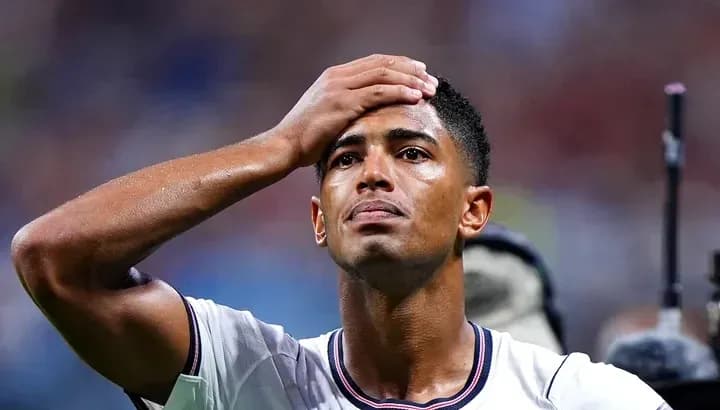
One shadow still lingers: Jude Bellingham faces the threat of a ban after cameras caught him slapping the back of Valentin Barco’s head during Argentina’s post-match celebrations. Any disciplinary action would be a late and significant twist for England’s talismanic midfielder.
On the pitch, England are likely to lean again on the core that pushed them to the last four: Declan Rice anchoring midfield, Bellingham driving from central pockets, Gordon and Morgan Rogers attacking from wide areas, and Harry Kane as the reference point up front.
The Match-Up: Blueprint vs Vulnerability
Spain have just shown the world how to suffocate France’s attack. England, though, are no Spain. Their World Cup knockout record underlines that reality, and they have not kept a single clean sheet in the knockout phase of this tournament.
France, crucially, also benefit from an extra day’s rest, both physically and emotionally. That matters at the end of a long, draining month. Deschamps’ players have been here before, used to the weight of latter-stage pressure, used to recovering from disappointment and going again.
England, by contrast, are still learning how to turn near-misses into something more substantial. The scars of another semi-final collapse are fresh, and another defeat to a major European rival would deepen the sense of a cycle repeating itself.
On balance, France look better placed to summon one last performance. Their depth, their experience, and the desire to send Deschamps out with a medal tilt the scales.
Prediction: France 2–1 England.
If that proves accurate, Les Bleus will step onto the podium once more, while England trudge away with another fourth-place finish and a familiar question hanging over them: how many more chances can this generation afford to waste?