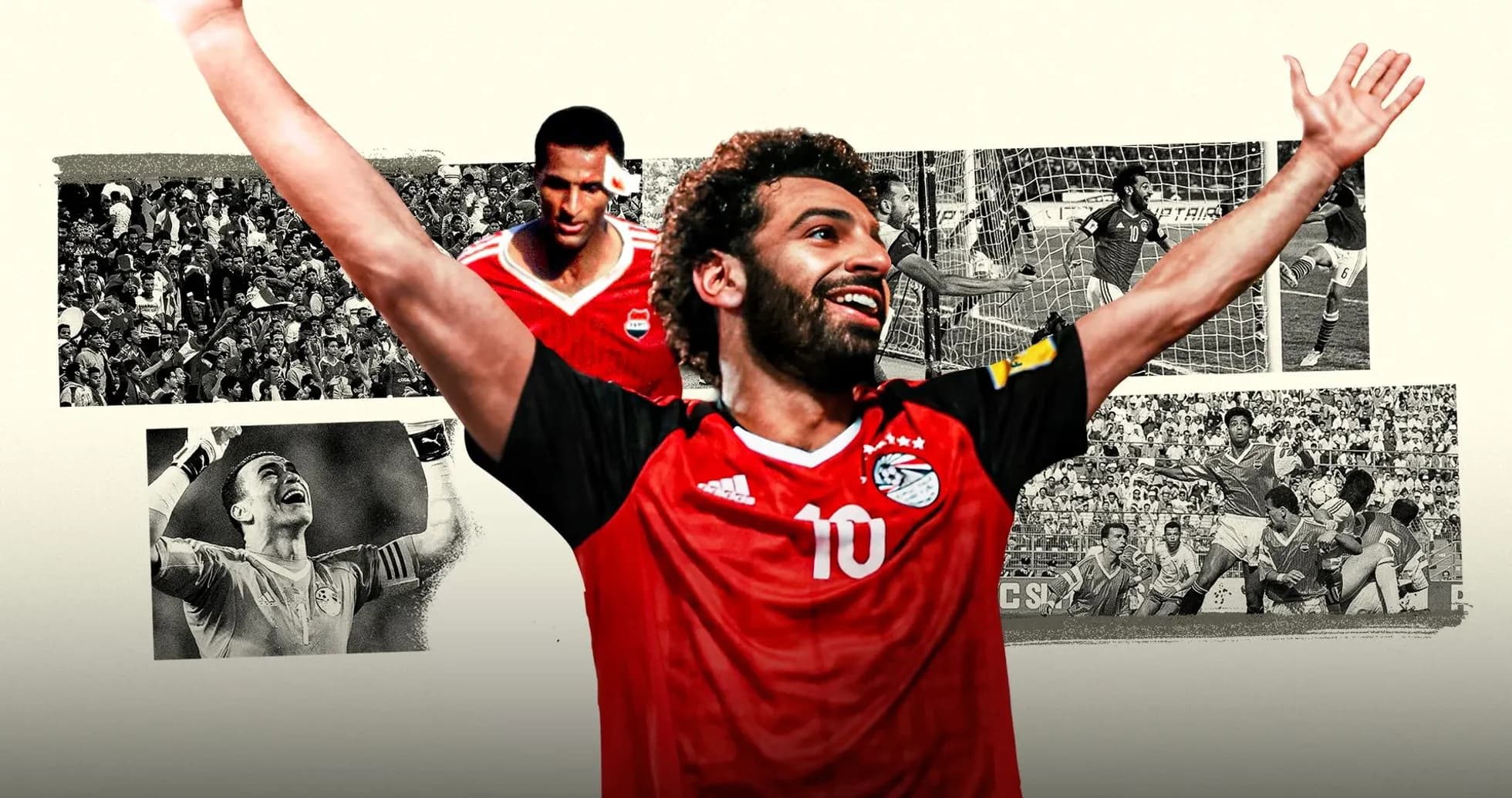
Egypt's Journey to World Cup Glory: From 1934 to 2026
It starts in 1934, in another age entirely. No television glare, no slow-motion replays, no phones held aloft. Just a radio, hissing and crackling, fighting through the static to carry broken sentences across Cairo’s alleys – and a small, stubborn dream burning in the hearts of 11 Egyptian players.
Egypt’s national team sailed to Italy that summer to become the first Arab and African country ever to reach a World Cup. The voyage was long, the ship old, the conditions basic. None of it mattered. They had already beaten Palestine to qualify. They were on the way to the world’s stage.
In Rome, they ran straight into Hungary, one of Europe’s great powers. Egypt lost 4-2, but Abdelrahman Fawzi struck twice and carved his name into history as the first African to score at a World Cup.
Back in Cairo, people crowded around radios in narrow streets, straining to hear every word. When the news of Fawzi’s goals came through, they clapped, they laughed, they cried. Pride, a new kind, washed over them. That was the moment the dream stopped being a fantasy and became a promise.
Then came the silence.
War swallowed the continent and the crack of gunfire drowned out the sound of the game. Egypt rebuilt itself brick by brick, and the World Cup became something distant again, followed only through the ink of newspapers and the imagination of readers.
Generations of players rose and fell. Saleh Selim, Taha Ismail, Hassan Shehata, Mahmoud El Khatib – giants of the African game. On their own continent, Egypt ruled. AFCON titles, legendary nights, a reputation forged in finals. But the World Cup remained that unreachable star, visible yet always out of reach.
Until 1990.
After 56 years away, the Pharaohs finally forced the door open. Under Mahmoud El Gohary’s stern gaze and steady hand, Egypt clawed their way through brutal qualifiers. One moment lit the fuse: Hossam Hassan’s goal against Algeria, the strike that shattered the glass ceiling.
That November night, the country erupted. Streets overflowed. Flags poured out from balconies. Car horns and chants fused into one deafening roar that climbed into the sky. Egypt were going back to the World Cup. The dream had survived.
June 1990. Italy again, this time Palermo. Egypt, back on the biggest stage, stared down the European champions, the Netherlands. For 45 minutes, they held firm. No goals, no fear.
Then came the 58th minute. A cross from Marco van Basten, a finish from Wim Jonk, and the Dutch led. It should have been the cue for the underdogs to fold.
Instead, the game tilted.
In the 83rd minute, Hossam Hassan burst into the box and went down. The referee pointed straight to the spot. A nation held its breath.
Magdy Abdelghany walked forward, placed the ball, drew in a deep breath and hit it with everything he had. The net bulged. The commentator exploded: “Goal for Egypt!” In that instant, Abdelghany etched himself into folklore. Years later, he would joke about it endlessly, retelling the story as if it were Egypt’s only footballing achievement. People laughed. They also never forgot.
That goal was more than a statistic. It was a bridge – from Fawzi to Abdelghany, from 1934 to 1990, from one generation’s dream to another’s reality. The match finished 1-1, but in Egyptian hearts, it felt like a win.
Ireland came next. Ninety minutes of tension, sweat, and shouting. Egypt dug in. Every tackle had a roar behind it. Every clearance carried weight. In goal, Ahmed Shobeir turned into a one-man barricade, saving everything as if his career, and his country’s reputation, depended on it.
He also turned time into a weapon. His deliberate, provocative time-wasting became infamous. Around the world, fans pointed to that game when they spoke about FIFA later bringing in the back-pass rule. Whether or not it truly sparked the change, the match ended 0-0 and felt, once again, like a triumph.
The world took notice. “Who are these Africans fighting like lions?” people asked. Headlines called them “The solid Egyptian team”. A label earned, not gifted.
Then came England. A relentless, suffocating contest. Egypt bent but refused to break – until a single goal condemned them to a 1-0 defeat. It stung, but El Gohary refused to frame it as failure.
“We’ve planted the seed today… Someone will harvest it tomorrow,” he said.
Decades later, that “someone” had a name.
Mohamed Salah. A boy from Nagrig, carrying a nation’s hopes on skinny shoulders. From Al Mokawloon to Basel, Chelsea to Fiorentina, Roma to Liverpool, he climbed step by step, each move a chapter, each goal a line in a story that Egypt followed like scripture.
In the 2018 World Cup qualifiers, he became more than a star. He became a lifeline. His goals dragged Egypt back from despair, his performances stitched belief into a country that had grown used to heartbreak.
Then came that night at Borg El Arab.
Egypt needed a win against Congo. The clock hit stoppage time with the score locked at 1-1. Commentator Medhat Shalaby’s voice cracked with urgency: “Give us something, ya akhi!” Attack after attack crashed against Congo’s defence. Anxiety turned to desperation.
In the 94th minute, Trezeguet went down in the box. Penalty. Shalaby screamed: “Allahu Akbar!” The stadium shook.
Salah took the ball. No one else. He placed it on the spot, allowed himself the faintest smile, then struck. The net rippled. The roar that followed rattled Alexandria and rolled across the country. Streets flooded with people. Strangers embraced. Children cried from pure joy.
After 28 years, Egypt were going back to the World Cup.
One month before Russia 2018, another stage awaited Salah. Kyiv lit up for the Champions League final: Real Madrid vs Liverpool. The “Egyptian King” chant echoed through the streets. Cameras tracked his every step. Commentators marvelled at his record-breaking Premier League season. This was supposed to be his coronation.
Then everything collapsed in a single tangle.
Midway through the first half, Salah grappled with Sergio Ramos and crashed to the turf. He clutched his shoulder, face twisted in pain. He tried to rise. He couldn’t. Tears replaced grimaces as he walked off.
In Cairo, noise died. Cafes fell silent. Screens glowed over frozen faces. Children who had danced to his goals sat motionless. It felt as though all of Egypt had fallen with him.
Weeks later, he came back. Injured, strapped, but unbroken. He went to Russia and sent a message to the world: “Bodies may fall… But dreams never do.”
Egypt’s return to the World Cup, though, began with another cruel twist. Against Uruguay in their opening match, Salah started on the bench, his shoulder still not right. His teammates fought like a team determined to rewrite history. They defended bravely, countered with intent, and looked more likely to score.
Then, in the 89th minute, Uruguay struck. A late goal, a gut punch. The performance promised more; the result said otherwise.
The country clung to one refrain: “When Salah returns, everything will change.”
He started against hosts Russia in Saint Petersburg, smiling in the line-up, but his body still carried the scars of Kyiv. Egypt fell three goals behind before Salah earned and scored a penalty. The net shook, but the tournament was already slipping away. Elimination arrived with a game to spare.
In the final group match against Saudi Arabia, Salah scored again. Egypt lost again. Three games, three defeats, no points. The Pharaohs left Russia with their pride bruised and their questions piling up.
The next chapter was harsher still.
AFCON 2019 on home soil should have been a celebration, a catharsis. The same generation that had brought Egypt back to the World Cup now had a chance to lift a trophy in front of their own people. Instead, the story turned sour. South Africa stunned them in the last 16. Cairo, which had prepared for a month-long party, fell into stunned silence.
Two years later, in Cameroon, the script changed tone, not cast. Egypt’s performances at AFCON 2021 weren’t always pretty, but something inside the team had shifted. Grit replaced glamour. Salah led a side that played with heart, not just reputation.
They lost their opening game to Nigeria. They responded by knocking out Ivory Coast, then Morocco, then hosts Cameroon. Three heavyweights. Three battles won on willpower and nerve.
The final against Senegal went to penalties. For the third time in the tournament, Egypt stood on the spot, their fate in the hands of their takers and their goalkeeper. This time, the shootout ended before Salah could even walk forward. Senegal triumphed. Egypt’s captain watched his chance vanish from the edge of the centre circle.
Weeks later, the same opponents, the same stakes, a different prize: a ticket to the 2022 World Cup. Again, the tie went all the way to penalties. This time, Salah did step up.
Lasers flashed across his face from the stands, green beams cutting through the dark. He looked calm, shoulders loose, eyes fixed. Then he struck. The ball flew high, over the crossbar and into the night.
Egypt froze. The dream of another World Cup disappeared in a heartbeat. Yet even in that moment, something held. You don’t erase a century of belief with one missed penalty.
Attention turned to the 2026 qualifiers. Salah was still there, still the leader, but he was no longer alone. Around him gathered a new generation – players who had grown up watching him on television, then sharing a dressing room with him, now passing him the ball in real time.
They didn’t see a distant superstar. They saw an older brother.
From the first game against Djibouti, the difference was obvious. Egypt played with structure and hunger. No fear, no hesitation. Salah kept scoring, but Omar Marmoush and Ahmed Sayed “Zizo” lit up the flanks, adding speed, flair and unpredictability.
On the touchline, Hossam Hassan prowled like a man who had waited his whole life for this job. He barked orders, waved his arms, lived every tackle and every sprint. “Press! Don’t back down!” he shouted. This wasn’t just coaching. It was a restoration.
He brought back something Egypt had lost: an identity. The fear drained away. Young players who had once idolised Salah from afar now combined with him without deference, only ambition.
Game after game, the unbeaten run grew. Ten qualifiers, eight wins, two draws. No panic, no late collapses. Egypt topped their group with a calm that spoke of maturity rather than arrogance.
At full-time of the final qualifier, Hassan didn’t sprint onto the pitch or punch the air. He stood on the touchline and smiled quietly. The first mission was complete. The players celebrated, but without wild excess. Their body language said it clearly: this was a step, not a destination.
Now the stage shifts again.
All eyes turn to the World Cup, where Egypt will arrive not just to make up the numbers, but to test whether nearly a century of dreams can finally be converted into something tangible. Hossam Hassan is already plotting. Mohamed Salah has already promised the fans: “This time, it won’t just be about taking part.”
The question is no longer whether Egypt belong at this level. It’s how far they dare to go.