
Declan Rice: England's Indispensable Midfielder
Aaron Cresswell calls Declan Rice “a freak of nature”. It sounds like a throwaway line, the sort of dressing‑room compliment players trade all the time. It isn’t. Not when you look at the numbers.
Since the start of the 2020‑21 season, Rice has played 360 games. Club, country, Europe, finals, title races – the lot. West Ham’s European adventures in 2022 and 2023, England’s endless churn of qualifiers and tournaments, Arsenal’s tilt at the Premier League and Champions League since he arrived. Four years of being the first name on almost every team sheet.
The temptation, always, is to keep asking for more.
A rare off‑day in the middle of chaos
Against Croatia in England’s wild 4-2 World Cup opener, the bill for that workload seemed to arrive.
This was Rice’s 63rd appearance of the 2025‑26 season. He looked it. England’s midfield, usually anchored by his authority, lost its bearings. The distances were wrong. The gaps were huge. The partnership with Elliot Anderson never settled; too often, Rice found himself dropping onto the toes of his centre-backs, leaving space for Luka Modric to pull him around and pull England apart.
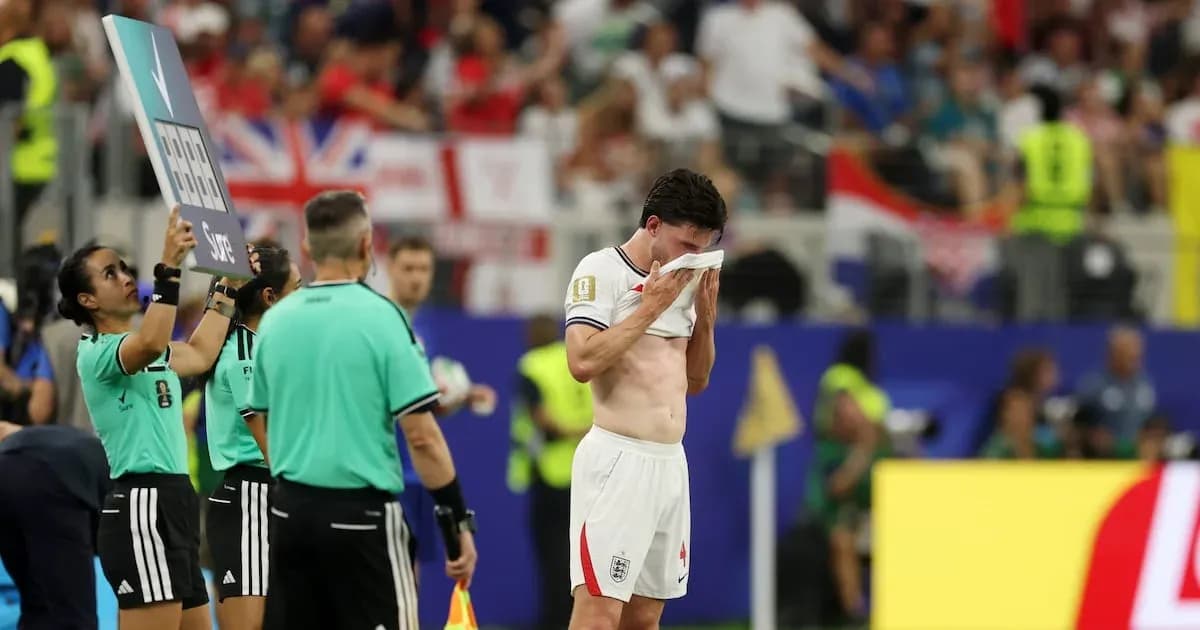
Thomas Tuchel can adjust the structure. He has to. But the tactical issues quickly gave way to a more worrying sight: Rice signalling that he could not continue.
With England 3-2 up and Croatia surging, Tuchel took off his vice‑captain in the 72nd minute. Under normal circumstances, that is unthinkable. This is the player you lean on when the game turns frantic, the one who thrives when the tackles fly and the ball keeps coming back. This time, he walked off, feeling discomfort in his lower back and upper hamstring.
Tuchel described the change as precautionary. Rice, true to type, was quick to insist he will be available to face Ghana on Tuesday. England cannot simply accept that at face value. Not now.
England’s dependence problem
The uncomfortable truth for England is that they do not function well without Rice. The evidence of the past six years is clear enough. When he is missing, they rarely look the same side, and this squad does not contain a like‑for‑like replacement.
Tuchel’s post‑match verdict – “Declan had some unusual ball losses” – was a polite way of acknowledging that Rice was nowhere near his usual level. Even so, England still looked more secure with him on the pitch than without him. Take him out entirely and the dilemma becomes brutal.
Kobbie Mainoo offers calmness and quality in possession, but he does not yet have Rice’s frame, his aerial presence, his set‑piece threat or his sheer defensive reach. Jordan Henderson brings experience and organisation, but at 36 he was overlooked when England wanted to keep the tempo high against Croatia. If Tuchel trusted him in that kind of game, he would have turned to him then.
So the coach went searching for something different.
Bellingham’s brief audition – and a Chelsea solution
Tuchel’s first move after withdrawing Rice was to drop Jude Bellingham deeper. On paper, it made sense: Bellingham has the engine, the touch, the personality to run a midfield. On grass, it almost cost England.
The balance disappeared. Croatia found routes through the centre. The experiment lasted eight minutes before Tuchel ripped it up.
Only then did a more convincing Plan B emerge. Djed Spence came on for Bellingham, Reece James stepped infield from right back, and England suddenly resembled a side that might be able to cope without Rice – at least for spells.
James knows the role. He played in midfield on loan at Wigan in 2018‑19 and has spent most of his Chelsea career rampaging down the right. But under Enzo Maresca’s 18‑month tenure at Stamford Bridge, he was pushed permanently into the middle. The idea raised eyebrows at first, not least from Tuchel himself, who had previously insisted he saw James as a right back for England.
Maresca persisted. The reward was there in the Club World Cup final last year, when James helped Chelsea beat Paris Saint‑Germain, and again when he partnered Moisés Caicedo in a 3-0 demolition of Barcelona last November. Five days later, he dominated Rice in a league meeting with Arsenal at Stamford Bridge.
That run of performances forced a rethink. By the time Tuchel named his World Cup squad, the tone had changed.
“Reece James can play in the 6 because he does on a high level for Chelsea,” he said as he justified leaving out Adam Wharton and Alex Scott. Versatility had become a selection principle, and James was central to it.
The reshuffle options – and the catch
If James steps into midfield, Tuchel has cover at right back. Spence can play there. So can Ezri Konsa and Jarell Quansah. One possible configuration would see Konsa tucking in almost as a third centre back alongside John Stones and Marc Guéhi, with Nico O’Reilly flying forward from left back to provide width.
On the tactics board, it works. On the medical chart, it is another story.
James has his own history with hamstring problems. The latest setback came in March and cost him almost two months of the season. Chelsea have had to manage his minutes carefully, picking their moments rather than throwing him into every battle.
England have already lost Tino Livramento to a calf injury, forcing Tuchel to call up Trevoh Chalobah. The season has been punishing for this squad. James is still the first choice at right back, but he cannot start every game and cannot be asked to shoulder Rice’s workload on top of his own.
Tuchel wants flexibility. What he has, for now, is fragility.
A World Cup built on tired legs
The warning signs were there long before a ball was kicked in this World Cup. Fitness concerns stalked Tuchel’s planning. The decision to take England to Florida early for a warm‑weather pre‑tournament camp was rooted in conditioning, in the need to squeeze one more peak out of players who have been running at full tilt for months.
Rice arrived late after playing in the Champions League final for Arsenal. Another high‑intensity occasion, another 90 minutes, another week without proper rest. He keeps pushing, because that is who he is and what his teams demand of him.
But there is always a price.
If England go all the way to the World Cup final and Rice starts every game, he will finish the season on 70 appearances for club and country. Seventy. For a midfielder who covers every blade of grass, makes every press, takes every set piece.
Tuchel cannot control the past four years. He can control what happens next. England’s head coach must now decide how far he dares to push the player his entire system leans on – and how quickly he can turn a theoretical Plan B into something that survives the reality of a World Cup knockout game without Declan Rice at its heart.



