Cremonese vs Torino: Tactical Analysis of a Goalless Draw
Cremonese and Torino played out a goalless but structurally revealing 0–0 at Stadio Giovanni Zini in Serie A’s Regular Season - 33. The hosts imposed themselves territorially and with the ball, yet could not convert their dominance into a breakthrough, while Torino accepted a reactive role, defending deep in a 3-4-1-2 and relying on sparse transitions. The expected goals profile – 0.77 for Cremonese against 0.16 for Torino – underlined a match where the home side carried more attacking weight but rarely created truly clear-cut chances, and the visitors were content to escape with a point after long spells without possession.
The scoring sequence is simple: there were no goals, and the only moment that threatened to alter the scoreboard was erased by VAR. On 64', Federico Baschirotto thought he had given Cremonese the lead, only for the intervention to confirm a “Goal cancelled” decision. The cancellation was pivotal: it came at a time when Cremonese’s pressure was peaking and could have forced Torino to abandon their conservative posture.
Disciplinary action was entirely on the Torino side and clustered in the final quarter of an hour. Saúl Coco received a yellow card for a foul on 78', as Cremonese continued to probe down his side and Torino’s back line was forced into more last-ditch interventions. Two minutes later, at 80', Enzo Ebosse was also booked for a foul, reflecting the strain on Torino’s left as Cremonese pushed higher with fresh legs. In the same 80' minute, Alieu Njie, who had entered earlier, was cautioned for a foul as well, further illustrating the visitors’ increasingly reactive and contact-heavy defending. Cremonese finished without a single card, a useful detail when set against their control of possession and territorial advantage.
Substitutions framed much of the tactical evolution. Marco Giampaolo’s first move came on 60', when D. Okereke (IN) came on for J. Vandeputte (OUT), and A. Zerbin (IN) came on for R. Floriani (OUT). Those twin changes injected pace and directness into both wide channels, signalling a shift from a more structured 4-4-2 to a version with more vertical threat from the flanks. On 73', M. Payero (IN) came on for A. Grassi (OUT), adding a more aggressive, line-breaking profile in central midfield to sustain pressure against a deep Torino block. Finally, on 84', M. Djuric (IN) came on for A. Sanabria (OUT), and T. Barbieri (IN) came on for S. Luperto (OUT), a double change that targeted both aerial presence up front and renewed energy at the back to guard against late counters.
Leonardo Colucci’s adjustments were almost entirely defensive and aimed at preserving compactness. On 68', L. Marianucci (IN) came on for G. Maripan (OUT), and A. Njie (IN) came on for G. Simeone (OUT). The first change refreshed the back three; the second replaced a forward with a more industrious runner, hinting at a shift towards defending space and chasing lost causes rather than constructing attacks. On 76', C. Biraghi (IN) came on for R. Obrador (OUT), and F. Anjorin (IN) came on for N. Vlasic (OUT), with Biraghi reinforcing the left flank defensively and Anjorin offering legs and height between the lines rather than Vlasic’s creative influence. The final Torino change on 90' saw S. Kulenovic (IN) introduced for an unnamed outgoing player, a late, low-risk switch that did not materially change their structure but offered fresh pressing energy for stoppage time.
From a structural standpoint, Cremonese’s 4-4-2 was the platform for dominance. With 65% possession, they built patiently from the back through E. Audero, who was largely untroubled and needed just 1 save all match. The centre-back pairing of Baschirotto and S. Luperto provided a stable base, stepping into midfield when Torino’s front two of G. Simeone and C. Adams failed to apply coordinated pressure. Full-backs F. Terracciano and G. Pezzella pushed high, helping Cremonese to pin Torino back and generate 6 corners to 1.
In midfield, W. Bondo and A. Grassi balanced ball circulation with second-ball control, while R. Floriani and J. Vandeputte initially provided width before being replaced by more direct options. The forwards, F. Bonazzoli and A. Sanabria, operated with varied depth: Bonazzoli often dropping to link play, Sanabria stretching the back line. Yet, despite 14 total shots (4 on target, 4 blocked), many efforts came from outside or semi-contested positions, reflected in the modest 0.77 xG. The structural superiority did not translate into repeated, high-value chances inside the box.
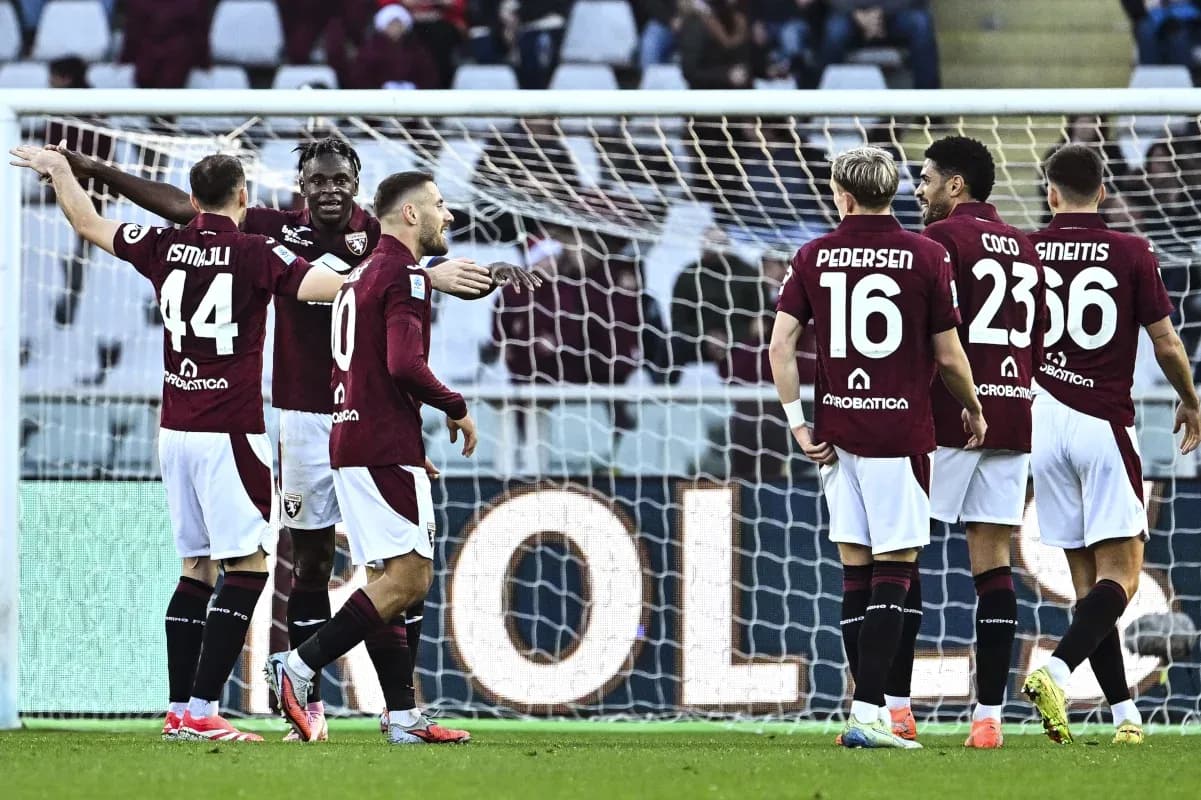
Torino’s 3-4-1-2 was, in practice, a 5-3-2 for long stretches. Wing-backs M. Pedersen and R. Obrador were pinned deep, often forming a back five with Coco, Maripan, and Ebosse. Ahead of them, C. Casadei and G. Gineitis had to cover large horizontal distances to close lanes, with N. Vlasic trying to connect to the front two but frequently isolated as Torino managed only 4 total shots and 1 shot on target. The visitors’ 35% possession and 278 total passes (212 accurate, 76%) highlight their reactive approach.
Goalkeeper A. Paleari was Torino’s key defensive figure, making 4 saves. While the raw xG against (0.77) was not extreme, his interventions were decisive in preserving the clean sheet when Cremonese managed to work shooting positions inside the area. Neither goalkeeper significantly outperformed xG – both sides registered 0 in goals prevented – but Paleari was busier and more central to the narrative of resistance.
Statistically, the verdict is clear: Cremonese were the proactive side, Torino the survivors. The home team’s 495 passes at 84% accuracy and 65% possession underline control, while their 8 shots inside the box show a consistent, if not ruthless, presence in dangerous zones. Torino’s 0.16 xG, 2 shots inside the box, and just 1 corner indicate a side that rarely advanced with numbers.
Disciplinary data further supports the tactical story: Cremonese committed 11 fouls and received no cards, suggesting controlled aggression within their pressing and counter-pressing. Torino, with 12 fouls and 3 yellow cards (all for fouls: Saúl Coco 78', Enzo Ebosse 80', Alieu Njie 80'), increasingly resorted to halting Cremonese’s attacks through contact as fatigue and territorial pressure mounted. In the end, the 0–0 reflects Torino’s defensive resilience more than balance, and for Cremonese it marks a missed opportunity where structural superiority and volume of play did not yield the decisive action in the box.