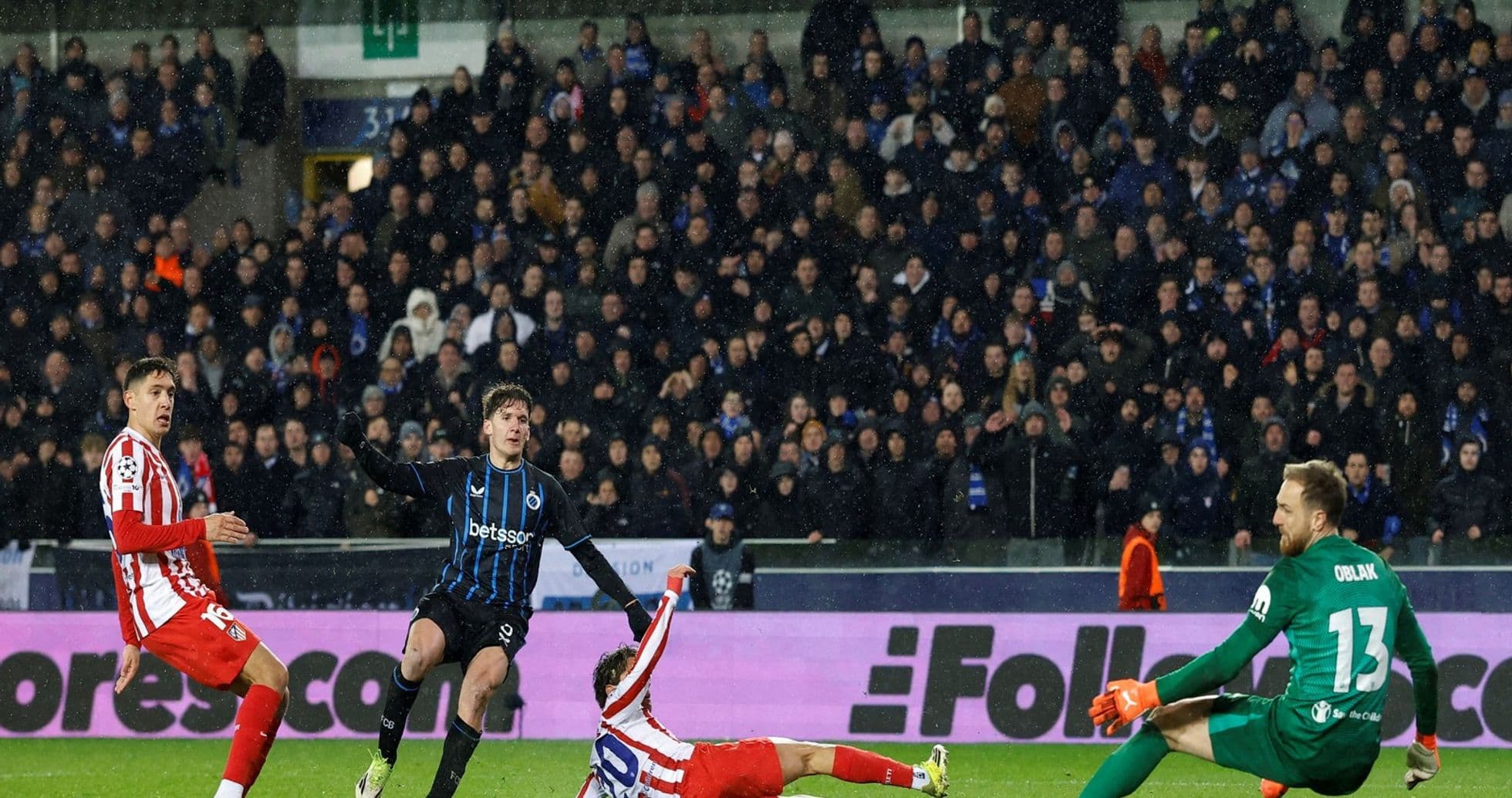
Club Brugge KV 3–3 Atletico Madrid: Late Equaliser by Tzolis
The Jan Breydel Stadium witnessed a breathless UEFA Champions League Round of 32 clash on 18 February 2026, as Club Brugge KV roared back from 0–2 and then 2–3 down to draw 3–3 with Atletico Madrid. Diego Simeone’s side looked in control at half-time, but Ivan Leko’s men produced a stirring second-half response, capped by Christos Tzolis’ dramatic 89' equaliser. The result keeps Atletico slightly ahead in the overall competition standings picture, but Brugge’s resilience reinforces their credentials as dangerous knockout opponents.
First half analysis
Atletico struck early authority through the game’s first major incident. After a VAR check confirmed a penalty for the visitors at 7', Antoine Griezmann’s involvement was underlined, and Julián Alvarez converted from the spot at 8' to make it 0–1. That early breakthrough allowed Simeone’s 4-3-3 to settle, with the experienced midfield trio of Griezmann, Koke and Marcos Llorente giving Atletico a platform.
Club Brugge, in Leko’s 4-2-3-1, were unable to translate their structure into clear first-half goalscoring events in the data, and they went into the break with a mountain to climb. Atletico doubled their lead right on the stroke of half-time: at 45', Ademola Lookman finished a move for 0–2, assisted by Griezmann. With no first-half cards or Brugge goals recorded, the narrative to the interval was of Atletico’s clinical edge in the key moments.
Second half & tactical shifts
The tone changed quickly after the restart. Atletico’s Marc Pubill was booked for a foul at 48', signalling a more intense contest. Just four minutes later, Brugge halved the deficit: at 52', Raphael Onyedika struck for 1–2, set up by Nicolò Tresoldi. That goal energised the hosts, and at 60' Tresoldi himself levelled the match at 2–2, this time assisted by Mamadou Diakhon.
Simeone reacted first. At 62', he withdrew goalscorer Lookman, sending on Alejandro Baena, a like-for-like attacking change aimed at refreshing the front line. Four minutes later, at 66', Griezmann made way for Alexander Sørloth, adding more penalty-box presence and altering the attacking reference point.
Brugge’s momentum was checked at 76' when Onyedika received a yellow card for a foul, and in the same minute Leko made his first change, taking off Tresoldi for Romeo Vermant, a straight swap at centre-forward. Atletico then regained the lead in cruel fashion for the hosts: at 79', an own goal by Joel Ordoñez, under pressure from play involving Llorente (credited with the assist), put the visitors 2–3 up.
Leko responded with a flurry of substitutions to chase the game. At 81', right-back Kyriani Sabbe was replaced by Hugo Siquet, and at 82' Diakhon made way for Shandre Campbell, adding fresh attacking legs in the line of three. In the 86' minute, Joaquin Seys was substituted by Bjorn Meijer and Aleksandar Stanković by Félix Lemaréchal, tweaks that injected new energy in defence and midfield for a final push.
The changes paid off. At 89', Tzolis struck a dramatic equaliser for 3–3, assisted by Onyedika, completing Brugge’s second comeback of the night. VAR confirmed the goal at 90+1'. Atletico’s late response was limited to further reshuffles: at 90+1', Koke was replaced by Johnny Cardoso in midfield, and Nahuel Molina went off for Robin Le Normand, adding defensive stability. Tension remained high deep into stoppage time, with Baena booked for an argument at 90+5', but neither side could find a winner.
Statistical deep dive
Over the 90 minutes, Club Brugge controlled 58% of the ball, with Atletico conceding possession at 42%. Leko’s side also showed slightly sharper ball circulation, completing 566 of 648 passes at 87% accuracy, compared to Atletico’s 405 of 479 at 85%. That territorial and passing edge underpinned Brugge’s ability to sustain pressure in the second half.
In attack, Brugge were the more prolific shooters, registering 17 total attempts to Atletico’s 13, and crucially hitting the target 10 times versus the visitors’ 4. Yet the expected goals figures were remarkably close: 2.22 xG for Brugge and 2.36 for Atletico, reflecting that both sides created comparable quality chances despite Brugge’s volume advantage. Atletico’s four goals on the scoreboard (including the own goal they forced) slightly outstripped their xG, while Brugge’s three goals were broadly in line with their underlying numbers.
Discipline-wise, the match remained relatively controlled. Atletico committed 8 fouls to Brugge’s 5 and collected two yellow cards (Pubill for a foul, Baena for an argument), while Brugge saw only Onyedika booked. With no red cards shown and fouls limited, the intensity came more from attacking exchanges than from persistent infringements.
Standings & implications
In the broader Champions League standings, Atletico Madrid remain better placed overall. They sit 14th in the competition table with 13 points, a positive goal difference of +2 (17 scored, 15 conceded) and a recent form line of LDWWW, still on course in the play-off path. Club Brugge, 19th with 10 points and a -2 goal difference (15 for, 17 against), continue to punch above their ranking, especially at home where they now have 10 goals in four matches. This 3–3 draw reinforces Brugge’s reputation as a resilient, high-variance side in knockout football, while Atletico leave Bruges knowing a tie they twice led has slipped into a far more finely poised contest.