Chelsea's Home Defeat Against Paris Saint Germain in Champions League
At Stamford Bridge in London, Chelsea’s perfect home record in this UEFA Champions League season was dismantled in ruthless fashion by Paris Saint Germain, who claimed a 3-0 win (HT: 0-2) in their Round of 16 tie. Under the eye of referee Slavko Vinčić, the visitors, ranked 11th in the competition standings with 14 points and a +10 goal difference coming into the night, outmanoeuvred a Chelsea side that had previously been flawless at home and sat 6th in the table with 16 points and a +7 goal difference.
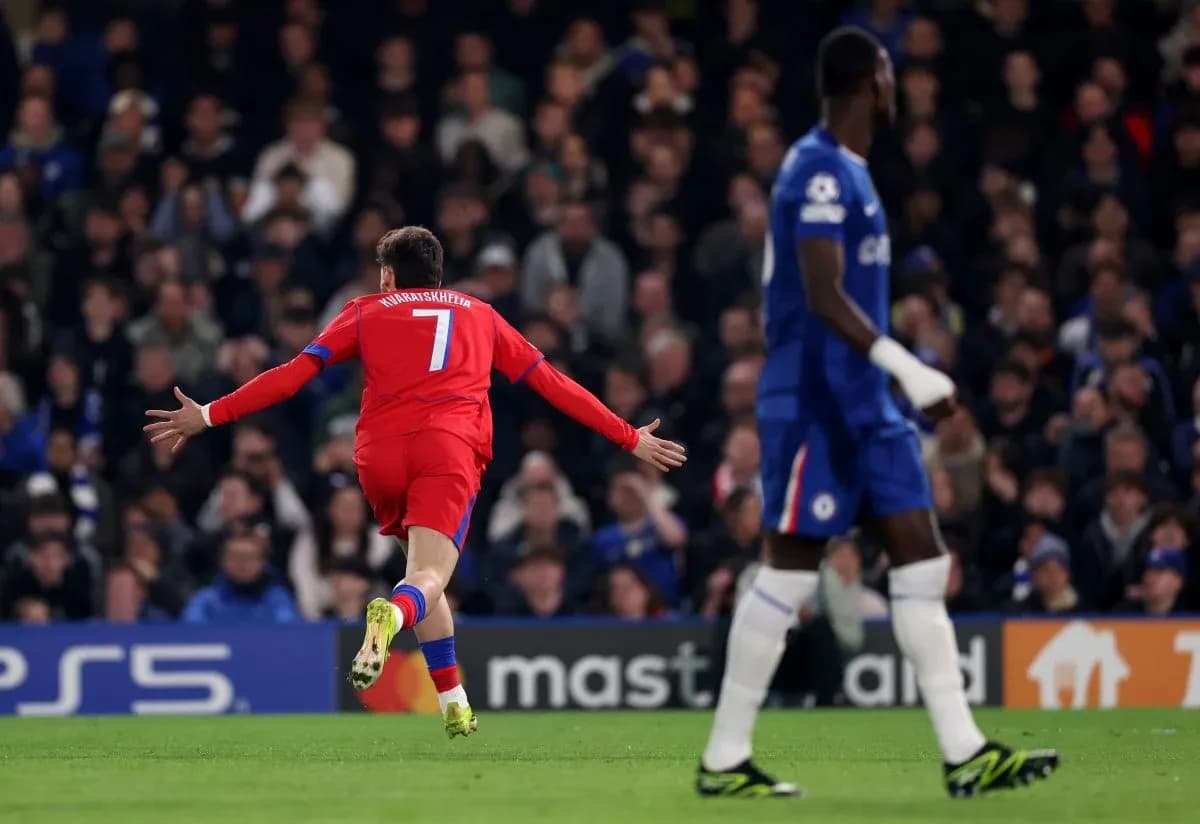
The pattern of the contest was established early. Paris Saint Germain, set up in a 4-3-3 by Enrique Luis, were incisive in the final third despite producing only eight shots in total. Khvicha Kvaratskhelia opened the scoring from open play in the 6th minute, and Bradley Barcola added a second, also from open play, in the 14th minute after being supplied by Achraf Hakimi. Those two strikes defined a first half in which the French side were not prolific in volume but devastating in efficiency.
Chelsea, lined up in a 4-2-3-1 under Liam Rosenior, reached half-time 0-2 down despite generating plenty of attacking moments. The hosts finished with 18 shots, including 9 on target, but repeatedly found Matvey Safonov in their way. The Paris Saint Germain goalkeeper made 9 saves, a figure that underlines both Chelsea’s territorial pressure and the visitors’ defensive resilience.
The half-time score of 0-2 tallied cleanly with the early brace from Kvaratskhelia and Barcola, and Rosenior reacted immediately at the break. At 46 minutes, Mamadou Sarr was withdrawn and Josh Acheampong was introduced in defence, an early reshuffle that hinted at Chelsea’s need to regain control in wide areas. Enrique Luis also adjusted: Joāo Neves went off for Senny Mayulu at 46 minutes, a change that would later prove decisive on the scoreboard.
Chelsea tried to tilt the match further in their favour just before the hour. At 59 minutes, Joāo Pedro made way for Liam Delap, and Cole Palmer was replaced by Alejandro Garnacho, fresh legs aimed at sharpening the attack. One minute later, Enzo Fernández went off for Roméo Lavia, adding more energy and progression from midfield. The intent was clear: Chelsea wanted more penetration and verticality.
Yet it was Paris Saint Germain who struck next. In the 62nd minute, Mayulu, the half-time introduction, scored from open play, again with Hakimi providing the assist. That third goal effectively settled the contest at 0-3 and showcased the visitors’ ability to turn minimal shooting volume into maximum impact.
Enrique Luis continued to manage his resources smartly. At 66 minutes, Ousmane Dembélé was taken off and Gonçalo Ramos was introduced, while Nuno Mendes left the pitch for Lucas Hernández, reinforcing both ends of the pitch and protecting the lead. Chelsea’s final throw of the dice came at 71 minutes, when Marc Cucurella was substituted out and Tosin Adarabioyo was brought in, another defensive alteration that underscored how the hosts were constantly having to rebalance in response to Paris Saint Germain’s threat. The visitors’ last change saw Kvaratskhelia depart at 73 minutes, with Kang-in Lee entering to help close out the game.
Statistically, the match was more nuanced than the scoreline suggests. Paris Saint Germain edged possession with 54% and completed 478 of 547 passes, an 87% accuracy that reflected composure and control. Chelsea, with 46% of the ball, still circulated it well, completing 387 of 456 passes at 85%. The hosts also forced 9 corners to Paris Saint Germain’s 3, illustrating how often they pinned the visitors back, particularly after the break.
In terms of chance quality, the numbers were surprisingly tight. Chelsea’s xG was 1.03, marginally below Paris Saint Germain’s 1.09, suggesting that the visitors’ finishing and Chelsea’s defensive lapses, rather than a chasm in chance creation, drove the 0-3 outcome. Both goalkeepers posted strong underlying performances: Robert Sánchez recorded 2 saves and, crucially, 2 goals prevented, indicating he limited the damage despite the three goals conceded. Safonov matched that with 2 goals prevented of his own on top of his 9 saves, a standout display that underpinned the clean sheet.
Defensively, Chelsea’s 6 blocked shots highlighted their willingness to throw bodies in front of efforts, while Paris Saint Germain did not register a single block, a quirk explained by the fact that Chelsea’s 9 efforts on target forced Safonov into direct action rather than being intercepted earlier. Discipline was notably clean: neither side received a yellow or red card, despite 8 fouls by Chelsea and 10 by Paris Saint Germain.
For Chelsea, whose Champions League form before this tie read WWLWD and whose home record stood at four wins from four with just one goal conceded, this 0-3 defeat at Stamford Bridge represents a brutal reset against higher-calibre opposition. Paris Saint Germain, arriving with a mixed recent record of DLDWL but an impressive 21 goals scored and a +10 goal difference, reaffirmed their attacking ceiling and tactical maturity on the road.
In the context of the Round of 16, the result leaves Chelsea facing a daunting task in the return leg, while Paris Saint Germain carry not only a commanding scoreline but also the psychological edge of having controlled the key moments and outperformed their marginal xG edge by a wide margin.