Canada vs Bosnia & Herzegovina: Tactical Analysis of the 1-1 Draw
Canada’s 1-1 draw with Bosnia & Herzegovina at BMO Field unfolded as a clash between a proactive, possession-heavy 4-4-2 from Jesse Marsch and a compact, physically assertive 4-4-2 block from Sergej Barbarez. Across 90 minutes, the tactical story was Canada’s territorial and statistical control versus Bosnia & Herzegovina’s disciplined low-to-mid block and direct threat in transition.
Both sides mirrored each other structurally on paper. Canada lined up with Maxime Crépeau in goal behind a back four of Richie Laryea, Derek Cornelius, Luc De Fougerolles and Alistair Johnston. The midfield band of four — Tajon Buchanan, Ismael Koné, Stephen Eustaquio and Liam Millar — supported a front two of Jonathan David and Tani Oluwaseyi. Bosnia & Herzegovina responded with Nikola Vasilj in goal, a back line of Sead Kolašinac, Tarik Muharemović, Nikola Katić and Amar Dedić, a hard‑working midfield four of Amar Memić, Ivan Bašić, Benjamin Tahirović and Esmir Bajraktarević, and a strike partnership of Ermedin Demirović and Jovo Lukić.
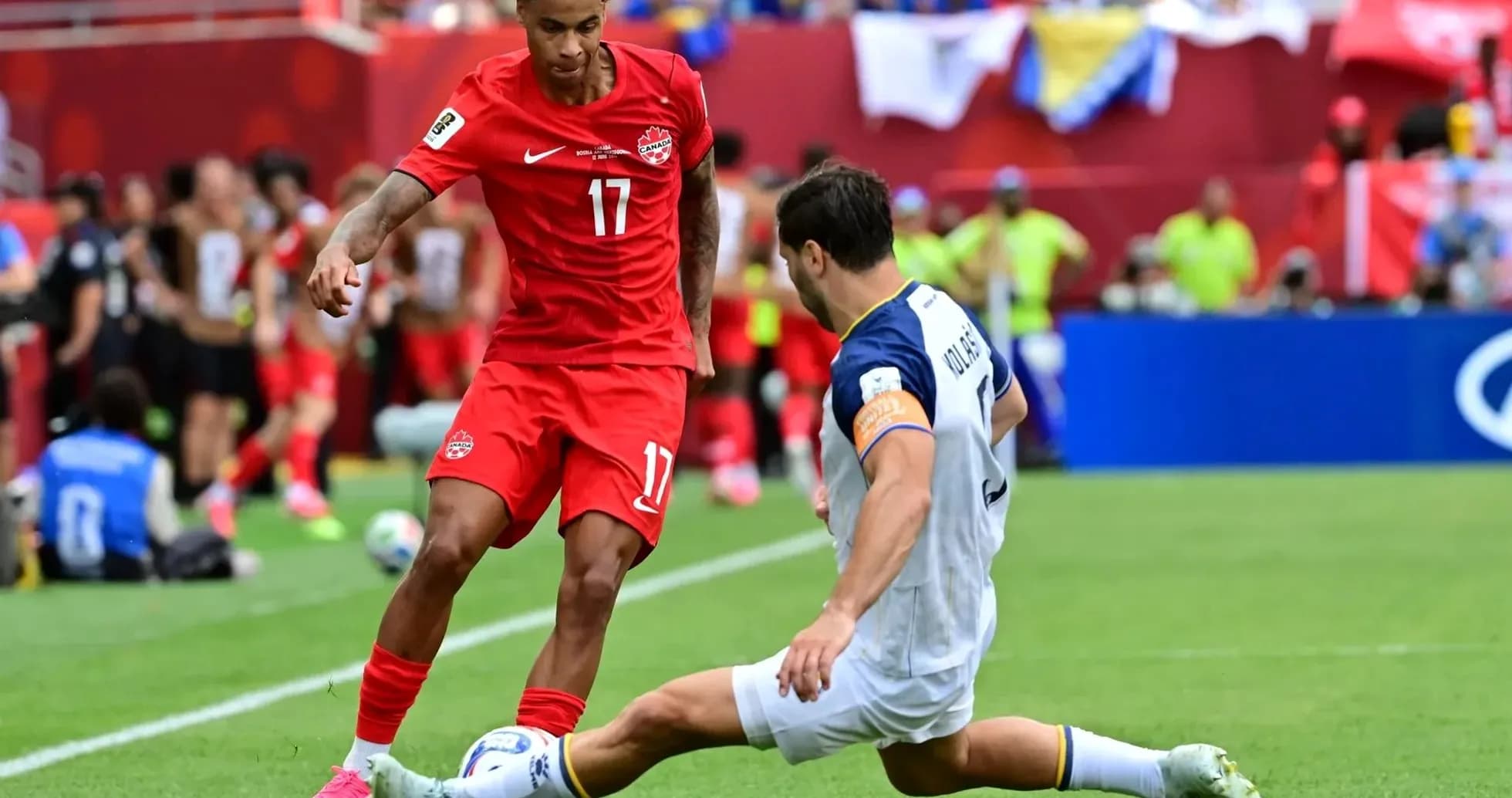
From the outset, Canada sought to dominate the ball and push their full-backs high. The 61% possession and 415 total passes (310 accurate, 75%) underline a clear plan: circulate through Eustaquio and Koné, then progress via the wide midfielders, with Laryea and Johnston overlapping to pin Bosnia & Herzegovina’s wingers. The home side’s 13 total shots, 10 from inside the box, and 9 corner kicks show how often they managed to compress play into the final third.
Bosnia & Herzegovina, by contrast, accepted a more reactive role with 39% possession and 270 passes (172 accurate, 64%). Their 8 total shots, with 5 inside the box, came largely from quick vertical attacks and exploiting Canada’s advanced full-backs. The opening goal at 21’ — Jovo Lukić finishing from a Sead Kolašinac assist — was emblematic: winning territory, then using Kolašinac’s forward thrust from left-back to create a high-quality chance. That chance creation is reflected in their 0.98 xG despite relatively few attempts.
Defensively, Bosnia & Herzegovina leaned heavily on physical duels and disruption. They committed 20 fouls to Canada’s 10 and collected three yellow cards (Demirović at 44’, Lukić at 45+1’, Katić at 90+3’, all for “Foul”). This aggression was part of a deliberate effort to break Canada’s rhythm, especially as the hosts tried to combine centrally between the lines. The back four remained compact, with Tahirović screening in front, forcing Canada wide and trusting Katić and Muharemović to deal with crosses and cutbacks.
Canada’s defensive shape in settled phases was also a 4-4-2, but with a higher line and more front-foot pressing. The two early Canadian bookings — Alistair Johnston at 11’ and Luc De Fougerolles at 53’, both for “Foul” — highlight how aggressively they stepped into duels, especially against Bosnia & Herzegovina’s front two. Still, with only 8 shots conceded and 3 on target, Canada generally controlled Bosnia & Herzegovina’s access to dangerous zones, using Cornelius and De Fougerolles to win first balls and Eustaquio to sweep up second balls.
In goal, Maxime Crépeau (Canada) was required to make 2 saves, a modest workload that underlines how infrequently Bosnia & Herzegovina converted their transitions into clear shots on target. His goals prevented figure of -0.26 suggests he slightly underperformed relative to the quality of chances faced, with the Lukić finish a key moment. At the other end, Nikola Vasilj (Bosnia & Herzegovina) made 1 save, yet Canada’s expected goals of 1.25 against their single strike implies that several efforts either missed the target or were blocked before reaching him. Bosnia & Herzegovina’s defensive unit, rather than the goalkeeper, absorbed much of the pressure, reflected in Canada’s 4 blocked shots.
The substitutions around the hour mark were pivotal in shifting the game’s momentum. At 61’, Marsch introduced Promise David (IN) for Jonathan David (OUT), Ali Ahmed (IN) for Tajon Buchanan (OUT), and Jacob Shaffelburg (IN) for Liam Millar (OUT). These changes injected fresh legs and more direct running, especially from Shaffelburg on the flank and Promise David between the lines. Barbarez responded at 62’ with Samed Baždar (IN) for Jovo Lukić (OUT) and Armin Gigović (IN) for Ivan Bašić (OUT), looking to preserve energy and maintain transition threat rather than chase a second goal.
As the match wore on, Canada’s sustained pressure told. At 76’, Cyle Larin (IN) came on for Tani Oluwaseyi (OUT), adding a more traditional penalty-box reference point. Two minutes later, at 78’, Larin equalised, finishing a move assisted by Promise David. The goal was a tactical vindication of Marsch’s attacking substitutions: Promise David operating in the half-space, Larin attacking central spaces against a tiring Bosnia & Herzegovina back line.
Bosnia & Herzegovina continued to refresh their defensive structure with Kerim Alajbegović (IN) for Amar Memić (OUT) and Ivan Šunjić (IN) for Esmir Bajraktarević (OUT) at 74’, then Dženis Burnić (IN) for Sead Kolašinac (OUT) at 84’. These changes further signalled a tilt toward game management and protecting the point. Canada’s final change saw Jonathan Osorio (IN) replace Stephen Eustaquio (OUT) at 90’, adding late energy in midfield but not altering the scoreline.
Statistically, Canada’s 1.25 xG to Bosnia & Herzegovina’s 0.98, combined with superior volume in shots (13 vs 8), shots on goal (4 vs 3), and corners (9 vs 4), supports the impression of a home side that largely dictated proceedings. The negative goals prevented values for both goalkeepers (-0.26 each) suggest that the finishing slightly outstripped the keeping, aligning with a 1-1 scoreline in a match where both teams produced a handful of decent looks rather than sustained waves of clear chances.
Overall, Canada’s high-possession, wing-oriented 4-4-2 produced territorial control and enough chances to merit their equaliser, but they lacked ruthlessness in the box and early defensive precision. Bosnia & Herzegovina’s compactness, physical edge, and efficient transitions made them dangerous in moments and ultimately secured a point that reflects their resilient defensive organisation more than attacking ambition.