Brugge vs Atletico: A Tactical Showdown
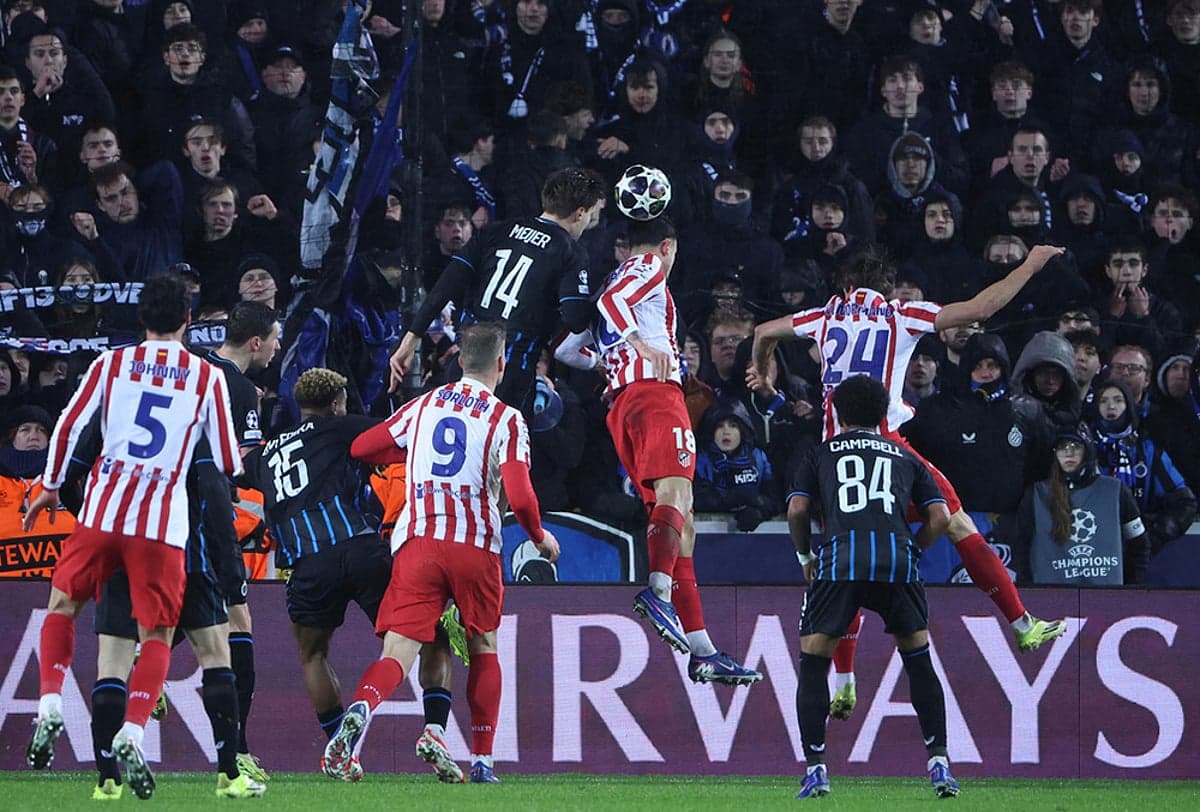
This was a clash between Club Brugge’s controlled possession and Atletico Madrid’s structured, vertical threat. Brugge held 58% of the ball, completing 650 passes at 87% accuracy, while Atletico operated with 42% possession and 484 passes at 85%. The first half largely belonged to Atletico in terms of territory and punch: despite less of the ball, they turned their phases into clear attacking moments. After the break, Brugge’s 4-2-3-1 increasingly dictated the tempo, pinning Atletico’s 4-3-3 deeper. Atletico controlled space through compactness and quick forward play; Brugge gradually took over by circulating the ball and sustaining pressure.
Offensive Efficiency
Brugge’s game plan revolved around volume and territory in the final third. They produced 17 total shots to Atletico’s 13, with a clear edge in accuracy: 10 shots on goal versus Atletico’s 4. Eleven of Brugge’s attempts came from inside the box, showing that their possession was not sterile but converted into high-quality positions. Their xG of 2.33 reflects consistent chance creation, supported by 4 corners and repeated overloads around the box.
Atletico, by contrast, were more selective and direct. With 13 shots (9 inside the box, 4 outside) and 6 corners, they focused on fewer but dangerous attacks, matching Brugge’s xG at 2.33 despite having fewer shots on target (4). This points to a clinical, high-value shot profile rather than speculative efforts. The 3–3 scoreline against identical xG suggests both sides executed their attacking plans reasonably well: Brugge through sustained waves and second phases, Atletico through incisive transitions and efficient use of advanced positions, especially in the first half before Brugge’s comeback momentum shifted the shot map.
Defensive Discipline & Intensity
The match was surprisingly controlled in terms of fouls for a high-stakes UEFA Champions League tie. Brugge committed just 5 fouls and received 1 yellow card, while Atletico made 8 fouls and picked up 2 yellows. This indicates more of a tactical, positional battle than a disruptive or overly aggressive contest.
Goalkeeping and last-line work shaped the outcome. Atletico’s Jan Oblak was heavily involved, registering 7 saves against Brugge’s 10 shots on target, underlining how much pressure the hosts generated in the second half. At the other end, Mignolet made only 2 saves from Atletico’s 4 shots on target, suggesting that when Atletico reached finishing zones, they were often very clear looks. The blocked shots figures (5 for Atletico, 3 for Brugge) show Atletico’s back line throwing bodies in front of efforts more frequently, consistent with a deeper, protective block as Brugge chased the game.
Brugge’s possession-based siege and shot volume (17 shots, 10 on target, 58% possession) matched Atletico’s compact, efficient attacking (13 shots, identical xG). Efficiency and resilience, rather than pure control of the ball, produced a tactical stalemate where Brugge’s sustained pressure cancelled out Atletico’s earlier, more direct superiority.