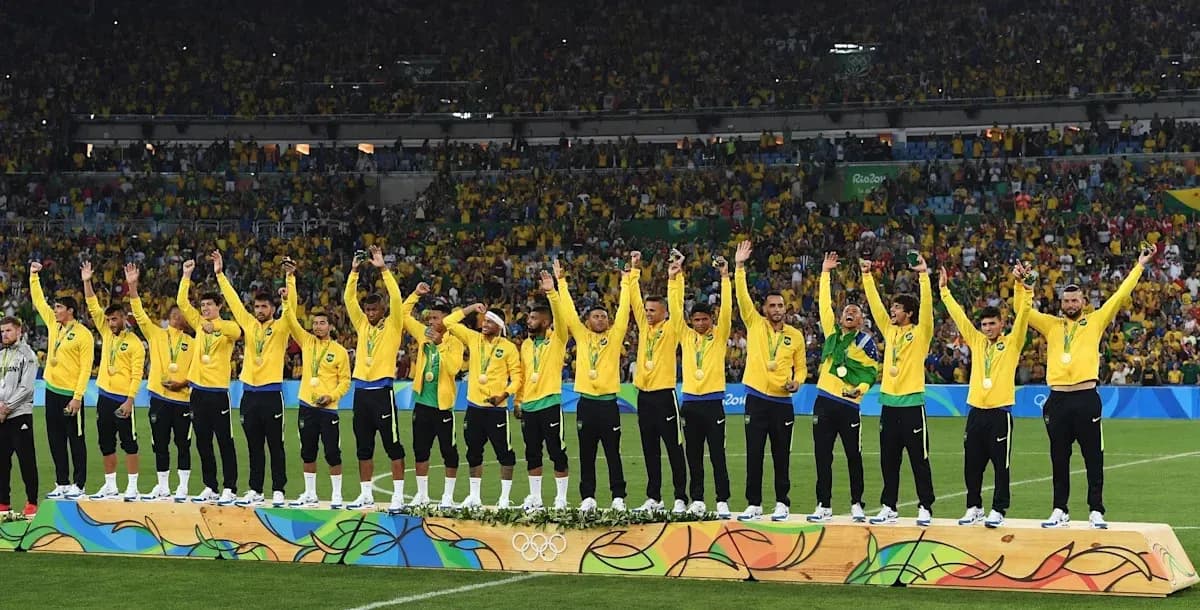
Brazil's Historic Olympic Gold: A Night to Remember
On a tense August evening in 2016, Brazil walked into the Maracanã carrying a weight that had nothing to do with the Olympic torch. It was history pressing down on their shoulders. A footballing giant that had won everything else was still missing one medal. One colour. One moment.
Olympic gold.
More than 63,000 fans packed into the stadium in Rio, a crowd that didn’t so much watch as vibrate with every touch. The opponent could hardly have been more symbolic: Germany, the team whose 7-1 demolition of Brazil at the 2014 World Cup on the same soil had left a scar. The script wrote itself. Brazil now had the chance to heal it.
Neymar’s free-kick and a nation on edge
The final itself never turned into the open spectacle some expected. It was tight, cautious, and laced with nerves. Then Neymar bent it.
In the 26th minute, the captain stood over a free kick, just left of centre, just close enough to dream. He curled the ball over the wall and under the bar, a perfect strike that exploded the Maracanã into raw, disbelieving noise. Brazil 1, Germany 0. A goal that felt like a release.
Germany, composed and methodical, refused to fold. They pressed, probed, and gradually pulled the game back towards them. The pressure told midway through the second half. In the 60th minute, Maximilian Meyer found space in the box and swept in the equaliser. Silence. Then a low murmur. Brazil 1, Germany 1, and the ghosts were back.
Extra time came and went with hearts in mouths and legs heavy. Neither side found a way through. The gold medal would be decided from the penalty spot.
Weverton’s save, Neymar’s kick, and a golden release
The shootout began with icy precision. Four kicks each, four conversions each.
Renato Augusto, Marquinhos, Rafinha and Luan were flawless for Brazil. Ginter, Gnabry, Brandt and Süle answered in kind for Germany. Every successful penalty tightened the knot in Brazilian stomachs. Then came the fifth German kick.
Nils Petersen, one of the tournament’s top scorers, stepped up. His run was clean, the strike firm. But Weverton guessed right, sprang low, and pushed the ball away. The stadium erupted as if the winning goal had already gone in. In reality, it had only set the stage.
Neymar walked forward with the country on his back. One kick for a century of footballing pride. He struck his penalty high and true. The net rippled, Neymar dropped to his knees in tears, and Brazil finally had its first Olympic gold in football. The Maracanã didn’t just celebrate. It roared as if trying to shake off decades of frustration in one sound.
The stuttering start that sparked a run
That golden night was the climax of a journey that had started in far less glamorous fashion. Brazil’s group-stage campaign in Rio was anything but convincing.
Drawn in Group A, the Seleção opened with two goalless games at the National Stadium in Brasília. First South Africa held them. Then Iraq did the same. Two 0-0 draws, two flat performances, and a rising wave of doubt. A home Olympics, a star-studded squad, and a team still searching for rhythm.
Qualification hung on the final group match in Salvador. At Arena Fonte Nova, against Denmark, Brazil had no margin for error. They didn’t just respond; they erupted. Gabriel Barbosa scored twice, Gabriel Jesus added another, and Luan completed a 4-0 rout that reset the mood of an entire campaign. From tension to belief in 90 ruthless minutes.
Knockouts: Colombia, Honduras, and a statement
The quarterfinals brought Colombia to Arena Corinthians in São Paulo. Colombia had emerged from a tricky Group B with 2-2 draws against Sweden and Japan and a 2-0 win over Nigeria. They were organised, dangerous, and confident.
Brazil handled them with authority. Neymar broke the deadlock, Luan added another, and a 2-0 win pushed the hosts into the last four. At that point, at least a bronze-medal match was guaranteed. The mission, though, was always gold.
Honduras awaited in the semifinal at the Maracanã. They had already surprised the tournament: advancing from a group with Argentina, Algeria and Portugal, then knocking out South Korea 1-0 in the quarterfinals. Any hope of another upset vanished quickly.
Brazil tore into them. Neymar struck twice, Gabriel Jesus matched him with two of his own, Marquinhos scored, and Luan completed a 6-0 demolition. It was a statement, not just a scoreline. The team that had stumbled through its first two matches now surged into the final playing with freedom and swagger.
The 18 names behind the medal
Behind the iconic image of Neymar on his knees and Weverton punching the air, there was a full squad that carried Brazil to that podium.
In goal, Weverton of Athletico-PR became the hero of the shootout, while Uilson of Atlético Mineiro provided depth in the position.
The full-back roles were covered by William (Internacional), Douglas Santos (Atlético Mineiro) and Zeca (Santos), offering width and balance on both flanks.
At centre-back, Rodrigo Caio (São Paulo), Luan Garcia (Vasco da Gama) and Marquinhos (Paris Saint Germain) anchored a defence that grew stronger as the tournament progressed.
Midfield control and creativity came from Thiago Maia (Santos), Rodrigo Dourado (Internacional), Rafinha Alcântara (Barcelona), Renato Augusto (Beijing Guoan), Felipe Anderson (Lazio) and Walace (Grêmio). They stitched together the transitions, shielded the back line, and fed the forwards who would decide games.
Up front, the firepower was unmistakable. Neymar, then of Barcelona, wore the captain’s armband and the expectations of a nation. Luan (Grêmio), Gabriel Barbosa (Santos) and Gabriel Jesus (Palmeiras) formed an attacking unit that finally clicked when it mattered most.
One name deserves a quieter, more bittersweet mention. Fernando Prass had been called up as one of the overage players, a veteran presence for a young squad. An elbow injury during the warm-up for a friendly against Japan at Serra Dourada in Goiânia ruled him out before the group stage even began. He never stepped onto the Olympic pitch, but he remains part of that story.
A decade later, that night at the Maracanã still stands apart. Brazil, the country that gave football to the world in so many ways, finally claimed the one prize that had always slipped away. The question now is simple: how long before another generation writes its own Olympic chapter in gold?