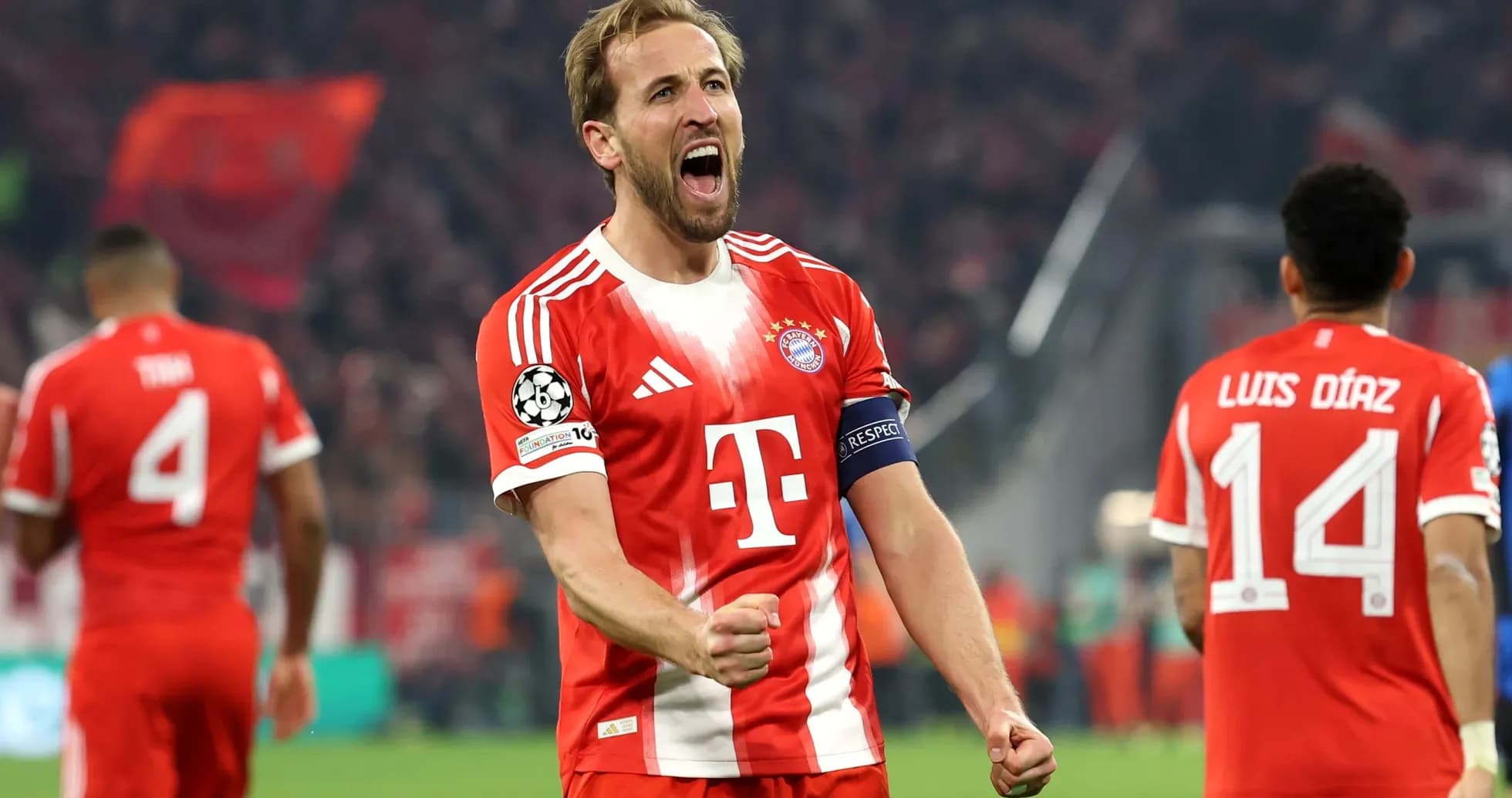
Bayern München Dominates Atalanta 4-1 in UEFA Champions League
Bayern dominated territorially and with the ball, using a 4-2-3-1 that effectively pinned Atalanta’s 3-4-2-1 deep. The 71% possession, 25 total shots and 3.61 xG show a controlled, high-volume attacking performance. Atalanta’s 14 shots and 2.3 xG indicate they still created some danger, mostly in transition and from central combinations, but they were outplayed over 90 minutes.
Final Score: Bayern München 4 - 1 Atalanta
1. Game State & Overall Tactical Story
Bayern München had 8 of their shots blocked by the Atalanta defense. Atalanta had 1 of their shots blocked by the Bayern München defense.
The 4–1 scoreline aligns closely with the underlying numbers: Bayern were consistently in better positions, with more box entries (15 shots inside the box vs Atalanta’s 10) and superior pass security (93% accuracy from 859 passes).
2. Bayern’s 4-2-3-1: Structure and Ball Progression
Base shape and roles
- Back four: Tom Bischof (LB), Jonathan Tah and Min-jae Kim (CBs), Josip Stanišić (RB).
- Double pivot: Leon Goretzka and Aleksandar Pavlović.
- Line of three: Luis Díaz (left), Raphaël Guerreiro (central), Lennart Karl (right).
- Harry Kane as the lone striker.
With the ball, Bayern often morphed into a 2-3-5:
- Full-backs: Stanišić advanced aggressively on the right to support Karl; Bischof stepped into a more conservative, stabilizing role on the left, allowing Díaz to stay very high and wide.
- Pivot: Pavlović operated as the deeper organizer, Goretzka as the more advanced carrier/second-wave runner.
- Front five: Díaz and Karl held width, Guerreiro occupied the left half-space or central pocket, Kane stayed between or just off the Atalanta center-backs.
Ball circulation
- Bayern’s 859 passes at 93% accuracy underline how cleanly they circulated through the thirds.
- The double pivot gave constant short options, preventing Atalanta’s first line (Scamacca, De Ketelaere, Sulemana) from isolating the center-backs.
- Stanišić’s involvement is highlighted by his assist for Kane’s second goal at 54': Bayern repeatedly created right-side overloads, then either:
- Combined down the flank for cutbacks, or
- Switched quickly to the far side for Díaz.
This patient but incisive possession game forced Atalanta’s 3-4-2-1 into a deep 5-4-1 block for long stretches, with the wing-backs pinned back and the two “tens” defending in their own half.
3. Final Third Patterns & Key Attacking Mechanisms
a) Kane as focal point
Kane’s influence was twofold:
- Penalty at 25'
- Bayern’s territorial dominance and pressure in and around the box drew the penalty, later confirmed by VAR at 22'.
- Kane’s conversion at 25' set the tone: Bayern could now dictate tempo without chasing the game.
- Second goal at 54'
- Assisted by Stanišić from the right, illustrating Bayern’s use of wide progression and then a direct final action into central spaces.
- Kane’s positioning between the center-backs forced constant defensive attention, freeing space for Guerreiro and Karl to attack pockets around him.
b) Interplay between wide players and the “10s”
- Luis Díaz & Lennart Karl were central to Bayern’s third and fourth goals:
- At 56', Karl scored, assisted by Díaz: a classic pattern of one winger attacking inside space while the other provides the final ball from the opposite channel.
- At 70', Díaz scored, assisted by Karl: the relationship inverted, underlining a deliberate tactical plan of cross-channel combinations rather than relying only on crosses from one side.
- Guerreiro, as the nominal central attacking midfielder, often dropped to help progression and drag Atalanta’s midfield out, opening half-space channels for Díaz and Karl to attack the line of three center-backs.
c) Volume and shot profile
- Bayern’s 25 total shots, with 15 inside the box, show a clear emphasis on breaking into high-quality zones rather than speculative long-range attempts.
- The 8 Bayern München shots blocked by the Atalanta defense also reveal how often Bayern were able to shoot from congested central areas – Atalanta frequently had to defend on their own penalty spot.
4. Out-of-Possession: Bayern’s Press and Defensive Control
Despite allowing 8 shots on target and needing 7 saves from Jonas Urbig, Bayern’s overall defensive structure was proactive:
- First line: Kane screened central passes into Éderson and Pašalić, guiding Atalanta wide.
- Mid-block: Goretzka and Pavlović stepped up aggressively when the ball went into Atalanta’s double pivot, trying to force turnovers in the middle third.
- Rest defense: Tah and Min-jae Kim held a high line, with Bischof more conservative to protect against Sulemana’s and later Raspadori’s depth runs.
The relatively low foul count (8) suggests Bayern controlled duels more through positioning and pressing traps than through constant physical disruption.
However, Atalanta’s 2.3 xG and 8 shots on target show that when Bayern lost the ball in advanced areas, Atalanta could break and find good chances – Urbig’s 7 saves were crucial in preventing a more chaotic scoreline.
5. Atalanta’s 3-4-2-1: Plan and Problems
Initial structure
- Back three: Scalvini (left), Hien (central), Kossounou (right).
- Wing-backs: Bellanova (right), Bernasconi (left).
- Double pivot: Éderson and Pašalić.
- Two behind the striker: De Ketelaere and Sulemana.
- Scamacca as the central striker.
Intended approach
- Build from the back with the three center-backs and double pivot, then:
- Use De Ketelaere between the lines to connect,
- Attack wide with wing-backs,
- Finish with Scamacca’s presence in the box.
- Out of possession, compress into a 5-4-1, with the “tens” dropping next to the double pivot to crowd central zones.
Where it broke down
- Territorial disadvantage
- With only 29% possession and 349 passes (85% accuracy), Atalanta struggled to sustain attacks.
- Bayern’s wide pressure kept the wing-backs deep, so Atalanta often had a flat back five and limited outlets.
- Transition reliance
- Their best moments came when they could bypass Bayern’s press quickly, finding Scamacca or the running lanes of Sulemana and De Ketelaere.
- The 10 shots inside the box and 2.3 xG show that when they did break through, they reached dangerous areas – but these moments were too sporadic.
- Defensive strain
- Constant defending against Bayern’s front five meant Atalanta’s midfield line was repeatedly dragged back into the area, leaving large gaps between midfield and attack when they tried to counter.
6. Substitutions and Tactical Adjustments
All times are regular time minutes.
Bayern München
- At 56', Deniz Ofli came on to replace Aleksandar Pavlović.
- Fresh legs in the defensive midfield zone to maintain intensity and protect the lead immediately after going 3–0 up.
- At 72', Nicolas Jackson came on to replace Harry Kane.
- Shift from a classic hold-up 9 to a more mobile runner in behind, exploiting Atalanta’s need to push higher.
- At 72', Serge Gnabry came on to replace Tom Bischof.
- This likely triggered a structural tweak: more attacking intent on the left flank, with an extra forward profile to stretch a tiring Atalanta defense.
- At 72', Filip Pavic came on to replace Josip Stanišić.
- A defensive refresh on the right side, protecting against late Atalanta pushes and managing minutes.
- At 83', Hiroki Itō came on to replace Raphaël Guerreiro.
- Added defensive stability and fresh legs, moving Bayern into a more secure, game-management posture for the closing stages.
The pattern: once Bayern were 3–0 up (56') and then 4–0 up (70'), Kompany used changes to:
- Maintain central control (Ofli),
- Add pace for counters (Jackson, Gnabry),
- Reinforce the back line and manage energy (Pavic, Itō).
Atalanta
- At 57', Marten de Roon came on to replace Éderson.
- De Roon added defensive steel and positional discipline in midfield, trying to stem Bayern’s central dominance.
- At 57', Lazar Samardžić came on to replace Charles De Ketelaere.
- More direct shooting threat and a different type of “10”, capable of attacking from deeper and wider zones.
- At 71', Giacomo Raspadori came on to replace Kamaldeen Sulemana.
- A more combination-oriented forward, helping link play and find pockets around Bayern’s center-backs.
- At 71', Nikola Krstović came on to replace Gianluca Scamacca.
- Fresh striker with more mobility and pressing energy to challenge Bayern’s build-up.
- At 83', Honest Ahanor came on to replace Giorgio Scalvini.
- Defensive reshuffle, possibly to add pace and aggression in the back line late on.
These changes gradually tilted Atalanta towards a more aggressive, risk-taking posture, culminating in their goal:
- At 86', Lazar Samardžić scored, assisted by Mario Pašalić.
- Illustrates the impact of the substitute “10”: Samardžić arriving into a dangerous space and taking advantage of Bayern’s slightly more relaxed game-management phase.
7. Key Individual Tactical Performances
Bayern
- Harry Kane:
- Penalty goal at 25' and a second at 54' highlight his clinical finishing and movement.
- His presence forced Atalanta’s back three to narrow, opening space for Díaz and Karl.
- Luis Díaz & Lennart Karl:
- Directly involved in Bayern’s third and fourth goals, constantly attacking half-spaces and wide channels.
- Their mutual assists underline a deliberate pattern of wide interchange and diagonal attacking runs.
- Josip Stanišić:
- Provided the assist for Kane’s second goal, showing how Bayern’s right-back was used as an advanced outlet to overload Atalanta’s left side.
- Jonas Urbig:
- 7 saves underline how important he was in preserving Bayern’s margin, especially against Atalanta’s 8 shots on target.
- His performance allowed Bayern to play a high line and commit numbers forward with confidence.
Atalanta
- Lazar Samardžić:
- Came off the bench and scored at 86', offering shooting from range and late box entries.
- Mario Pašalić:
- Assist for Samardžić’s goal; his timing into advanced positions remained a threat even under heavy defensive workload.
- Marco Sportiello:
- 4 saves against Bayern’s 8 shots on target; the negative goals_prevented (-1) suggests he was beaten in line with or slightly below expectation, but he was under relentless pressure.
8. Statistical Context & Tactical Implications
- Possession: 71% vs 29% Bayern imposed their positional play and forced Atalanta into a reactive, deep block.
- Shots & xG:
Bayern created more and better chances, but Atalanta’s xG and on-target tally show they remained a live threat in transitions and late surges. - Bayern: 25 shots, 8 on target, 3.61 xG.
- Atalanta: 14 shots, 8 on target, 2.3 xG.
- Passing:
This gap reflects Bayern’s sustained control and Atalanta’s more direct, opportunistic style under pressure. - Bayern: 859 passes at 93% accuracy.
- Atalanta: 349 passes at 85% accuracy.
- Fouls: 8 (Bayern) vs 4 (Atalanta) Bayern’s slightly higher foul count is consistent with a team counter-pressing aggressively after losing the ball high up the pitch.
9. Tactical Verdict
Bayern’s 4-2-3-1 outplayed Atalanta’s 3-4-2-1 through:
- Superior structure in possession (clear roles in the double pivot and wide zones),
- Intelligent use of Kane as a reference point,
- Constant wide overloads and half-space attacks via Díaz, Karl, and Stanišić,
- Effective game management through substitutions once the lead was secure.
Atalanta’s plan to combine through their “tens” and wing-backs showed glimpses of danger and produced a respectable 2.3 xG, but their inability to escape sustained pressure and protect the box against Bayern’s multi-lane attacks ultimately decided the tie in Munich.