Bayer Leverkusen vs Olympiakos: A Strategic Battle Analysis
Bayer Leverkusen controlled the rhythm through the ball, but also through territory and chance quality. With 58% possession and 591 total passes at 84% accuracy, they imposed a measured, structured game from their 3-4-2-1 base. Olympiakos Piraeus, in a 4-2-3-1, accepted longer spells without the ball (42% possession, 414 passes at 79% accuracy), aiming to spring forward once they recovered. However, Leverkusen’s positional structure meant that while Olympiakos saw enough of the ball to avoid being completely pinned back, they rarely controlled space in advanced zones. The hosts’ plan of mid-block plus quick transitions never really translated into sustained territorial pressure.
Offensive Efficiency
The offensive contrast was defined by quality over quantity. Olympiakos actually attempted more total shots (13 to Leverkusen’s 8), but only 1 of those hit the target and their expected goals stood at just 0.87. The shot profile reveals the problem: 9 of their 13 efforts came from outside the box, and 6 were blocked, underlining how often they were forced into low-probability attempts against a set defence.
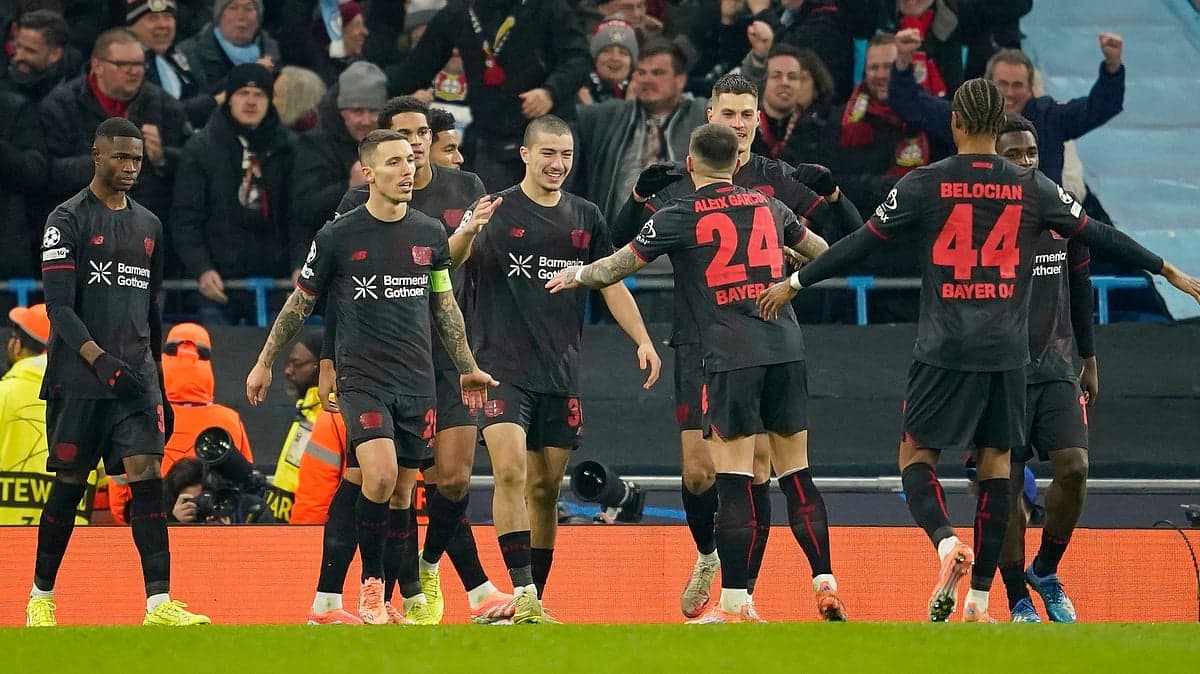
Leverkusen, by contrast, were ruthlessly efficient. They needed only 8 shots but placed 5 on target and generated 1.95 expected goals, heavily skewed toward high-quality chances. Seven of their eight efforts came from inside the box, reflecting how their possession game was geared toward patiently engineering clear openings rather than volume shooting. Both sides finished with 3 corners each, which shows Leverkusen didn’t rely on set-piece bombardment; instead, their superiority came from structured combinations in open play, using the wing-backs and the two supporting forwards behind P. Schick to arrive in central finishing zones. The 0–2 scoreline mirrors that gap in chance quality and execution.
Defensive Discipline & Intensity
The game was relatively controlled in terms of physicality. Olympiakos committed 7 fouls and Leverkusen 9, with just one yellow card apiece, suggesting neither side adopted a highly disruptive or foul-heavy strategy. Defensively, the key difference lay in how each team protected their box. Olympiakos registered 6 blocked shots, indicating a reactive, last-ditch defending phase once Leverkusen broke through lines. Their goalkeeper made 3 saves with 0 goals prevented, meaning Leverkusen’s finishing largely matched their xG profile.
On the other side, Leverkusen allowed 13 shots but only 1 on target, a testament to their compactness around the area and effective shot suppression. J. Blaswich was barely involved with just 1 save and 0 goals prevented, underlining how well the back three and midfield screen managed distances and denied central shooting lanes.
Leverkusen’s controlled possession and focus on high-quality box entries (7 shots inside the area, 1.95 xG) comfortably outperformed Olympiakos’ lower-possession, low-efficiency approach (13 shots, 1 on target, 0.87 xG). Efficiency and structural solidity trumped volume and sporadic transitions.