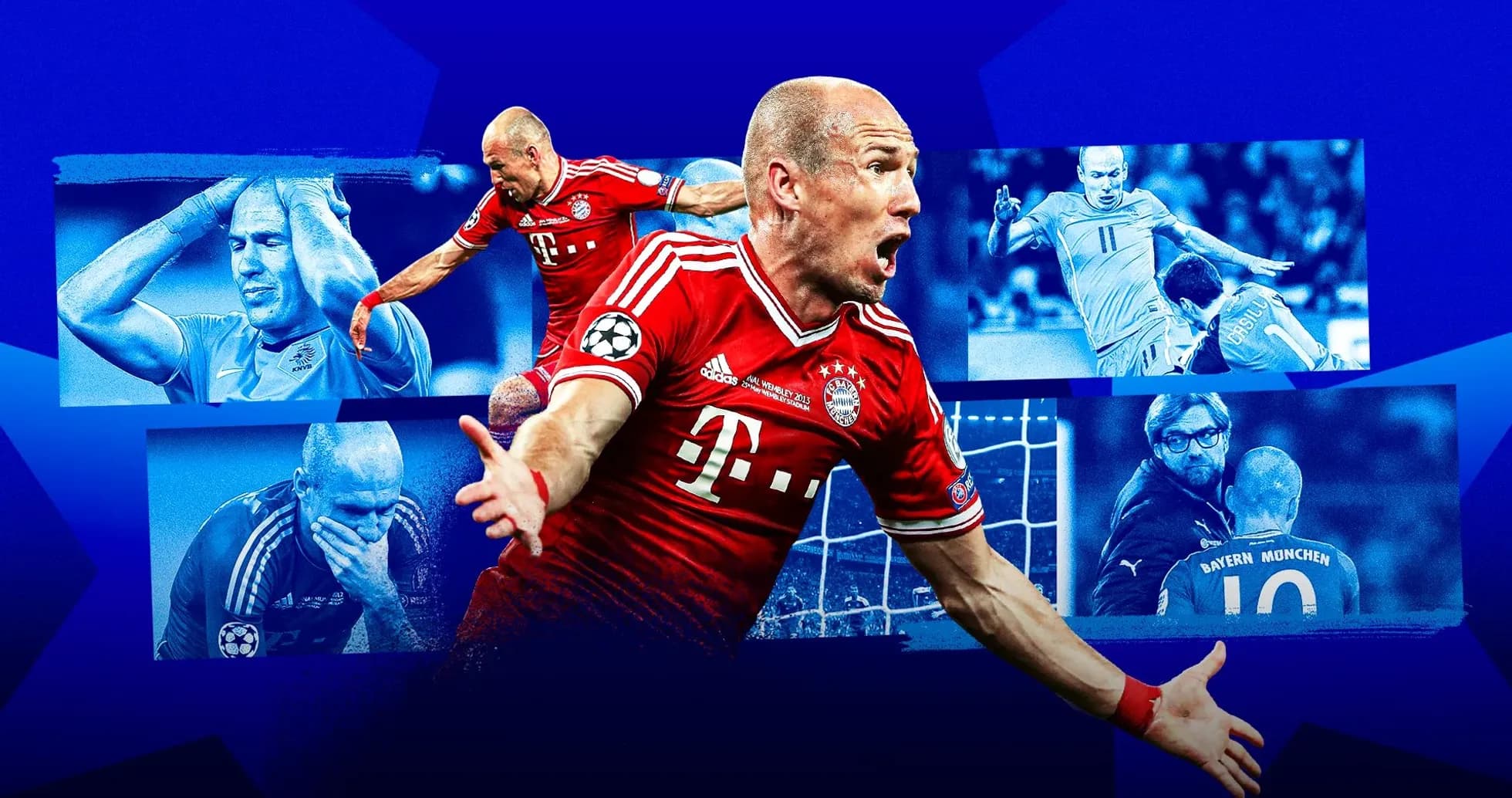
Arjen Robben: From ‘Man of Glass’ to Legendary Winger
Before the whispers about missed penalties and big-stage failures, Arjen Robben was something simpler and far more frightening: inevitable.
Everyone knew what he was going to do. Full-backs studied it, managers warned about it, fans screamed about it from the stands. He would drive down the right, dip his shoulder, cut inside onto that left foot and bend the ball into the far corner. Predictable. Unstoppable.
Manchester United, Barcelona, Borussia Dortmund – all left with scars from Champions League nights when Robben tore through them. He collected domestic titles at PSV, Chelsea, Real Madrid and Bayern Munich. By 2010, the stage felt set. This was supposed to be his era.
The one-man rescue act
Louis van Gaal’s Bayern were building something ominous. Mario Gomez, Thomas Müller, Franck Ribéry, Bastian Schweinsteiger – a powerful core, guided by a coach who believed in Robben as the spearhead. Bayern stormed to the Bundesliga and DFB-Pokal double in 2009-10, but their Champions League campaign began sluggishly.
Robben dragged them through it.
Against Fiorentina in the last 16, Bayern took a 2-1 lead from the first leg, Robben on the scoresheet from the spot. In Florence, though, they crumbled, falling 3-1 behind. Then, in the 65th minute, Robben picked up the ball in the middle of Fiorentina’s half and uncorked one of the finest strikes of his career, a swirling, vicious effort that levelled the tie at 4-4 on aggregate and sent Bayern through on away goals.
The pattern repeated in the quarter-finals. Robben missed the first leg against Manchester United through injury as Bayern edged a 2-1 win. At Old Trafford, they were 3-1 down and sinking. A corner from Ribéry arced towards the edge of the box. Robben met it with a first-time volley so clean, so precise, that even he seemed stunned as he wheeled away in celebration. Again, away goals. Again, Robben the saviour.
In the semi-final against Lyon, he did it once more. A sudden, long-range strike, hit with that familiar whip, left Hugo Lloris rooted in a 1-0 win. Bayern reached the final with a winger who looked like he could bend entire ties to his will.
Then came the wall.
Inter, injuries and a World Cup scar
At the Santiago Bernabéu against José Mourinho’s Inter in the 2010 Champions League final, Robben finally met a night he couldn’t bend. Bayern lined up with Ivica Olić and Thomas Müller up front, Ribéry suspended, the balance off. Inter were ruthless, Bayern limp, and Robben isolated in a 2-0 defeat.
That summer, another defining chapter awaited.
By then, his body had betrayed him often enough to earn the nickname ‘Man of Glass’. Hamstring problems delayed his start to the 2010 World Cup, but once fit, he was central to the Netherlands’ run to the final. He opened the scoring against Slovakia in the last 16, set up a crucial goal in the 2-1 win over Brazil in the quarters, then headed what proved to be the semi-final winner against Uruguay.
In Johannesburg, the final against Spain turned nasty and nervy. Nine Dutch players were booked. Nigel de Jong’s chest-high challenge on Xabi Alonso became the enduring image of their brutality. Yet the moment that truly changed history was far cleaner.
Just after the hour, Wesley Sneijder slid a pass through the middle. Robben surged clear, one-on-one with Iker Casillas, the World Cup at his feet. He waited. Calculated. Perhaps for a fraction too long. As he tried to guide the ball to his left, Casillas flung out a leg and diverted it wide with the faintest touch. Dutch media called it ‘The toe of Casillas’.
Casillas later admitted he assumed Robben would beat him, that of all the options, the Dutchman chose the wrong one. If that ball had gone in, he said, the final would have taken a very different turn.
It never did. Andrés Iniesta decided it in extra time. The Netherlands couldn’t recover. Robben carried the miss with him.
“It hurts to miss such a chance,” he reflected four years later. “It’s part of sport, just a moment, a snapshot. But it will be part of me and part of my career for all of my life.”
More snapshots were coming.
Penalties, pain and the ‘loser’ label
Robben limped through 2010-11, barely fit but still devastating when available. In just 14 Bundesliga appearances he scored 12 goals and provided eight assists. The following season, he stayed on the pitch more often and Bayern surged back to the Champions League final.
In the semi-final second leg at the Bernabéu, Bayern trailed Real Madrid 2-0 on the night and 3-2 on aggregate inside 14 minutes. The dream was slipping away. In the 27th minute, they won a penalty. Robben, standing where he had once worn white, stared down Casillas again.
This time, no toe. Just fingertips, and not enough of them. Robben’s strike squeezed past the Madrid keeper to level the tie on aggregate. Bayern would win on penalties. It felt like an exorcism.
Instead, it was a dress rehearsal for a deeper wound.
At the Allianz Arena in the 2012 final against Chelsea, Bayern led 1-0 late on, were pegged back by Didier Drogba, and then saw the Ivorian foul Ribéry in extra time. Another penalty. Another chance for Robben to seize the moment.
He went low to the corner. Petr Čech read it, dropped, and smothered the ball. The stadium fell silent. Bayern would lose on penalties. Weeks earlier, Robben had missed a title-deciding spot-kick against Borussia Dortmund in the Bundesliga. The story wrote itself: brilliant, fragile, unreliable when it mattered most.
“I can't describe how I feel with words, but it's been a terrible night,” he said. “Two or three times, you feel you have the cup in your hands but at the end you stand with nothing.
“It wasn't a good penalty. I wanted to shoot the ball hard and high in the goal, but the ball didn't go high enough. It was a terrible penalty kick. After that, I still played well but you have to change your mindset at that point.”
The injuries persisted into 2012-13. Robben played only 16 league games, often watching from the sidelines as Bayern ripped through the Bundesliga. Yet he stayed healthy when it mattered most in Europe. Bayern would be grateful.
The night he owned Barcelona
The semi-final against Barcelona turned into a demolition. Over two legs, Bayern won 7-0 on aggregate, and Robben sat at the heart of the destruction.
In Munich, he hounded Jordi Alba relentlessly and curled in a superb third goal in a 4-0 rout. At Camp Nou, he delivered the kind of moment that defined him: early in the second half, he took a long pass on the right, cut inside with a single, vicious touch past Adriano, created a sliver of space and whipped the ball into the top corner.
“That 4-0 was my best game at the Allianz Arena,” he later told Sport Bild. “Against such a great team. With an uncharacteristic Robben goal. I broke through on the right wing with a stepover and had time to curl the ball into the far corner from a tight angle.”
He wasn’t done rewriting scripts.
Wembley, redemption and the goal of a lifetime
The 2013 final at Wembley against Borussia Dortmund was frantic, wild, and for long spells tilted towards Jürgen Klopp’s side. Dortmund’s press rattled Bayern in the first half. Then the match opened up.
Robben slipped a pass across goal for Mario Mandžukić to score the opener. Dortmund equalised from the spot eight minutes later. Soon after, Neven Subotić produced a miraculous intervention to deny Robben what looked like a tap-in. The familiar fear surfaced: another final, another haunting miss?
Time ticked away. Then came the ball that would change everything.
A long pass dropped towards the edge of the Dortmund box. Ribéry battled for it, then flicked a delicate backheel through a tangle of yellow shirts. Robben burst into the gap.
Roman Weidenfeller stood in front of him. Mats Hummels and Subotić closed in. Johannesburg. Munich. All of it sat on his shoulders.
Robben glided between them, nudged the ball past Weidenfeller and, with almost absurd calm, rolled it slowly towards the far corner. It trickled over the line and kissed the net.
“When I got the ball, I was free,” he told reporters. “I anticipated Franck’s movement. The only thought was: ‘I hope he puts the ball there’ because I saw the space. I took it well. My first choice was actually to go past [Weidenfeller] on the left side but then he made a move and I could put it to the other side. He was on the wrong leg.”
Bayern were champions of Europe again. Robben’s curse was shattered.
“To finally win this Champions League, that's a dream come true,” he said. “You can't describe it – so many emotions go through your head, especially because you know what it is like to lose. I think you can enjoy it even more when you win the title.
“After the disappointment of last year, and to a [lesser extent] 2010, and the World Cup for me – that's three finals and you don't want the stamp of a loser. At last we did it today, and we can forget about the other things a bit. It was a sense of ‘finally’.”
In 2025, Bayern fans voted that goal the greatest in the club’s 125-year history. Second place? Robben’s volley at Old Trafford.
The narrative had flipped.
Brazil, full throttle
By the time the 2014 World Cup arrived in Brazil, Robben was 30 and playing with a kind of liberated fury. The burden of those old failures hadn’t vanished, but they no longer defined him.
Netherlands opened against Spain in a rematch of the 2010 final. This time, the Oranje shredded La Roja 5-1. Robben produced a performance that felt like personal vengeance wrapped in brilliance.
For his first goal, he plucked a long ball from the sky, twisted away from Sergio Ramos and finished with clinical precision. His second was pure electricity: he sprinted clear from his own half, outpaced Ramos, dragged Casillas to the turf and thrashed the ball into the net while the goalkeeper flailed on his knees.
Under Louis van Gaal, the Netherlands reached the third-place play-off, punching above their supposed weight. Robben was their spear, relentless and ruthless.
The old tag of ‘big-game bottler’ no longer fit. He was something else entirely now: a phenomenon who had stared down his worst moments and come back sharper.
Legacy of a once-maligned genius
The numbers tell part of the story. Eight Bundesliga titles. Five DFB-Pokals. A Champions League crown. Across 307 appearances for Bayern, 144 goals and 101 assists.
After 2013, Bayern reached four more Champions League semi-finals, though Pep Guardiola never managed to reclaim the European title. Robben, when fit, remained central to their identity: that familiar movement from the right, the cut inside, the shot that everyone in the stadium saw coming and still couldn’t stop.
When he left Bayern in 2019, tears in his eyes and another league title in his hands, the same fans who had once whistled him for missed penalties now serenaded him as a legend. They no longer saw the tragic figure who crumbled under pressure. They saw the ferocious winger who had carried the weight of failure, stumbled on the biggest nights, and still forced his way into the game’s history.
Arjen Robben’s career was never just about the goals he scored. It was about the ones he missed, the nights that broke him, and the way he kept coming back to demand the ball again.