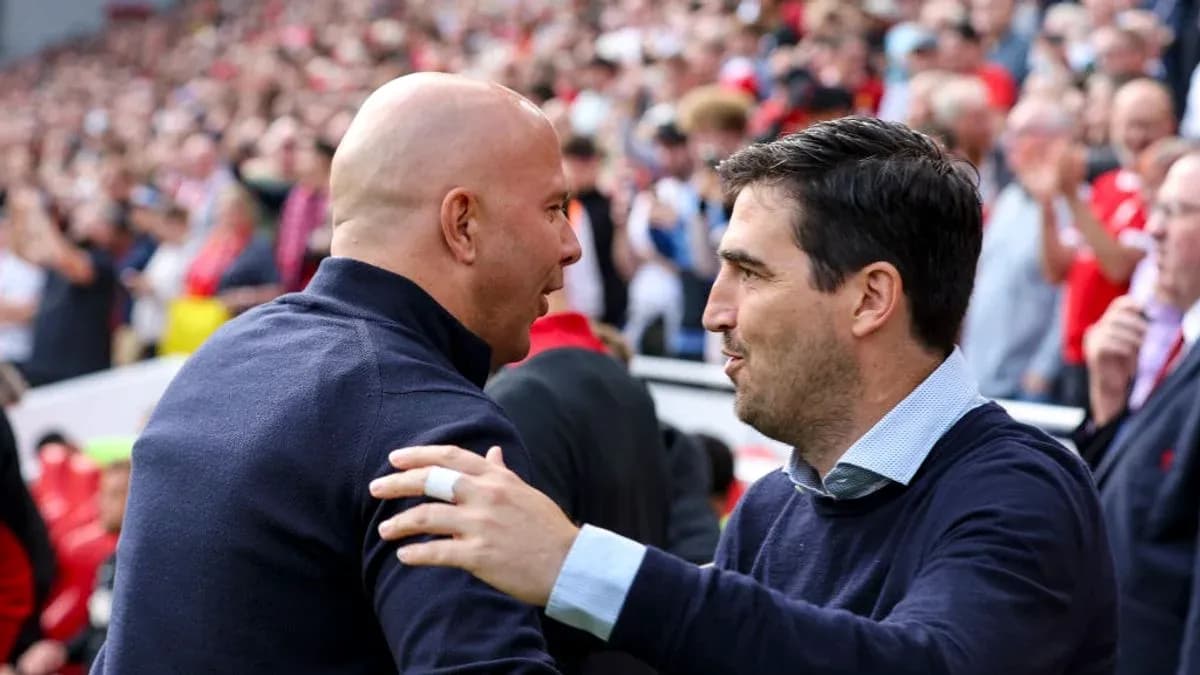
Andoni Iraola's Tactical Transition at Liverpool
Andoni Iraola has never been afraid of a slow burn. It took him 10 games to taste victory with Bournemouth in the Premier League. At Liverpool, he might need just as much patience – and so will everyone watching.
His first competitive outing ended in a 2-2 draw with Newcastle. On paper, not a disaster. On the pitch, a different story. Liverpool were outrun, ragged without the ball and repeatedly exposed in transition. For a coach who lives off intensity and verticality, that will have stung.
This is not the first warning he has sounded.
Caught Between Klopp and Slot
During the club’s preseason tour in the United States, Iraola openly questioned the squad’s “energy”, a pointed remark that many read as a jab at the Arne Slot era. Now, speaking with Steven Gerrard on TNT Sports, he went a step further and laid bare the tactical fault line running through this Liverpool side.
Asked by Gerrard whether he feels closer in style to Jurgen Klopp or Slot, Iraola did not hesitate.
“Probably closer to Jurgen, probably, I would say. But I loved a lot of the things that the team had with Arne also,” he replied.
That line matters. He is not ripping up what came before, but he is clearly steering away from Slot’s more measured, possession-heavy blueprint and back toward Klopp’s “quick” and “vertical” football – the kind of game Iraola built his reputation on.
Yet the numbers from the Newcastle match told a different story.
“There has to be a balance. Things are going to evolve differently because the first game we had 60, 61 percent of possession straight away,” Iraola said, reflecting on that opener.
Then came the phrase that should make Liverpool sit up.
“Naturally, because the natural tendency of the players is towards that side, and I need to adapt also towards that side. ... But we also need to keep being vertical, keep attacking, keep taking sometimes some risks.”
The “Natural Tendency” Problem
That “natural tendency” is exactly what is troubling. Under Slot, Liverpool were drilled to dominate the ball, to patiently pick apart low blocks, to occupy the final third in numbers. Against Newcastle, several of his key players looked locked into that muscle memory.
Dominik Szoboszlai, Ryan Gravenberch, Jeremie Frimpong and Milos Kerkez often hovered high, happy to stay near the attacking third when Liverpool had possession. That suits a slow, probing game. It does not suit Iraola’s demand for fast, aggressive transitions where the team moves as one – forward and back.
The consequence? When Liverpool lost the ball, they were stretched. Too many bodies ahead of the play, not enough protection behind it. That left a 35-year-old Virgil van Dijk and the inexperienced Jeremy Jacquet exposed in huge swathes of space. Newcastle did not need a second invitation. Both goals Liverpool conceded carried the fingerprints of that imbalance.
This is the tactical hangover from the Slot era: a squad conditioned to think in long spells of possession, now being asked to sprint, press and break with far greater urgency. Iraola wants risk, but not this kind of risk – not the kind that abandons his back line.
Fitness, Intensity and Time
Tactics are only half the story. Iraola has already flagged another major issue: fitness.
After Liverpool’s preseason match against Leeds in early August, he offered a blunt assessment.
“I think we played really good [in the] first half, especially the first 30 minutes, but right now probably we don’t have much more in terms of the level required to play like this,” he said. “Then they were much better in the second half.
“The problem is right now probably they don’t have the energy for 90 minutes and they start to get tired. It will take time with them, we need more training with them.”
Those comments line up with what we saw against Newcastle. Liverpool could not maintain their intensity, either with or without the ball. The legs faded, the distances grew, the structure frayed. For a coach whose game model is built on relentless work, that is non-negotiable.
So Iraola faces a double job.
He must rewire the team’s habits in possession – away from static occupation of zones and toward dynamic, vertical movement – while simultaneously dragging their physical level up to the demands of his style. That means unlearning parts of Slot’s approach without losing the technical quality and control it brought.
None of that happens in a week.
The draw with Newcastle was a reminder that Liverpool are in transition, not just between managers, but between footballing identities. Iraola knows exactly what he wants. The question is how long it will take this squad, with its “natural tendency” to slow the game, to truly play at his speed.