AC Milan vs Juventus: Tactical Analysis of a Goalless Stalemate
Under the grey April sky at Stadio Giuseppe Meazza, AC Milan and Juventus walked out knowing this was not just another chapter in Serie A’s long season, but a direct duel for control of the Champions League places. Heading into this game, Milan sat 3rd on 67 points with a goal difference of 21 (48 scored, 27 conceded), Juventus 4th on 64 points with a goal difference of 28 (57 scored, 29 conceded). Ninety minutes later, the scoreboard still read 0-0, but the tactical story was far richer than the numbers suggested.
I. The Big Picture – Styles in Collision
Milan’s season-long identity has been built on control and balance. Overall they average 1.4 goals for and 0.8 against per match, with a particularly stingy away record but a solid platform at home: at home they score 1.3 and concede 0.9 on average. The 3-5-2 that Massimiliano Allegri chose here is no experiment; across the campaign Milan have lined up in this shape 30 times, using its three‑centre‑back base to protect a side that thrives in transition through Rafael Leão and Christian Pulisic.
Juventus under Luciano Spalletti arrived as the division’s more explosive attack. Overall they score 1.7 goals per game and concede 0.9, with a notably potent home output of 2.0 goals, while on their travels they still carry threat at 1.4 scored and 0.9 conceded. Their 3-4-2-1 is the season’s default (22 uses), a structure that marries width from the wing‑backs with an intricate central triangle of Manuel Locatelli, Weston McKennie and the roaming forwards behind Jonathan David.
The goalless final score, then, was less about two blunt attacks and more about two defensive systems at near-peak concentration.
II. Tactical Voids – Absences and Discipline
Juventus travelled without J. Cabal and A. Milik, both ruled out by muscle injuries. On paper, neither is a nailed-on starter in this configuration, but their absence narrowed Spalletti’s options. Without Milik’s penalty-box presence, the coach leaned fully into mobility up front, trusting David’s movement and the dribbling of J. Boga and F. Conceição rather than a classic reference striker from the bench.
Milan, by contrast, had a full complement of their listed core, though the presence of P. Estupiñán only on the bench carried its own subtext. His Serie A red card earlier in the season is a reminder of the risk baked into Allegri’s wing-back options, and in a fixture where tempers traditionally flare, that mattered.
Across the season, Milan’s disciplinary profile shows a clear late-game spike: 23.08% of their yellow cards arrive between 76-90 minutes, with another 17.31% from 91-105. Juventus mirror that volatility in a slightly earlier band, with 23.40% of their yellows between 61-75 and 19.15% between 76-90. This match, with its razor-thin margin for error in the table, demanded emotional control; both sides largely managed it, the tempo of tackles hard but rarely reckless, the memory of previous reds for Cambiaso and Estupiñán hovering like a warning sign.
III. Key Matchups – Hunter vs Shield, Engine vs Enforcer
The headline duel was always going to be “Hunter vs Shield” on both sides.
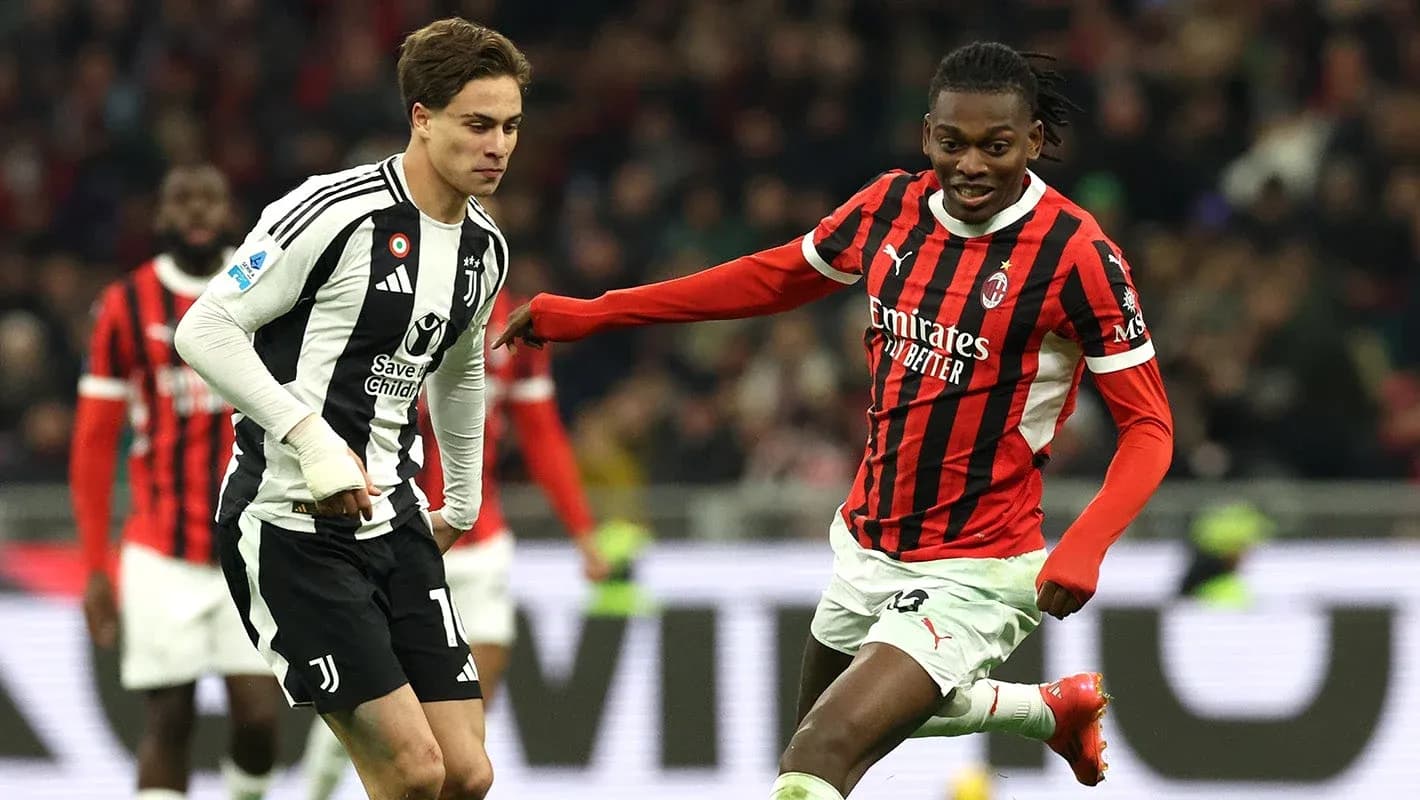
For Milan, Rafael Leão – 9 league goals and 3 assists in total – started as the left forward in the 3-5-2, paired with Pulisic, who has 8 goals and 3 assists overall. Together they form a dual-pronged counter-attacking threat that thrives when space opens. Their task was to unpick a Juventus back three marshalled by Bremer, supported by P. Kalulu and L. Kelly, in front of a team that has conceded only 29 goals in total and kept 15 clean sheets.
Juventus’ defensive shield is structurally sound and statistically elite. On their travels they concede just 0.9 goals per game, and here the back line held its nerve. Bremer’s positioning squeezed Leão’s preferred inside-left lanes, while the double screen of Locatelli and K. Thuram limited the quality of ball into Milan’s forwards. When Leão did receive between the lines, he met a compact block rather than the broken-field chaos he prefers.
At the other end, the “Hunter” role belonged more to the collective than a single star. Jonathan David’s 6 goals and 4 assists overall paint him as a hybrid finisher-creator, while Kenan Yıldız, watching from the bench, represents Juventus’ most productive attacking profile this season with 10 goals and 6 assists in total. Spalletti’s choice to start Conceição and Boga behind David leaned into dribbling and 1v1s rather than Yıldız’s all‑round orchestration.
Milan’s shield – M. Maignan behind a trio of S. Pavlović, M. Gabbia and Fikayo Tomori – has underpinned 15 clean sheets overall and a total concession of just 27 goals. At home they allow only 0.9 per game, and the structure here was textbook Allegri: Tomori aggressive in stepping out, Gabbia anchoring, Pavlović covering depth. Juventus’ attempts to overload the half-spaces were repeatedly funneled wide, where A. Saelemaekers and D. Bartesaghi could double up with the outside centre-backs.
In midfield, the “Engine Room” clash was defined by Luka Modrić and Adrien Rabiot against Locatelli and McKennie. Modrić, at the base of Milan’s central trio, dictated tempo and passing angles, while Rabiot provided the legs to shuttle into both boxes. Locatelli, one of Serie A’s leading yellow-card recipients with 8 bookings overall, walked the line between disruption and discipline, racking up interventions without tipping into chaos. His season numbers – 91 tackles, 23 blocked shots and 36 interceptions – were reflected in a performance that constantly broke Milan’s rhythm.
McKennie, meanwhile, embodied Juventus’ two-way ambition: 5 goals and 5 assists overall, plus 35 tackles and 8 blocked shots. His runs beyond the ball forced Milan’s midfield five to constantly recalibrate, preventing them from simply sitting in a low block.
IV. Statistical Prognosis – A Stalemate with Champions League Weight
Following this result, the raw numbers still favour both sides as Champions League calibre outfits. Milan’s overall goal difference of 21, built on 48 scored and 27 conceded, reflects a team that manages risk exceptionally well. Juventus’ superior goal difference of 28 (57 scored, 29 conceded) speaks to a slightly higher attacking ceiling, particularly at home, but their away metrics – 23 goals for, 16 against – underline a pragmatic edge on the road.
In xG terms, the shape of this match was always likely to be tight. Milan’s season-long averages (1.4 scored, 0.8 conceded) against Juventus’ (1.7 scored, 0.9 conceded) suggest a marginally higher offensive output for the visitors, but the defensive solidity on both sides and their combined 30 clean sheets overall pointed strongly toward a low‑scoring contest.
The late-game card profiles for both teams hinted that the final quarter-hour could decide everything, either through a lapse in discipline or a tired leg in the box. Instead, both back lines held, both midfields ran themselves into the turf, and the penalty narratives – Milan perfect from 5 overall, Juventus 2 from 2 but with Yıldız and Pulisic each having a miss on their personal records – never came into play.
The tactical verdict: this was a draw that confirmed rather than questioned the identities of both squads. Milan remain the masters of controlled aggression in a 3-5-2 that protects Maignan and unleashes Leão and Pulisic when possible. Juventus stay the more expansive, multi-structured side, able to morph their 3-4-2-1 into a front three or a reinforced midfield without losing defensive solidity.
In a title race this may feel like two points dropped for either side. In the quieter language of underlying performance, it reads as something else: two Champions League-bound teams, finely matched, cancelling each other out in a tactical arm-wrestle that may yet define who finishes 3rd and who settles for 4th.