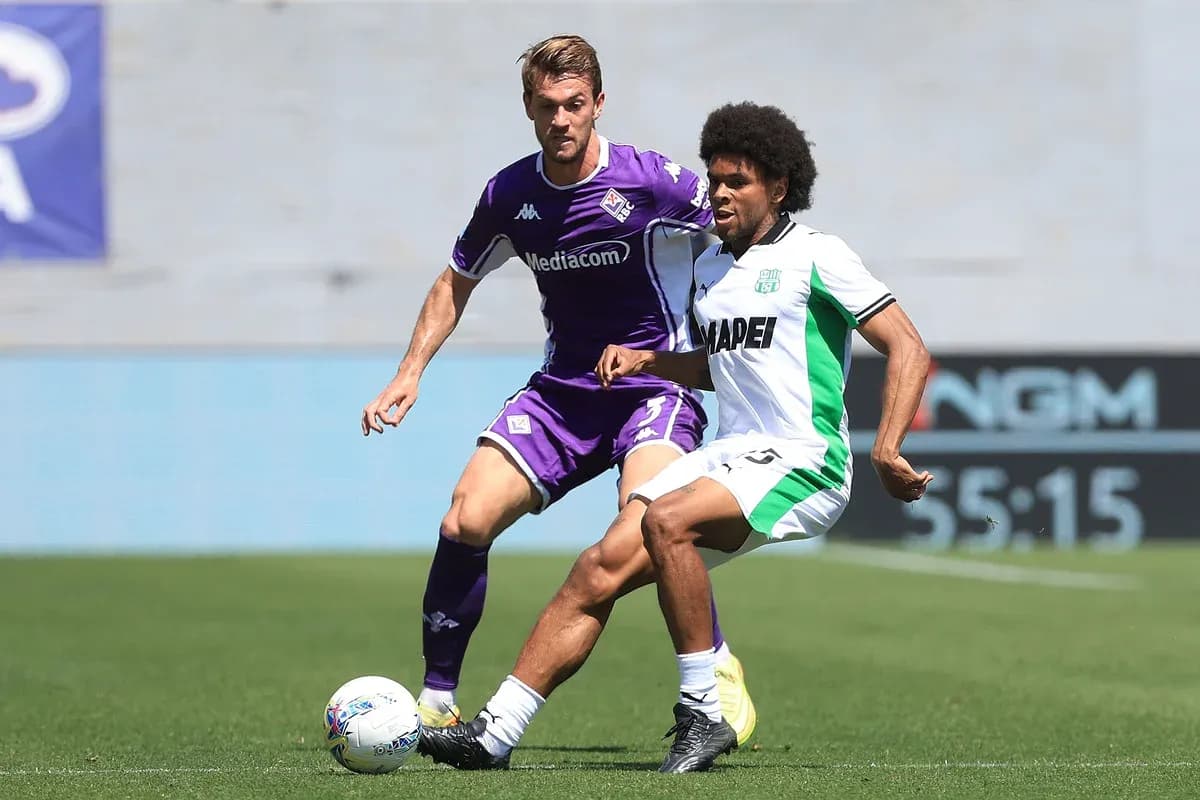
Fiorentina and Sassuolo End in 0-0 Stalemate
Stadio Artemio Franchi felt strangely unresolved at full time. A 0-0 that did not quite fit the narrative of two sides whose seasons have been defined more by chaos than control. Following this result, Fiorentina remain 15th on 37 points, their goal difference locked at -7 after 38 goals for and 45 against. Sassuolo, 10th with 46 points and a goal difference of -3 (41 scored, 44 conceded), leave Florence with the draw that their table position suggests but the flow of the game often questioned.
Both coaches leaned into their seasonal identities. Paolo Vanoli went back to the 4-3-3 that has been Fiorentina’s most-used structure this campaign (11 league outings), a shape designed to stabilise a team whose form line – “DDLLDLLDLLDDLLLWLWDDWLLDWWLDWDWWDD” – reads like a seismograph. Fabio Grosso, by contrast, doubled down on Sassuolo’s 4-3-3, the formation they have deployed in 32 of 34 league games, trusting the patterns that have brought 13 wins and 41 goals overall.
The tactical voids were glaring even before a ball was kicked. Fiorentina were stripped of their cutting edge and balance: Moise Kean, their joint top league scorer with 8 goals, was out with a calf injury; Robin Gosens, F. Parisi and T. Lamptey removed natural width and overlapping threat on the left; Marin Pongračić, suspended for yellow cards, took with him 10 bookings, 22 successful blocks and a dominant aerial presence from the heart of defence. N. Fortini’s back injury further thinned the depth.
For Sassuolo, the absence of Domenico Berardi – sidelined by a red-card suspension – was as much psychological as tactical. Seven goals, four assists and a creative gravity that bends entire defensive blocks out of shape were missing from Grosso’s right flank. D. Boloca’s muscle injury robbed them of midfield verticality, while D. Bakola, F. Cande and E. Pieragnolo remained on the injury list, limiting rotation options at the back and on the flanks.
Those absences shaped the lineups. Fiorentina’s back four of Dodo, D. Rugani, L. Ranieri and L. Balbo stood in front of D. de Gea, with a midfield triangle of R. Mandragora, N. Fagioli and C. Ndour tasked with building through thirds rather than going direct to a missing focal striker. Up front, J. Harrison and M. Solomon flanked A. Guðmundsson, whose season has been a curious blend of creativity and volatility: 5 goals, 4 assists, and a red card on his disciplinary record.
Sassuolo mirrored the shape but not the intention. U. Garcia and S. Walukiewicz at full-back, with J. Idzes and T. Muharemovic centrally, shielded S. Turati. Ahead, N. Matic anchored the midfield with I. Kone and K. Thorstvedt offering legs and late arrivals. The front three of C. Volpato, A. Pinamonti and A. Laurienté was built around one clear idea: use Laurienté’s 8 assists and 47 key passes to feed Pinamonti, who has 8 goals but also a red card and one missed penalty this season.
The Hunter vs Shield duel crystallised around Pinamonti and Fiorentina’s defence. Heading into this game, Fiorentina conceded an average of 1.2 goals at home, 20 in 17 matches. Their minute-distribution for goals against shows a worrying late-game pattern: 22.22% of their concessions come between 76-90 minutes, with 20.00% in both the 46-60 and 61-75 ranges. Pinamonti, whose own scoring profile aligns with Sassuolo’s offensive surges between 46-75 minutes (45.24% of their goals overall fall in that window), was primed to exploit exactly where Fiorentina bend most.
Yet the Shield held. Without Pongračić, L. Ranieri’s season-long numbers hinted at a different type of defender stepping forward. Across the campaign he has committed only 21 fouls despite 176 duels, with 34 tackles and 8 successful blocks. That blend of timing and anticipation was crucial in keeping Pinamonti’s 51 shots and 26 on target this season from finding another victim. D. Rugani’s conservative positioning completed a back line that prioritised protection over progression.
In the Engine Room, the duel between N. Fagioli and N. Matic defined the game’s tempo. Fagioli, deployed as a connective midfielder, tried to accelerate Fiorentina’s transitions, but he often found himself funneled into Matic’s orbit. The Serbian’s season – 42 tackles, 9 blocked shots and 23 interceptions – underpinned Sassuolo’s ability to slow Fiorentina just as they approached the dangerous 46-60 minute window where the hosts have scored 26.32% of their league goals.
Card profiles hinted at a simmering, if not explosive, contest. Fiorentina’s yellow cards skew heavily late: 25.64% in the 76-90 minute range and another 15.38% in stoppage time (91-105). Sassuolo mirror that edge, with 28.38% of their yellows also arriving between 76-90 minutes and 14.86% deep into added time. Both sides are used to living on the disciplinary line late on; that the match finished without decisive dismissals owed as much to referee Livio Marinelli’s management as to player restraint.
Statistically, the stalemate runs against the grain of the season. Overall, Fiorentina average 1.1 goals for and 1.3 against per game, Sassuolo 1.2 for and 1.3 against. Under/over profiles for both sides tilt towards low-scoring contests (only 2 of Fiorentina’s 34 games have gone over 2.5 goals, and just 5 of Sassuolo’s), so the 0-0 fits the macro trend, even if the tactical matchup suggested a narrow edge for the visitors.
From an xG and defensive solidity perspective, the draw feels like a slight victory for Fiorentina’s structure. Their late-game frailty – 22.22% of goals conceded between 76-90 – met a Sassuolo attack that is particularly dangerous from 61-75 (23.81% of their goals) and 46-60 (21.43%). Neutralising that intersection was Vanoli’s central achievement. Sassuolo, for their part, extended their tally of clean sheets on their travels to 4, reinforcing a defensive profile that is sturdier away (1.2 goals conceded on average) than at home (1.4).
Following this result, Fiorentina emerge as a side that may finally be learning to suffer without collapsing, while Sassuolo leave with the sense that, without Berardi’s chaos and Pinamonti’s penalty-box edge, their 4-3-3 can control games but not always decide them. In a season defined by volatility, this was ninety minutes of rare, if uneasy, equilibrium.