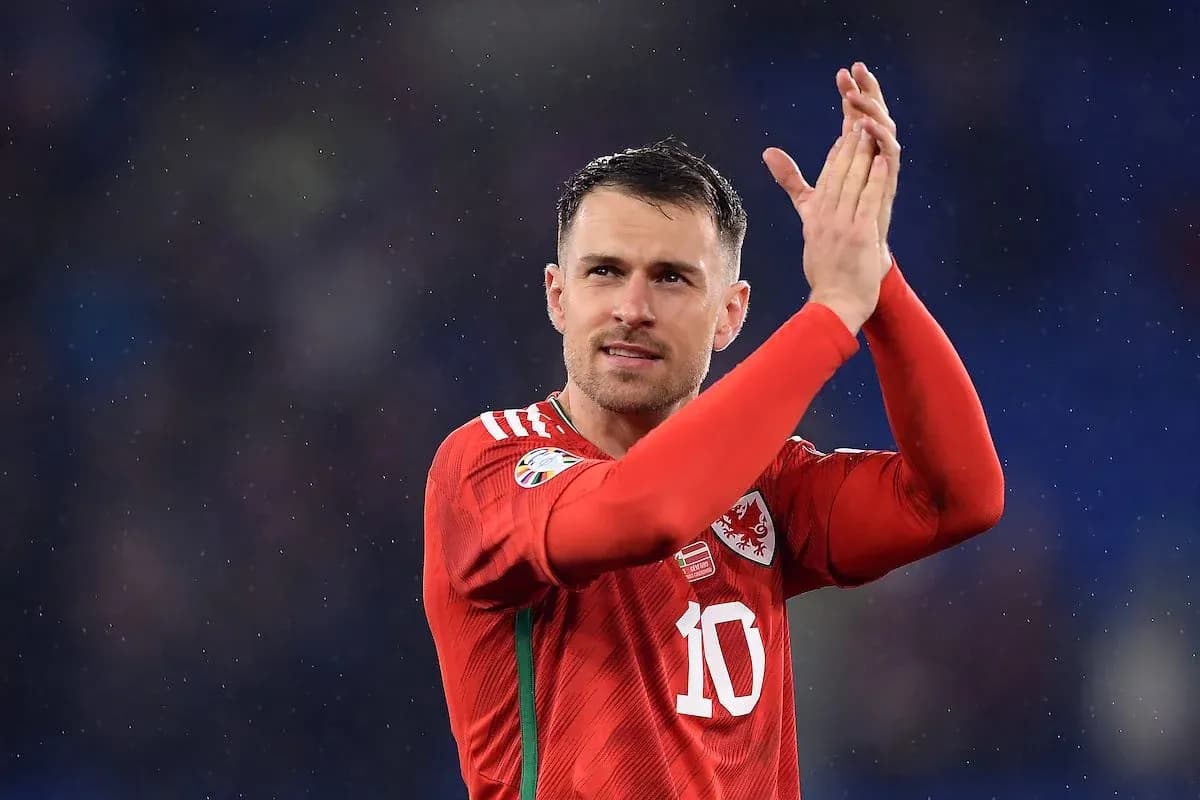
Aaron Ramsey: A Farewell to Cymru's Heartbeat
Aaron Ramsey, the elegant heartbeat of Cymru’s golden generation, has called time on his playing career at 35 – a farewell that feels as much like the closing of an era as the retirement of a single player.
For 16 years in a red shirt, Ramsey stitched himself into the fabric of Welsh football history. Eighty-six caps. Twenty-one goals. Three major tournaments. Semi-finalist at EURO 2016. A driving force behind qualification for EURO 2020 and the 2022 FIFA World Cup. For a nation that once waited 58 years to reach a major finals, his impact cannot be measured by numbers alone.
“It has been my privilege to wear the Welsh shirt and experience so many incredible moments in it,” he said as he confirmed his decision to retire. He spoke of managers, staff, the people around him who helped him get there. But anyone who watched Cymru over the last decade and a half knows how often Ramsey was the one dragging his country with him.
From teenage prodigy to captain of a nation
John Toshack saw it first. In November 2008, he threw a 17-year-old Ramsey into senior international football. The youngster had already raced through the U17, U19 and U21 sides ahead of schedule, a clear outlier in both talent and temperament.
By 20, he was no longer just a rising star. Gary Speed handed him the captain’s armband, a statement that Ramsey was not only the future of Cymru, but its present. That faith would be repaid on some of the biggest nights the national team had ever known.
A versatile midfielder who glided between deep-lying playmaker and advanced creator, Ramsey combined technical class with a sharp competitive edge. He led, he organised, he demanded. Over the years he wore the armband under different managers, and he ends his international journey as captain to Craig Bellamy.
EURO 2016: the summer that changed everything
For generations of Cymru supporters, the story of EURO 2016 begins and ends with a sense of disbelief. For Ramsey, it was the stage on which his reputation went global.
He was central to Chris Coleman’s side as they finally ended that 58-year exile from major tournaments. In France, he didn’t just belong – he shone. Ramsey’s energy, vision and timing drove Cymru to a historic semi-final, where they eventually fell to Portugal, the future champions.
He never made it onto the pitch that night in Lyon. A yellow card in the quarter-final win over Belgium ruled him out of the biggest game in modern Welsh history, a cruel twist that still lingers in the national memory. Yet his performances up to that point were impossible to ignore. He earned a place in the UEFA Team of the Tournament alongside midfield partner Joe Allen, a fitting nod to the influence he had exerted on the competition.
The man for the decisive night
Ramsey’s defining moments rarely came in low-stakes fixtures. When Cymru needed him most, he usually answered.
To reach EURO 2020, they had to beat Hungary in their final qualifier. Ramsey scored both goals in a 2-0 win, a night in Cardiff that felt like a personal mission as much as a collective one. Those finishes did not just secure a ticket to another finals – they underlined his role as the man who could carry the weight of a nation’s expectation.
He would later see another lifelong target achieved as Cymru reached the 2022 FIFA World Cup in Qatar. For a player whose early years coincided with the barren days of Welsh football, to stand on that stage completed a circle few thought possible when he first emerged.
His last appearance for Cymru came in September 2024, coming off the bench in a 2-1 away victory over Montenegro in the UEFA Nations League. Before the match, Bellamy did not underplay his significance.
“We’re talking about one of the best players to ever play for Wales,” the head coach said, before reeling off the clubs on Ramsey’s CV – Arsenal, Juventus, Nice – as proof of the standards he had maintained. Bellamy spoke of the example Ramsey set, the details in his attitude and preparation, the way young players watched him and learned what it meant to live at the top level.
Club career: Wembley hero and serial winner
If Cymru gave Ramsey his greatest emotional highs, club football gave him some of his most iconic images.
He came through at Cardiff City, the local boy rising from the youth ranks to the first team and featuring in the 2008 FA Cup Final defeat to Portsmouth. That Wembley appearance brought him to wider attention, and the move to Arsenal soon followed.
At the Emirates, the FA Cup would become his personal stage. Under Arsène Wenger, despite suffering a horrific broken leg in 2010, Ramsey fought his way back to become one of the Premier League’s standout midfielders over the next decade.
His defining club moments came in that same competition he first graced with Cardiff. He lifted the FA Cup three times with Arsenal, scoring the winning goals in the 2014 and 2017 finals. Twice he decided the showpiece occasion at Wembley, twice he turned silverware from hope into reality.
In 2019 he left north London and followed the path once taken by John Charles, signing for Juventus. In Turin he added major honours to his résumé: a Serie A title, the Coppa Italia and the Supercoppa Italiana. The medals only underlined what those who watched him weekly already knew – his game translated at the very highest level.
His journey then took him to Rangers, where he helped the Glasgow club win the Scottish Cup and reach the UEFA Europa League final in 2022. Spells with Nice in France and UNAM in Mexico’s Liga MX rounded off a club career that spanned countries, cultures and styles.
As his playing days wound down, Ramsey also stepped into the technical area, taking over as interim head coach of Cardiff City for the final fixtures of the 2024/25 season. Even as his legs began to slow, the game’s pull – and his instinct to lead – remained.
An irreplaceable heartbeat
Ramsey scored in both EURO 2016 and EURO 2020 – against Russia in a 3-0 win in France, and against Türkiye in a 2-0 victory that helped drive another campaign forward. Those goals sit easily on any highlight reel, but they only hint at what made him different.
It was the way he saw passes others never spotted. The weight of the ball, the timing of the run, the calm in tight spaces when everything around him seemed to quicken. His leadership was not just about armbands or team talks; it was about taking responsibility in the most demanding moments and making the right choice when panic would have been easier.
He arrived as a teenager with frightening potential. He leaves as one of the defining players of his generation, a standard-bearer for a country that learned to believe again.
For the Red Wall, the memories will not fade quickly. Nor will the question that now hangs in the air: how do you replace a player like Aaron Ramsey, when the honest answer is that you probably never do?