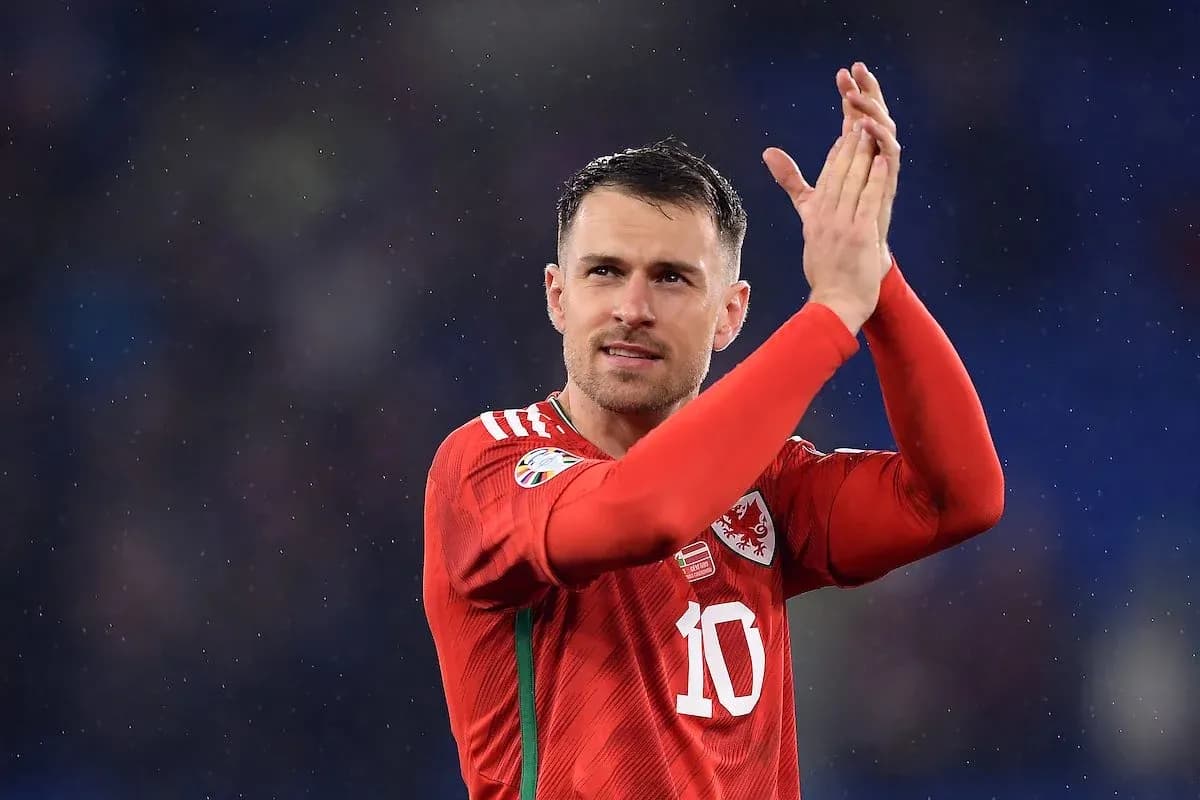
Aaron Ramsey: The Heartbeat of Cymru's Golden Generation
Aaron Ramsey, the elegant heartbeat of Cymru’s golden generation, has called time on his playing career at 35 – leaving behind numbers that tell only a fraction of the story.
Eighty-six caps. Twenty-one goals. Three major tournaments. Sixteen years at the centre of a national transformation.
“It has been my privilege to wear the Welsh shirt and experience so many incredible moments in it,” Ramsey said as he confirmed his retirement, paying tribute to the managers and staff who shaped his journey. The word “privilege” cuts both ways. For a country that waited 58 long years to feel relevant on the biggest stage again, the feeling is mutual.
From teenage prodigy to captain of a nation
John Toshack saw it first. In November 2008, he threw a 17-year-old Ramsey into senior international football and never looked back. The teenager had already sped through the U17, U19 and U21 levels ahead of schedule; it felt inevitable he would end up running the senior side as well.
By 20, he was doing exactly that. Gary Speed, building something bold and modern, placed the armband on Ramsey’s arm. It was a statement as much as a selection: this was a player to build around, technically gifted yet fiercely competitive, capable of dictating a game or finishing it.
Ramsey grew from versatile midfielder into a more advanced, attacking presence as his career evolved. He drifted between lines, broke into the box, threaded passes that split defences and nerves alike. Coaches trusted him, team-mates followed him. Craig Bellamy, who inherited him as captain in the final chapter, saw the same qualities.
EURO 2016: the summer he owned Europe
The defining image of Ramsey in a Cymru shirt may not be of him playing at all, but sitting suspended in the stands as his team lost their EURO 2016 semi-final to eventual champions Portugal.
They had got there largely because of him.
Chris Coleman’s side ended that 58-year exile from major tournaments by qualifying for EURO 2016, then ripped up the script in France. Ramsey was at the centre of it all, driving Cymru into the last four and earning a place in the UEFA Team of the Tournament alongside midfield partner Joe Allen.
He missed the semi-final, but his imprint on that campaign was unmistakable. The wider recognition he received from Europe simply confirmed what the Red Wall had long believed: at his peak, Ramsey was world class.
The man for the moment
Ramsey’s knack for timing did not fade after France.
When Cymru needed a result to reach EURO 2020, it was Ramsey who stepped up. Two goals in a 2-0 win over Hungary in the final qualifier, a night that felt like a personal mission as much as a national one. He delivered, and the country followed him again.
He scored at EURO 2016 in the 3-0 win over Russia. He scored at EURO 2020 in the 2-0 victory over Türkiye. He then ticked off a lifelong ambition as Cymru qualified for the 2022 FIFA World Cup in Qatar. For a generation that grew up on near-misses and hard-luck stories, Ramsey helped rewrite the script.
His final appearance for Cymru came in September 2024, coming off the bench in a 2-1 away win over Montenegro in the UEFA Nations League. Bellamy, speaking before that game, did not bother with understatement.
“We’re talking about one of the best players to ever play for Wales,” the head coach said, highlighting Ramsey’s influence on young players and his enduring standards in training and in games. The respect was clear. So was the legacy.
Arsenal, Wembley and a career rebuilt
The international story only makes sense alongside the club career that ran parallel.
Ramsey emerged at boyhood club Cardiff City, rising through the youth ranks and reaching the 2008 FA Cup Final as a teenager, where Cardiff fell to Portsmouth. Arsenal moved quickly. The switch to north London would define him.
Under Arsène Wenger, Ramsey became one of the Premier League’s standout midfielders across the best part of a decade, despite a horrific broken leg in 2010 that could easily have derailed him. He refused to let it.
The FA Cup became his stage. He lifted the trophy three times with Arsenal, scoring the winning goal in both the 2014 and 2017 finals. Those Wembley strikes sealed silverware and etched his name into club folklore.
In 2019, he chose a new challenge and a familiar path for a Cymru great, joining Juventus and following in the footsteps of John Charles. Turin brought trophies: a Serie A title, a Coppa Italia and a Supercoppa Italiana, with Ramsey adding Italian honours to an already rich CV.
His journey then took him to Rangers, where he helped the club win the Scottish Cup and reach the UEFA Europa League final in 2022, before spells with Nice in France and UNAM in Mexico’s Liga MX rounded off his club career. Late on, he stepped briefly onto the touchline too, taking over as interim head coach of Cardiff City for the final fixtures of the 2024/25 season, hinting at a future beyond the pitch.
An irreplaceable thread in Cymru’s story
Strip it back and the numbers impress: almost 550 competitive club games despite persistent injuries, 86 caps, goals at back-to-back European Championships, qualification-clinching performances when the pressure burned hottest.
Yet the numbers still undersell him.
Ramsey’s real legacy lies in the way he played. The glide across midfield. The disguised pass that opened a defence. The late run into the box at exactly the right moment. The quiet, assured leadership that never needed a slogan.
He arrived as a teenager with frightening potential. He leaves as one of the finest players Cymru has ever produced, a central figure in an era that changed how a nation sees its football team.
For the Red Wall, the memories will not fade quickly. Nor will the question that lingers now: who on earth replaces Aaron Ramsey?