Žilina's Tactical Mastery in 2-1 Comeback Against Hajduk Split
Žilina’s 2-1 comeback over HNK Hajduk Split at Štadión pod Dubňom was shaped far more by structure, pressing triggers and in‑game adjustments than by any dominance in the classic statistical categories, most of which are not recorded here. With the tie played in the UEFA Europa League 1st Qualifying Round, both coaches leaned heavily on their preferred identities: Pavol Stano kept Žilina in a high-energy 3-4-3, while Gonzalo Garcia set Hajduk up in a 4-2-3-1 built to control the half-spaces and spring transitions.
Out of possession, Žilina’s back three of T. Paliscak, J. Minarik and A. Narimanidze gave them immediate width in the first line, allowing the wing‑backs T. Hranica and K. Bari to jump aggressively onto Hajduk’s full-backs. The first half, however, belonged structurally to the visitors. With R. Pukstas and A. Pajaziti forming the double pivot, Hajduk consistently created a 2‑4 base in build-up: the centre-backs M. Skelin and Alec Van Hoorenbeeck split, the full-backs S. Hrgovic and D. Melnjak advanced, and the pivots offered short angles to beat Žilina’s first press.
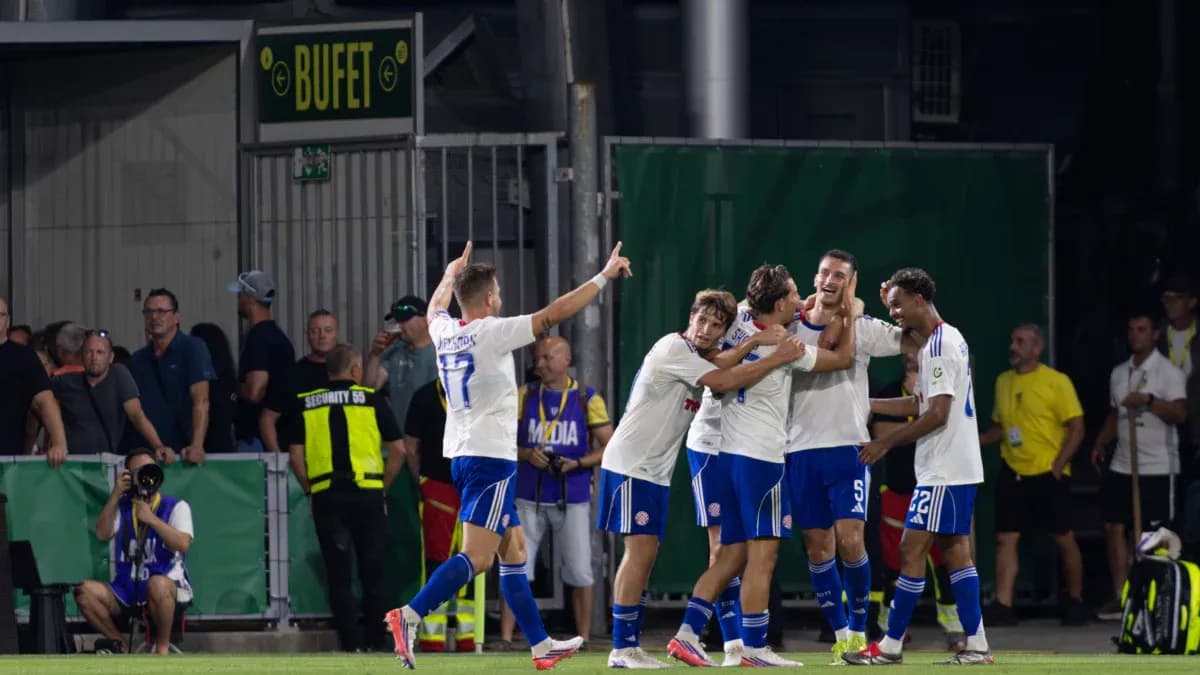
The key pattern behind Hajduk’s 45' opener came from that left side. Hrgovic, nominally the right-back on the teamsheet, was decisive as a provider from deeper zones, while Melnjak attacked the far post. The goal itself — Alec Van Hoorenbeeck finishing from an assist by S. Hrgovic — reflected Hajduk’s emphasis on wide overloads and second-phase control around Žilina’s box. The subsequent VAR check at 45+3' confirmed the goal and underlined how deliberately Hajduk had targeted the spaces around Žilina’s outside centre-backs.
Žilina went in 0-1 down at half-time but Stano’s structural response was immediate. At 46', M. Okal (IN) came on for T. Paliscak (OUT), a like-for-like defensive change on paper that subtly rebalanced the back line. Okal’s introduction stabilised the right side and allowed Hranica to push higher as a true wing‑back, while the central midfield pairing of X. Adang and M. Kacer became more aggressive in stepping onto Hajduk’s pivots.
The equaliser at 52' came straight from this higher second-half posture. With Žilina’s front three of F. Kosa, M. Roginic and P. Ilko stretching Hajduk’s back four horizontally, the home side could finally find vertical lanes into the half-spaces. Roginic’s 52' goal, assisted by Kosa and confirmed by VAR at 54', was a classic 3‑4‑3 pattern: wing‑back or wide forward receiving between the lines, a quick combination, and a central finish against a backpedalling defence. It marked a clear momentum shift, with Žilina now compressing the pitch and forcing Hajduk’s 4‑2‑3‑1 to defend deeper than intended.
From that point, the tactical battle revolved around bench usage and control of central zones. Garcia’s first adjustment at 64' — D. de Almeida (IN) for N. Skoko (OUT) — aimed to restore ball security and line-breaking passing from the No. 10 space. Stano answered at 66' with a double change: F. Bzdyl (IN) for M. Kacer (OUT) and M. Fasko (IN) for F. Kosa (OUT). This effectively refreshed both the central engine and the left side of the front line, keeping Žilina’s pressing intensity high and their transitions sharp.
The 67' yellow card for Xavier Adang (“Persistent fouling”) was a direct by-product of Žilina’s more combative midfield stance. Adang repeatedly stepped out to disrupt Hajduk’s attempts to play through Pukstas and Pajaziti, accepting disciplinary risk to prevent the visitors from settling into their earlier rhythm. Later, at 82', A. Florea (IN) replaced Adang (OUT), giving Žilina fresh legs and a slightly different profile in the right half-space, which became important for closing the game out.
Hajduk’s 75' double change — A. Sanyang (IN) for S. Hrgovic (OUT) and A. Guram (IN) for R. Brajkovic (OUT) — shifted their attacking reference points. Without Hrgovic’s deep delivery from the right and Brajkovic’s third‑man runs, Hajduk lost some of the wide patterns that had troubled Žilina in the first half. Instead, they leaned more on individual actions and late surges, which Žilina’s now more settled back three could manage with better spacing.
Up front, the 72' substitution of S. Datko (IN) for P. Ilko (OUT) further freshened Žilina’s pressing line, ensuring the home side could continue to harass Hajduk’s build-up into the final quarter-hour. Garcia’s 84' move to bring on M. Livaja (IN) for M. Sego (OUT) signalled a desire for a stronger penalty‑box presence and link play, but by then Žilina’s block was compact and well-protected by the extra midfield energy of Florea and Bzdyl.
The decisive late phase encapsulated the game’s tactical arc. A. Florea’s 90+2' yellow card (“Foul”) reflected Žilina’s willingness to break up transitions and protect their advantage with calculated interventions. The 90' own goal by D. Melnjak, credited to Žilina, was less about a crafted pattern and more about sustained territorial pressure forcing errors in Hajduk’s defensive third. With the visitors now chasing and their structure stretched, the home side’s aggressive wing‑back play and constant occupation of central channels increased the likelihood of such a mistake.
Defensively, both teams walked a fine line. Hajduk’s first-half yellows — Šimun Hrgović at 21' and Alec Van Hoorenbeeck at 30', both for “Foul” — came from trying to contain Žilina’s direct running and counter-press. Žilina’s pair of cautions (Adang for “Persistent fouling”, Florea for “Foul”) spoke to a second-half in which the home side accepted more defensive duels to protect their lead.
With no recorded data on possession, shots, passes or saves, the tactical verdict rests on structure, substitutions and discipline. Hajduk’s 4‑2‑3‑1 controlled the early phases and produced a well‑constructed lead through wide overloads, but their later changes removed some of the mechanisms that had hurt Žilina. Stano’s use of his bench — especially the early defensive reshuffle with Okal, the energetic midfield rotation with Bzdyl and Florea, and the refreshed front line with Fasko and Datko — allowed Žilina’s 3‑4‑3 to grow into the game, increase territorial pressure, and ultimately force the decisive own goal. In a tie where the numbers are largely absent, the 2-1 scoreline reflects a contest won in structural adaptation and second-half intensity rather than in clear statistical superiority.