Universitatea Craiova vs Ararat-Armenia: Tactical Analysis of 1-1 Draw
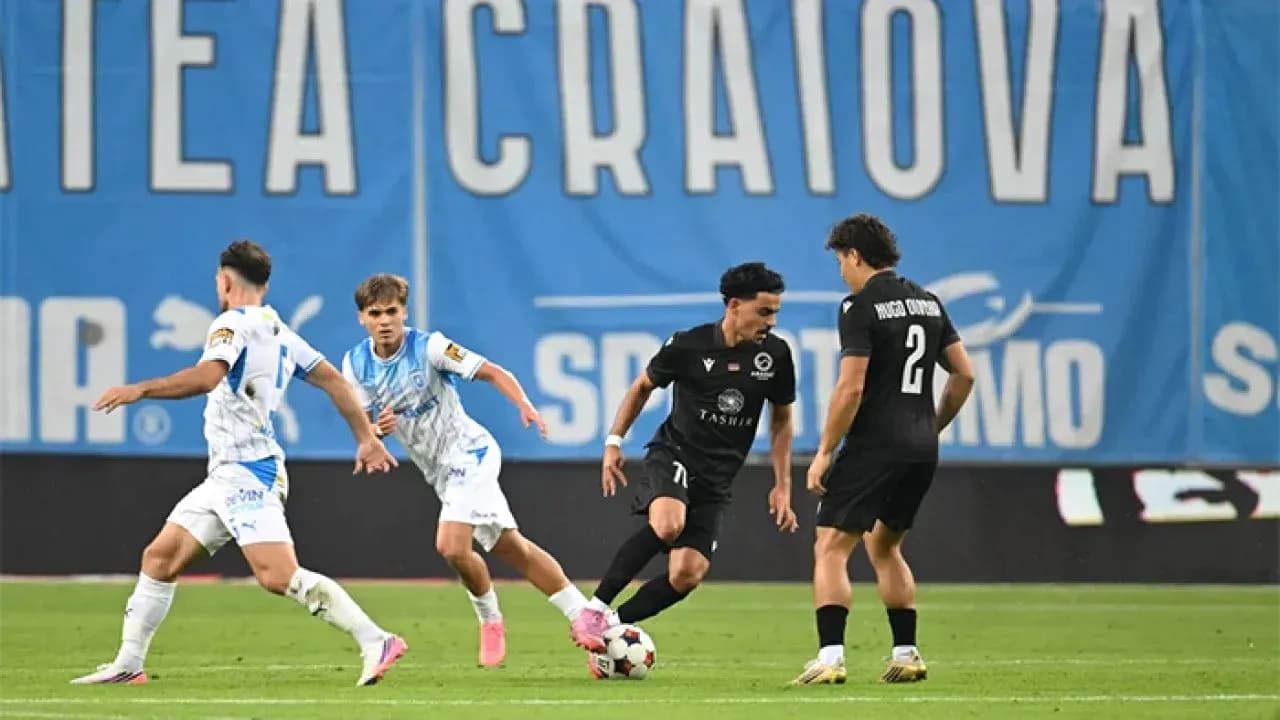
Universitatea Craiova’s 3-4-3 and Ararat-Armenia’s 4-3-3 produced a tactically tight 1-1 at Stadionul Ion Oblemenco, defined more by structure and risk management than by chaos. The statistical profile is clear: Craiova generated the bulk of the finishing volume (7 shots on goal, 7 off target, plus 1 blocked), while Ararat-Armenia were far more selective (2 shots on goal, 4 off target, 2 blocked). Yet the scoreboard and the possession figures both locked at parity: both teams are recorded with 0% ball possession, which prevents any firm conclusion on territorial control but underlines that the draw came from contrasting approaches rather than one-sided dominance.
Team Strategies
Filipe Coelho’s 3-4-3 for Universitatea Craiova was built around a back three of O. Romanchuk, A. Rus and V. Screciu, with width and progression coming from N. Bancu and C. Mora as nominal wide midfielders. In practice, Bancu operated as the primary left-sided outlet and final-third reference, supported inside by A. Cicaldau and A. Mekvabishvili. The front line of D. Matei, A. Al Hamlawi and S. Baiaram gave Craiova three vertical points, but the shot map distribution (7 on goal, 7 off) suggests a side that often had to shoot under pressure rather than consistently manufacturing clear, central chances.
Ararat-Armenia’s 4-3-3 under Tulipa was much more conservative in terms of volume. The back four of E. Grigoryan, A. Malis, B. R. Wilson Valdez and Junior Julio, with H. Oliveira stepping into the second line, gave them a strong central block. The midfield trio of K. Muradyan, Benny and A. Serobyan (with rotations as substitutions arrived) was tasked with screening rather than over-committing. Up front, Sandro Lima was the reference point, flanked by Z. Banjaqui and A. Serobyan initially, before a series of like-for-like changes refreshed the wide lanes. With only 2 shots on goal and 4 off, Ararat-Armenia clearly prioritised shot quality and defensive stability over sustained attacking pressure.
Wing Play and Tactical Dynamics
The game’s key tactical hinge was how each side used its wing corridors. Craiova’s 3-4-3 naturally created 2v1 or 3v2 scenarios on the flanks, with Bancu and Mora pushing high and Cicaldau sliding across to overload. This is reflected in their corner count: 8 corner kicks to Ararat-Armenia’s 4, signalling repeated territorial gains in wide areas and forced defensive interventions. However, Ararat-Armenia’s double layer on the outside – full-back plus a hard-working winger – and the presence of an extra central midfielder in the 4-3-3 allowed them to absorb crosses and cut-backs without collapsing centrally.
Defensive Statistics
Defensively, the foul count paints an important picture. Craiova committed 15 fouls to Ararat-Armenia’s 5, and the home side also collected 4 yellow cards while the visitors avoided any bookings. This imbalance points to a Universitatea Craiova block that was more frequently reacting in transition and having to break up counters or late runs from midfield. It also suggests that when Ararat-Armenia did attack, they were able to draw contact in awkward zones, even if that did not translate into a high shot volume.
Substitution Patterns
Craiova’s substitutions at 62’ and 69’ were clearly aimed at refreshing the front line and midfield legs to maintain pressure. S. Nsimba (IN) came on for A. Al Hamlawi (OUT) and M. Etim (IN) replaced D. Matei (OUT) at 62’, a double change that re-energised the pressing and off-ball running in the final third. Later, Teles (IN) for A. Cicaldau (OUT) at 69’ shifted the profile of the midfield, potentially adding more vertical running and late box entries in place of Cicaldau’s more controlled distribution. The final wave at 85’, with T. Baluta (IN) for A. Mekvabishvili (OUT) and L. Basceanu (IN) for S. Baiaram (OUT), emphasised a push for fresh legs and different angles between the lines rather than a structural overhaul; the 3-4-3 framework remained intact.
Ararat-Armenia’s substitution pattern was more about preserving the integrity of their 4-3-3 while rotating the labour-intensive roles. Franca Carlos (IN) for Benny (OUT) at 69’ helped maintain energy in the midfield screen. J. A. Balanta (IN) for H. Oliveira (OUT) at 75’ and the triple change on 80’ – Z. Shaghoyan (IN) for Z. Banjaqui (OUT), M. Carlier (IN) for K. Muradyan (OUT), and A. Tera (IN) for A. Serobyan (OUT) – refreshed all three lines without altering the shape. This allowed Tulipa to keep his defensive structure intact late on, crucial in resisting Craiova’s renewed push after their own bench was deployed.
Goalkeeping and Shot Statistics
Without recorded goalkeeper saves, it is not possible to quantify the shot-stopping impact of L. Popescu (Universitatea Craiova) or Joao Bravim (Ararat-Armenia). What can be inferred, however, from the shots-on-goal differential (7 vs 2) is that Craiova’s pressing and territorial play forced Ararat-Armenia to defend their box for longer stretches, even if the visitors largely kept those efforts within manageable zones. The blocked shot numbers – 1 for Craiova, 2 for Ararat-Armenia – further underline Ararat-Armenia’s compactness and willingness to get bodies in front of efforts around the edge of the area.
Disciplinary Profile
The disciplinary profile is particularly telling in terms of game rhythm. Universitatea Craiova’s 4 yellow cards, combined with 15 fouls, indicate a stop-start dynamic largely driven by the home side’s aggressive counter-press and recovery runs. Ararat-Armenia’s 5 fouls and zero cards point to a more controlled, positional defensive game, relying on distances and structure rather than last-ditch interventions. This helped them maintain numerical parity and avoid the destabilising effect of suspensions or a late sending-off in a finely balanced play-off tie.
Overall Match Analysis
Overall, the tactical verdict is of a match where Universitatea Craiova carried more attacking initiative – as shown by their 7 shots on goal, 7 shots off target and 8 corners – but Ararat-Armenia executed a disciplined 4-3-3 that successfully limited high-risk situations and kept the game within a narrow margin. The absence of possession and passing data prevents a full passing-network analysis, yet the fouls, corners and shot distribution are enough to sketch the core dynamic: Craiova as the proactive, higher-risk side in a 3-4-3, Ararat-Armenia as the compact, low-volume 4-3-3 that left with a structurally earned draw.