Sweden’s Tactical Superiority in 5-1 Victory Over Tunisia
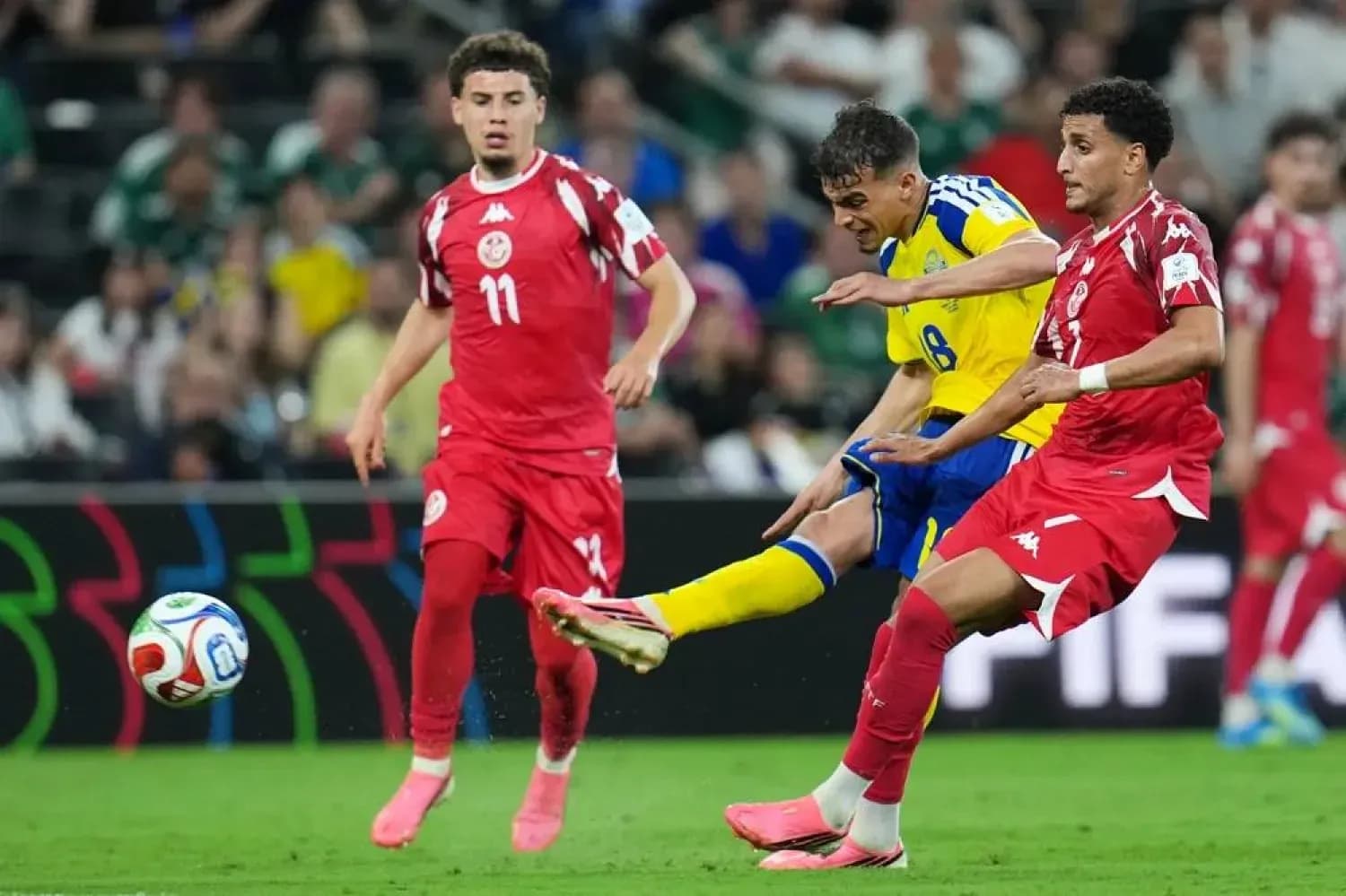
Sweden’s 5-1 win over Tunisia at Estadio BBVA was built on a clear structural superiority rather than territorial dominance. Graham Potter’s side accepted a near-even share of the ball (49% possession) but used their 3-1-4-2 to attack far more efficiently, generating 13 total shots to Tunisia’s 6 and 9 efforts from inside the box to Tunisia’s 2. Despite an xG of just 1.36, Sweden converted ruthlessly, repeatedly exploiting the spaces around and behind Tunisia’s back five.
In possession, Sweden’s back three of Gustaf Lagerbielke, Isak Hien and Victor Lindelöf provided a stable platform, with Jesper Karlström as the single pivot screening and connecting. The shape often resembled a 3-2-5 in attack: Karlström dropping alongside the central centre-back to facilitate circulation, with Yasin Ayari and Benjamin Nygren stepping into advanced half-spaces and Gabriel Gudmundsson plus Alexander Bernhardsson providing width. The front pair of Viktor Gyökeres and Alexander Isak constantly threatened the channels between Tunisia’s outside centre-backs and wing-backs.
Opening Goal
The opening goal at 7 minutes set the tactical tone. Sweden progressed through midfield and found Yasin Ayari between Tunisia’s midfield and defensive lines. His ability to arrive in advanced central pockets punished Tunisia’s 5-3-2, which struggled to compress vertically. With Tunisia’s midfield three occupied by Sweden’s double eights and pivot, Ayari was frequently the free man, and his early strike forced Tunisia’s block to become more aggressive and less compact.
Second Goal
Sweden’s second, on 30 minutes, highlighted the complementary movement of the front two. Viktor Gyökeres drifted into a wider lane to receive and then combined with Alexander Isak, who finished after being supplied by Gyökeres. This pattern — Gyökeres stretching the line horizontally, Isak attacking the inside channel — repeatedly unsettled Montassar Talbi and Omar Rekik, dragging them into uncomfortable 1v1s. Sweden’s 3-1-4-2 ensured they could always commit numbers around second balls, helping them win territory despite not dominating possession.
Tunisia's Strategy
Tunisia’s 5-3-2 under Sabri Lamouchi was designed for control rather than penetration. They actually edged possession (51%), completed 364 passes to Sweden’s 353, and matched Sweden’s pass accuracy at 79% (364 passes, 288 accurate for Tunisia; 353 passes, 280 accurate for Sweden). But their circulation was sterile: only 2 shots inside the box from 6 total attempts, and an xG of 0.28 reflects how rarely they converted possession into real chances. Much of their build-up stalled in front of Sweden’s midfield line, with Rani Khedira and Ellyes Skhiri forced into lateral passes under the cover shadow of Sweden’s front two.
Hannibal Mejbri’s creativity did carve out Tunisia’s lone goal at 43 minutes, when Omar Rekik scored from a situation Mejbri helped construct. That sequence showed Tunisia’s best route: quick vertical combinations when Mejbri could receive between the lines. But those moments were isolated. Sweden’s back three controlled the box, and with Karlström screening, Tunisia’s forwards Elias Saad and Anis Ben Slimane were often outnumbered 3v2 centrally.
Second Half
The second half underlined the divergence in attacking clarity. Sweden, already 2-1 up at the break, continued to attack decisively. On 59 minutes, Gyökeres finished a move assisted by Isak, again exploiting gaps as Tunisia’s wing-backs were caught high and the outside centre-backs dragged wide. Sweden’s shot profile — 7 shots on goal from 13 total, with 3 blocked — shows a team consistently creating clean looks rather than speculative efforts.
Potter’s in-game management further tilted the tactical balance. At 65 minutes, Elliot Stroud (IN) came on for Gabriel Gudmundsson (OUT), and Lucas Bergvall (IN) replaced Benjamin Nygren (OUT). These changes injected fresh legs into the wide and half-space roles, maintaining Sweden’s intensity against a tiring Tunisian back line. Later, Mattias Svanberg (IN) came on for Jesper Karlström (OUT) at 84 minutes, adding more forward thrust from midfield. Svanberg immediately impacted the game, scoring Sweden’s fourth at 84 minutes after being assisted by Isak, who continued to drop and link play even as the match opened up.
In contrast, Tunisia’s wave of substitutions around 72–84 minutes — Sebastian Tounekti (IN) for Elias Saad (OUT), Mohamed Belhadj Mahmoud (IN) for Yan Valery (OUT), Elias Achouri (IN) for Ellyes Skhiri (OUT), Ismael Gharbi (IN) for Rani Khedira (OUT), and Firas Chaouat (IN) for Anis Ben Slimane (OUT) — signalled a shift towards more attacking profiles but did not resolve their structural issues. With the midfield anchor removed and fresh attackers introduced, Tunisia lost what little central control they had, and Sweden found even more space to transition through the middle.
Defensive Performance
Defensively, Sweden were largely untroubled. They conceded only 2 shots on goal and 6 total shots, committing 10 fouls to Tunisia’s 8, which suggests they were able to defend proactively without resorting to persistent last-ditch challenges. The back three handled crosses and direct balls comfortably, while the single booking in the match went to Tunisia: at 54 minutes, Rani Khedira (Tunisia) — Tripping. That moment reflected Tunisia’s growing desperation as they tried to disrupt Sweden’s rhythm higher up the pitch.
In goal, Kristoffer Nordfeldt (Sweden) had a relatively quiet evening, credited with 1 save. Abdelmouhib Chamakh (Tunisia) also recorded 1 save, but the underlying metrics paint a harsh picture for the Tunisian goalkeeper unit. Both teams’ statistics list goals prevented at -2.99, and with Sweden scoring 5 from an xG of 1.36, Tunisia’s goalkeeping and last-line defending significantly underperformed the quality of chances faced. Sweden, by contrast, conceded only once from Tunisia’s xG of 0.28, underlining how little danger their structure allowed.
Final Stages
The final stages showcased Sweden’s depth and control of game state. At 90 minutes, Anthony Elanga (IN) came on for Alexander Isak (OUT), and at 90+1 minutes Daniel Svensson (IN) replaced Alexander Bernhardsson (OUT), preserving energy and defensive stability. Even with these rotations, Sweden kept their attacking edge, and in the 90+6 minute, Ayari added his second, assisted by Bergvall, capping a performance where Sweden’s positional play, vertical timing, and strike partnership outclassed Tunisia’s more rigid 5-3-2.
Overall, the 5-1 scoreline reflects not just clinical finishing but a coherent Swedish structure that consistently created high-quality central and half-space opportunities, while Tunisia’s possession-heavy approach lacked penetration and became increasingly vulnerable once they were forced to chase the game.