England vs France: Tactical Analysis of the 6-4 World Cup Final
France’s 6-4 defeat to England in the World Cup 3rd Place Final at Hard Rock Stadium, Miami Garden was a tactical rollercoaster defined by structural imbalance in the first half and aggressive recalibration after the break. England’s 4-0 half-time lead framed everything: it forced Didier Deschamps to abandon control principles and chase chaos, while Thomas Tuchel’s side shifted from proactive dominance to game-state management, using possession and field position to absorb France’s surge.
England’s early plan was clear and ruthlessly effective. With 54% of the ball and 515 passes (467 accurate, 91%), they built through Declan Rice as the central pivot, using Marcus Rashford and Bukayo Saka as aggressive wide outlets and Ivan Toney as a reference point. Rice’s early goal at 3' signalled a France midfield that was too flat: Warren Zaïre-Emery and Adrien Rabiot were often on the same horizontal line, leaving space in front of the centre-backs. England repeatedly exploited that pocket, drawing France’s defenders out and then attacking the gaps with runners from deep.
Set-piece and second-phase organisation hurt France badly. Ezri Konsa’s goal at 18' came from England’s ability to keep pressure alive around the box, with France failing to clear zones decisively. The back four of Malo Gusto, Ibrahima Konaté, Maxence Lacroix and Theo Hernández never established a stable line in the first half; distances between full-backs and centre-backs were inconsistent, and England’s 16 shots inside the box underline how easily they accessed high-value areas.
In open play, Tuchel tilted the structure asymmetrically. Djed Spence often stepped high to pin Theo Hernández, while Saka and Rashford attacked the half-spaces. England’s 19 total shots, with 11 on goal, reflected not volume for its own sake but shot quality from central locations. France’s press was disjointed: Kylian Mbappé led the line but was isolated, Michael Olise and Rayan Cherki did not always track England’s advancing full-backs, and Rice repeatedly received under minimal pressure, able to dictate tempo and direction.
Deschamps’ quadruple substitution at 46' was essentially a tactical reset rather than routine rotation. Bradley Barcola (IN) came on for Désiré Doué (OUT), Ousmane Dembélé (IN) for Rayan Cherki (OUT), Dayot Upamecano (IN) for Ibrahima Konaté (OUT), and Lucas Digne (IN) for Theo Hernández (OUT). The changes sharpened France’s edges in both transition and structure. Barcola’s direct running widened England’s back line, Dembélé provided 1v1 threat on the flank, and Upamecano brought more front-foot defending to compress the space behind the midfield.
The impact was immediate. France’s 19 total shots matched England’s, but crucially they produced 12 shots inside the box and 9 on goal, supported by an xG of 2.87. The second-half plan was to attack earlier and more vertically: Mbappé dropped into the left half-space to combine with Olise, who acted as the primary creative hub between the lines. The 48' goal from Mbappé, assisted by Olise, encapsulated the new pattern: early ball into Mbappé’s feet, quick combination, and a finish before England could reset.
France’s second and third goals, at 54' (Barcola, assisted by Mbappé) and 66' (Mbappé again from Olise’s pass), came from the same logic: overloads on the flanks, quick switches, and aggressive runs into the box. England, who had defended compactly in the first half, now struggled to control the wide channels. Their 6 blocked shots show a team forced into last-ditch interventions as France flooded the penalty area with runners.
Tuchel’s response was to adjust personnel rather than radically alter the shape. At 79', Jude Bellingham (IN) replaced Eberechi Eze (OUT) and Elliot Anderson (IN) came on for Ivan Toney (OUT), shifting England towards a more possession-oriented, midfield-heavy configuration to regain control of central spaces. Jarell Quansah’s withdrawal for Reece James at 83' further stabilised the right side, recognising France’s repeated attempts to isolate that channel.
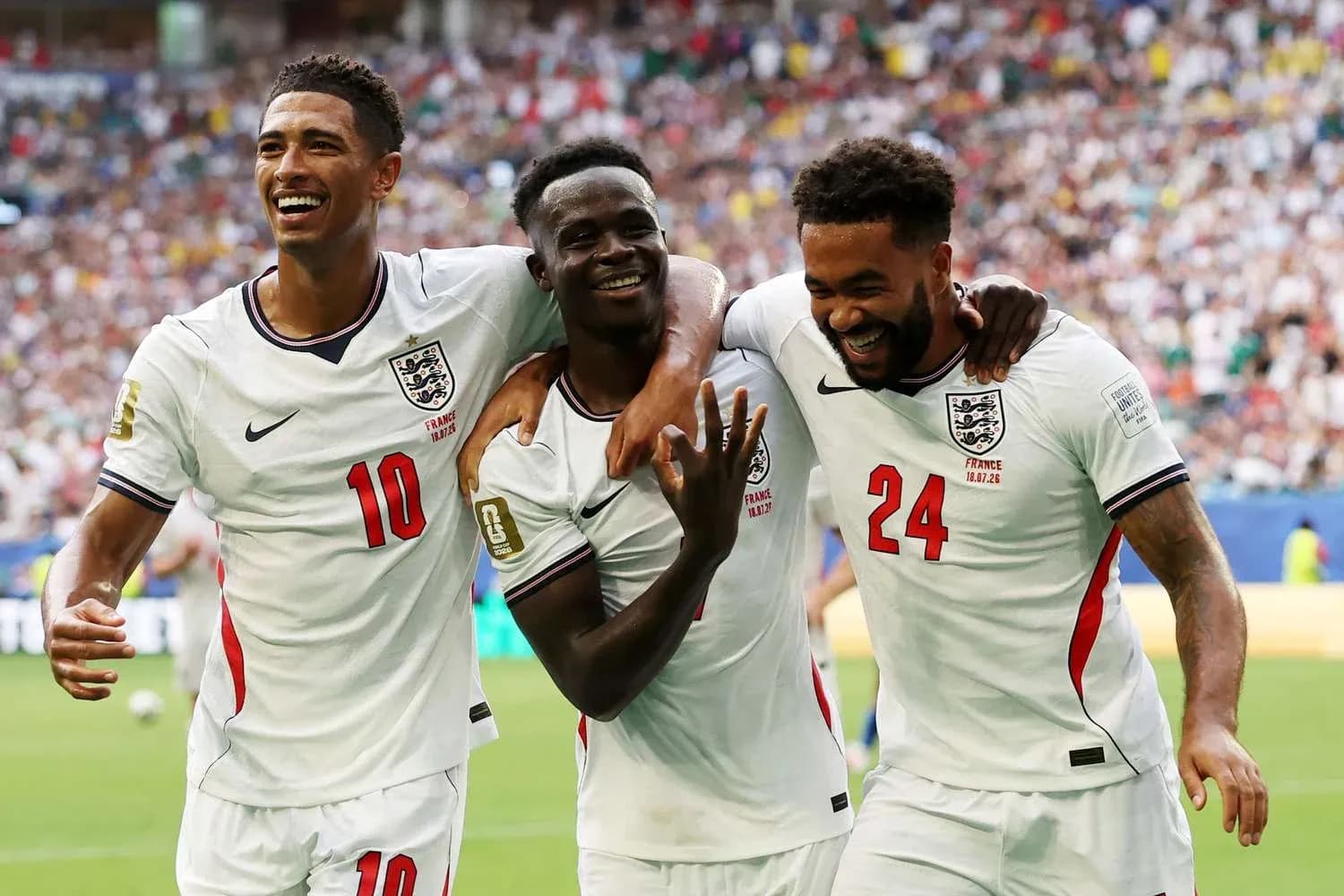
The late-game pattern became one of France’s volume versus England’s efficiency. Despite France’s territorial pressure and 3 corner kicks, England managed game-state with composure, still producing 2.58 xG of their own. Bukayo Saka’s penalty at 87' reflected England’s continued ability to threaten in transition and draw decisive actions in the box, even under pressure. Ousmane Dembélé’s 90+6' goal, assisted by Dayot Upamecano, showed France’s refusal to abandon their aggressive posture, pushing centre-backs high and leaving themselves exposed. Jude Bellingham’s 90+8' strike then punished that risk, emblematic of England’s capacity to turn France’s pursuit of an equaliser into exploitable space.
In goal, Mike Maignan (France) faced 11 shots on target and made 4 saves, with goals prevented measured at 0.05. The numbers point to a defence that allowed too many clear looks rather than a goalkeeper underperforming relative to shot quality. Dean Henderson (England), by contrast, made 5 saves from 9 shots on goal, also with 0.05 goals prevented, reflecting a broadly average performance supported by a defence that, while stretched in the second half, still managed 6 blocked shots and maintained structure in key moments.
Discipline subtly framed the tactical tone. France committed 14 fouls to England’s 8, a gap consistent with a side chasing the game, pressing higher and engaging more duels. With no cards shown to either team, both coaches were free to maintain aggressive approaches without fear of suspensions or in-game dismissals, which encouraged France’s all-out second-half press and allowed England to continue playing through pressure rather than retreating into a low block.
Passing profiles underline the contrasting phases. France’s 445 passes with 405 accurate (91%) suggest that once they settled, they circulated the ball cleanly, particularly in the second half when they dominated territory. However, their possession share of 46% shows that England still controlled more of the overall tempo. England’s extra 70 passes and similar 91% accuracy reflect a side comfortable both in structured build-up and in calming the game when under siege.
Strategically, the match can be read as a story of initial structural superiority from England, followed by France’s high-risk, high-reward adjustment. England’s first-half exploitation of midfield spacing and France’s weak box protection created an almost unassailable lead. France’s second-half reconfiguration, powered by Mbappé, Olise, Barcola and Dembélé, turned the contest into a chaotic shootout that the numbers suggest was closer than the first-half scoreline implied. Ultimately, England’s early control and late-game management ensured that, despite France’s tactical recovery and superior xG, the 6-4 scoreline reflected a game where structural discipline in the opening 45 minutes outweighed reactive brilliance in the final 45.