Spain vs Austria: A Clash of Footballing Ideologies
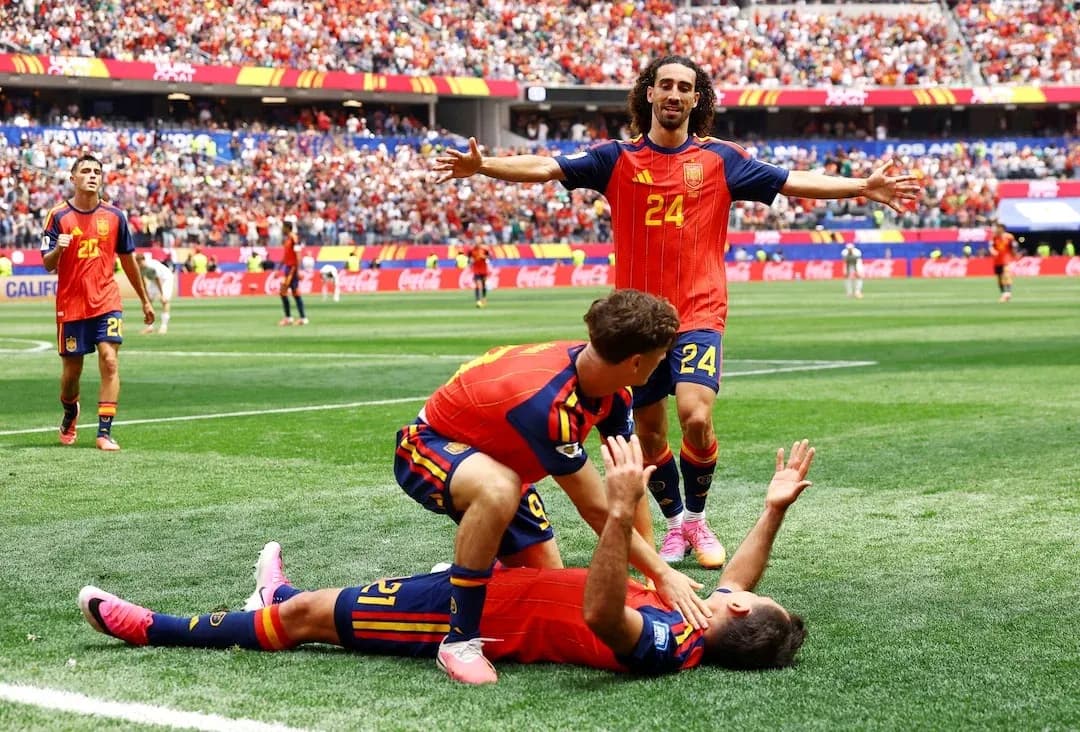
SoFi Stadium in Inglewood stages a Round of 32 clash that feels like a collision of footballing ideologies. Spain arrive as group winners from Group H, unbeaten and unbreached, while Austria come through Group J with more scars, more chaos, and the sense of a side that thrives on volatility. The scoreboard will eventually read 3–0 to Spain, but the story of how these squads are built and how they collide tactically is written long before kick-off.
I. The Big Picture – Two 4-2-3-1s, two very different DNAs
On paper, both teams mirror each other in a 4-2-3-1. In reality, the shapes tell opposite stories.
Spain’s World Cup campaign has been defined by control and defensive perfection. Heading into this game, they had played 4 matches in total, winning 3 and drawing 1, with no defeats. At home they had played 3, winning 2 and drawing 1, while on their travels they had played 1 and won it. Overall they had scored 8 goals and conceded none; at home they had scored 7 and conceded 0, away they had scored 1 and conceded 0. The goal difference overall is therefore +8, built on an attacking average of 2.3 goals at home and 1.0 away, with a total average of 2.0, and a defensive record that reads 0.0 goals conceded per match in every dimension. Four clean sheets in four, three of them at home, one away. They even reached this knockout tie having failed to score only once at home, underlining how rare it is to keep them quiet.
Austria, by contrast, are a high-variance proposition. Heading into this game, they had played 4 matches in total, with 1 win, 1 draw and 2 defeats. At home they had played 1 and won it; on their travels they had played 3, drawing 1 and losing 2. They had scored 6 goals overall (3 at home, 3 away) but conceded 9 (1 at home, 8 away), giving them a negative goal difference of −3. The attacking averages tell of potential – 3.0 goals at home, 1.0 on their travels, 1.5 overall – but the defensive averages are brutal: 1.0 conceded at home, 2.7 on their travels, 2.3 overall. This is a team that can punch, but often leaves its chin exposed.
II. Tactical Voids – Discipline, control, and the edges of chaos
Spain’s discipline has been almost unnervingly clean. Across the tournament they have picked up very few yellow cards, with the limited data showing a split of 50.00% of their yellows between 46–60 minutes and 50.00% between 91–105 minutes. No red cards, no penalties taken, none missed. It is the profile of a side that does not need to gamble or lunge; they suffocate games with structure rather than desperation.
Austria live closer to the line. Their yellow card distribution is revealing: 20.00% of their yellows come in the first 15 minutes, another 20.00% between 31–45, but a striking 60.00% arrive between 76–90. This is a team that starts combative and finishes frantic, often chasing games late. They have not seen red in this tournament, but the cumulative picture is of a side that grows more reckless as the clock ticks.
Within that, Stefan Posch is the disciplinary bellwether. Across the World Cup he has committed 7 fouls and collected 2 yellow cards, leading both the yellow and red card charts for Austria in this data snapshot. His 10 interceptions show good reading of the game, but the volume of duels (35, with 16 won) and fouls committed underline how often he is dragged into emergency defending. Against Spain’s fluid front line, he becomes both essential and vulnerable.
III. Key Matchups – Hunter vs Shield, and the Engine Room
The clearest “Hunter vs Shield” duel is Mikel Oyarzabal against Austria’s back four. Oyarzabal comes into this tie as one of the World Cup’s most efficient forwards: 4 goals and 1 assist in 4 appearances, from 15 shots with 8 on target. He averages just over 75 minutes per match, with a rating of 7.7, and has been trusted from the start in all his games. He does not rely on penalties – he has scored none from the spot – which makes his return even more impressive.
He will be probing a defence that, on their travels, concede 2.7 goals per match and have yet to keep a clean sheet. Austria’s biggest away defeat so far is 3–0, a scoreline that mirrors the eventual outcome here and hints at structural fragility. Konrad Laimer, deployed as a nominal left-back in this 4-2-3-1, and the central pairing of Kevin Danso and David Alaba will have to manage Oyarzabal’s movement while also tracking the surges of Lamine Yamal and Dani Olmo from the line of three.
In midfield, the “Engine Room” confrontation is pure modern football theatre. For Spain, Rodri anchors alongside Pedri at the base of a double pivot that is really a platform for domination. Spain’s preference for 4-3-3 earlier in the tournament (used twice) has evolved into this 4-2-3-1, but the principles remain: Rodri as metronome and shield, Pedri as connector and tempo-setter.
Austria respond with Nicolas Seiwald and Xaver Schlager as their own double pivot. They are industrious, aggressive, and tasked with doing two jobs at once: screening the back line from Spain’s between-the-lines threats and springing transitions to Marcel Sabitzer, Patrick Wanner, and Michael Gregoritsch. If they lose that central duel, Austria’s already fragile defensive averages threaten to unravel under Spain’s positional play.
IV. Statistical Prognosis – Control vs volatility
Spain’s overall profile – 8 goals scored, 0 conceded, 4 clean sheets, no penalties awarded, no red cards – screams control and repeatability. They do not need chaos to win; they manufacture high-quality chances through structure and deny them at the other end through territorial dominance.
Austria’s numbers tell the opposite story: 6 goals for, 9 against, no clean sheets, and a late-game yellow card spike at 76–90 that suggests matches slipping away from them. Their single converted penalty shows they can take advantage when the moment comes, but their defensive averages, especially on their travels, suggest they are more likely to be the side conceding the decisive chances.
Overlay those statistical profiles onto the tactical shapes, and the narrative becomes clear. Spain’s 4-2-3-1, with Rodri and Pedri dictating and Oyarzabal leading a fluid attacking line, is built to exploit a defence that concedes too often and tires late. Austria’s best hope lies in disrupting the rhythm early through Seiwald and Xaver Schlager, channelling Sabitzer’s creativity, and hoping Gregoritsch can turn scarce moments into goals.
In a knockout tie at SoFi Stadium, the numbers and the tactical geometry both lean heavily towards Spain. The 3–0 final scoreline is not an accident; it is the logical conclusion of a tournament arc in which one side has mastered control, and the other has been unable to escape its own volatility.