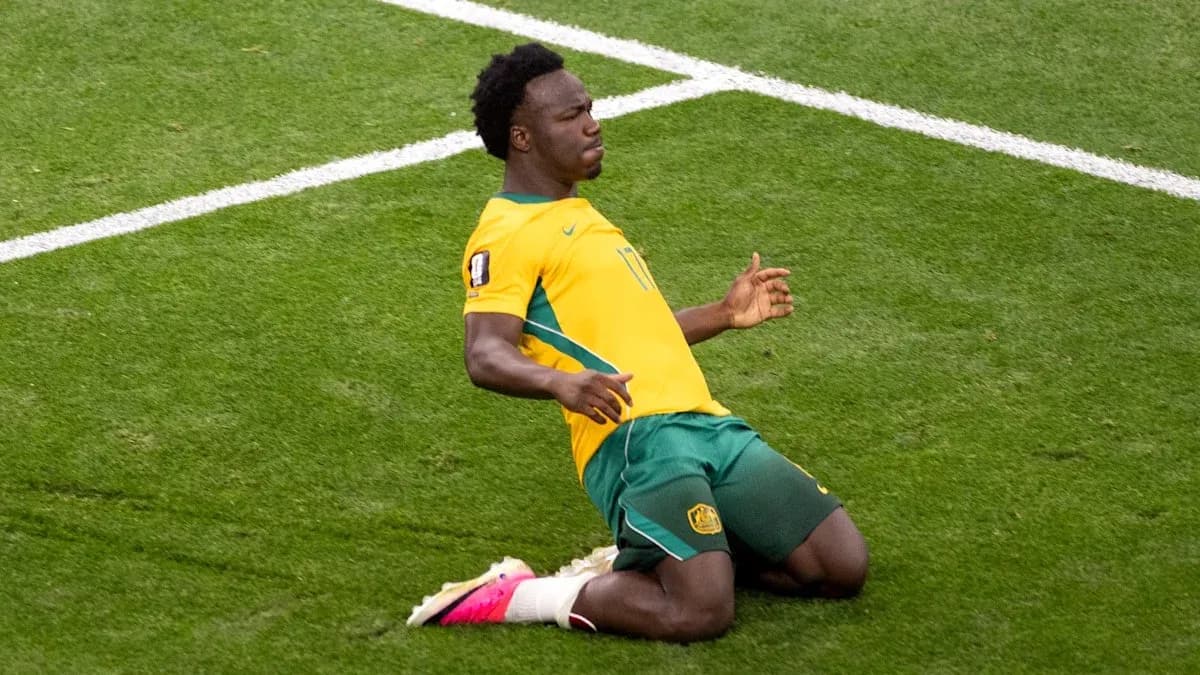
Socceroos Advance: Concerns Over Striker Depth
The Socceroos are through. The job is done. But the way they got there has Australia’s old strikers shifting uncomfortably in their seats.
A 0-0 draw with Paraguay was enough to book a place in the round of 32 at the FIFA World Cup, and in the middle of a bruising, tactical stalemate, a 21-year-old fullback became the team’s sharpest attacking weapon.
Jordan Bos, thrown into the starting XI after Jacob Italiano’s late injury withdrawal, lit up the right flank. The reshuffle pushed Aziz Behich to the left and handed Bos the role usually reserved for a winger. He didn’t blink.
The switch worked. Tactically, it made sense. Emotionally, it gave the Socceroos a jolt. Yet for Scott McDonald and Robbie Slater, watching on, that was exactly the problem.
A defender as the main threat
On Stan Sport’s Added Time, Slater didn’t bother dressing it up.
“Up front is a bit of a worry when we’re looking at Jordy Bos as one of the most threatening (for Australia),” he said.
When your most dangerous outlet is a converted fullback, the alarm bells ring loudest among the men who used to live off chances in the box. McDonald nodded along, seeing a forward line that never quite imposed itself and a system that leaned heavily on Bos to give Australia a way out.
The concern wasn’t about Bos. He was brilliant. It was about everyone in front of him.
Mo Toure stayed on the bench. Nestory Irankunda, usually a winger who loves space and chaos out wide, was asked to lead the line as Australia’s No.9. Popovic turned to Tete Yengi instead of Toure when he wanted fresh legs up top, and that decision told McDonald plenty.
“There is a problem in terms of the No.9. Not bringing (Mo) Toure on instead of Tete Yengi tells me today that there’s no trust there,” McDonald said.
The question hangs over the next match: does Popovic suddenly start Toure? Or has a pecking order already been set in stone? From a striker’s perspective, McDonald didn’t like the message.
“Does he go and start him (Toure) out of the blue in the next game? You just can’t tell with Tony. But as a striker, being Toure, I don’t like that. That doesn’t fill me with confidence that my coach trusts me.”
Irankunda’s burden through the middle
Up front, it felt like a thankless shift. McDonald has worn that expression before.
“No matter who we put up there, it’s a thankless task up there. Look at Nestory (on Friday), he had very little and was living off scraps,” he said.
Irankunda, just 20, was asked to operate in traffic, back to goal, against a rugged Paraguayan back three that took no chances with his pace. They crowded him, cut off the channels, and left him with almost no room to spin in behind.
McDonald saw a player out of his natural habitat.
“Look, he’s gotta hold it up a little bit better,” he admitted. “I think at times he struggled because it’s not his natural game.”
The problem wasn’t just Irankunda’s adaptation. It was structural. When he drifted wide, as instinct tells him to, the box emptied out.
“But also when he plays up top, we don’t have a box outlet. Jordy Bos playing on the right-hand side was brilliant and it gave us that outlet.”
Paraguay’s back three read the script. They shaded across, doubled and sometimes tripled Irankunda, and refused to give him the channels he normally punishes.
“With the way Paraguay were set up as well with the back three, it is very hard for him to get down the sides of the opposition. There was no space,” McDonald said. “They were aware of his threat also, with three taking care of him.”
So Irankunda sat in that awkward space between what he wants to be and what the team needed: part creator, part finisher, never fully either.
“He probably sometimes needs to be more in central positions and wait for things to happen,” McDonald added.
The No.9 question that won’t go away
This is where the conversation turned to the art of the modern striker. McDonald pointed to Erling Haaland as the extreme example: a forward who barely touches the ball, yet always seems to appear in the right patch of grass at the right second.
“As we see the best strikers in the world – like Erling Haaland – they’re not interested any more. They just get into the right areas and allow others and trust others to do the dirty work then get on the end of things.”
That’s not Irankunda’s instinct. Not yet.
“That’s not naturally probably where (Irankunda) thinks. He wants to be the guy creating that and doing things, getting on the edge of the box and having shots. So if you’re gonna play that role, you just need to play it a little bit more smarter and be a bit more patient.”
McDonald’s critique wasn’t a swipe at Irankunda’s talent. It was a blunt assessment of the demands of the position. The No.9, especially at World Cup level, is a specialist role. Back to goal. First contact. Aerial presence. Relentless movement in the box.
“I didn’t like it either,” he admitted, thinking back to his own career as a striker. “I mean, for the majority of my career it was always you played off the big man or whatever.”
Then came the line that cuts to the heart of Australia’s long-running search for a dominant centre-forward.
“But I’ve always said it, if you can head it, you’ve got a better chance of being a No.9 for the Socceroos. It’s as simple as that.”
Through, but far from settled
So Australia march on, their place in the knockouts secure, their defensive structure holding, their young fullback shining. On paper, that looks tidy.
Underneath, the old questions about the Socceroos’ spearhead refuse to die. Bos has been a revelation. Behich has adapted. The back line looks organised.
But as the stakes rise and the opponents sharpen, can a World Cup campaign really lean on a fullback to be its most dangerous outlet? Or will someone in that crowded, uncertain No.9 queue finally step forward and claim the role that has defined so many Australian teams of the past?