Shamrock Rovers Secure 3-1 Victory Over Egnatia Rrogozhinë
Shamrock Rovers’ 3-1 win over Egnatia Rrogozhinë at Tallaght Stadium in the UEFA Europa League 3rd Qualifying Round was shaped far more by structural choices and in‑game adjustments than by any dominance in classic statistical categories, most of which are unavailable. With both sides starting in a 3-5-2, the match became a contest of who could better exploit the wing corridors and half-spaces, and who could manage penalty-box moments with greater clarity.
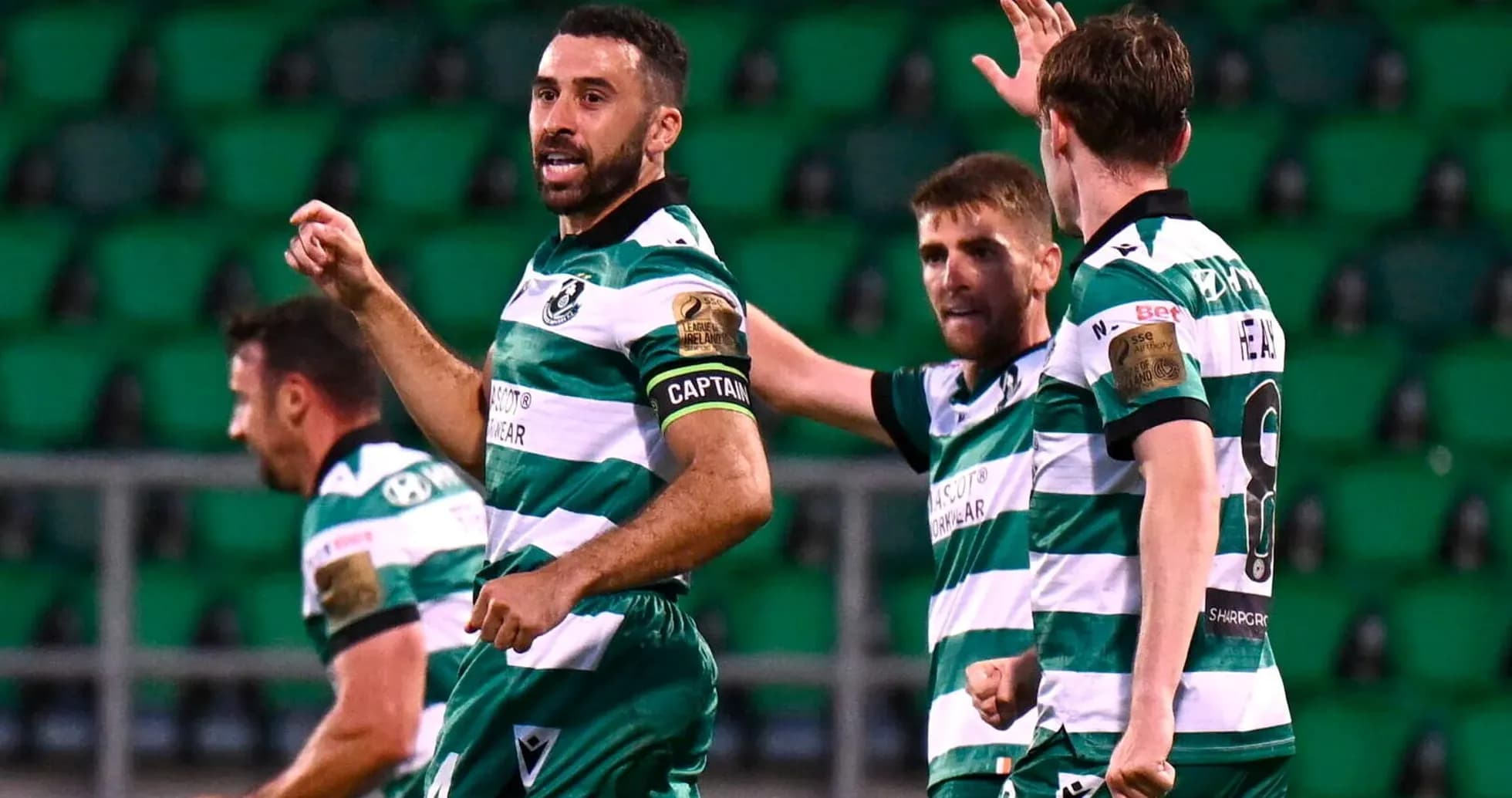
Stephen Bradley’s 3-5-2 for Shamrock Rovers was built on a back three of T. Sobowale, R. Lopes and E. Stevens, with W. Fitzgerald and A. Brennan providing width from the flanks. In possession, this often resembled a 3-2-5: M. Healy sat as the primary controller with D. Watts and J. Byrne stepping into advanced pockets, while the front pairing of G. Burke and A. Greene looked to pin Egnatia’s back line and attack the channels outside their wide centre-backs. The first-half penalty converted by Burke at 29' underlined Rovers’ plan to overload central zones and force desperate interventions inside the box.
Egnatia Rrogozhinë mirrored the shape but with a subtly different balance. Their back three of Z. Aliyev, E. Bitri and E. Sota was screened by a dense midfield including Fernando Medeiros and A. Kryeziu, with G. Jaime and A. Yago operating as aggressive wing-backs and I. Diabate supporting the front line. The equaliser sequence around 41' — a missed penalty by Guillem Jaime followed almost immediately by a normal goal from G. Jaime — highlighted their capacity to flood the area with second runners and react first to loose balls, even when the initial execution faltered.
Second Half Adjustments
The second half was defined by how each coach manipulated the shared 3-5-2. At 46', Bradley’s first change — J. Mulraney (IN) came on for A. Brennan (OUT) — refreshed the right flank, adding more direct dribbling and crossing threat. Simultaneously, Nevil Dede made a triple adjustment that changed Egnatia’s attacking profile: A. Albanese (IN) came on for I. Diabate (OUT), K. Loukili (IN) came on for I. Gruda (OUT), and J. Montenegro (IN) came on for D. Adjessa (OUT). Egnatia moved towards a more fluid front line with Albanese between the lines and Montenegro as a penalty-box reference, but these changes also disrupted their defensive cohesion in wide areas.
The turning point came from Shamrock Rovers’ set-piece and second-phase organisation. At 55', R. Lopes’ goal, assisted by J. Byrne, reflected a well-rehearsed routine: Byrne’s delivery targeted the central lane where Lopes attacked the space between centre-backs, capitalising on Egnatia’s reshuffled marking assignments after the interval substitutions. Just two minutes later, the own goal by A. Yago at 57' — credited to Shamrock Rovers — was the product of sustained pressure and aggressive occupation of the six-yard box, forcing the wing-back into a panicked intervention facing his own goal. Within three minutes, the match flipped from 1-1 to 3-1, and Rovers’ structural superiority in rest defence (their ability to guard transitions while attacking) allowed them to protect that lead.
Bradley’s game management after going 3-1 up was pragmatic and tactically coherent. At 58', J. Afolabi (IN) came on for A. Greene (OUT), giving Rovers a more physically robust outlet to hold long clearances and contest aerial duels. On 69', there was a double switch: D. Mandroiu (IN) came on for G. Burke (OUT) and N. Razi (IN) came on for D. Watts (OUT). Mandroiu’s introduction added ball retention and counter-attacking craft, while Razi’s fresh legs in midfield helped maintain compactness and cover the half-spaces against Egnatia’s increasingly direct play. At 77', J. O’Sullivan (IN) came on for J. Byrne (OUT), trading some creative passing for extra energy and defensive work rate in central areas.
Egnatia’s response changes at 69' and 81' were more reactive than proactive. At 69', N. Ajetovikj (IN) came on for Z. Aliyev (OUT), altering the composition of the back three but not fundamentally changing the team’s attacking structure. At 81', E. Ndreca (IN) came on for A. Yago (OUT), effectively acknowledging the wing-back’s difficult night after the own goal and trying to inject late width and crossing quality. By that stage, however, Shamrock Rovers’ block was well set, and the Albanian side struggled to generate clean entries into the box.
Discipline played a quiet but telling role in the tactical story. Egnatia collected two yellow cards, both for “Foul”: at 38', Ildi Gruda (Egnatia Rrogozhinë) — Foul, and at 47', Alessandro Albanese (Egnatia Rrogozhinë) — Foul. Both bookings reflected Egnatia’s difficulty in handling Rovers’ midfield rotations, particularly when Rovers’ eights received between the lines and turned to drive at the back three. Shamrock Rovers’ single booking, at 60' for Dylan Watts (Shamrock Rovers) — Foul, came as they adjusted to a more protective posture after going 3-1 up, occasionally arriving late into duels to break up Egnatia’s attempts at quick combinations.
With no reliable data on shots, possession, passing or goalkeeping saves, the statistical lens is necessarily narrow, but a few truths stand out. The final scoreline of 3-1, with Shamrock Rovers scoring once from the spot, once from a set-piece situation and once via an own goal forced by pressure, underscores their efficiency in dead-ball and penalty-box phases rather than any proven volume of chances. The card count — Shamrock Rovers: 1 yellow, Egnatia Rrogozhinë: 2 yellows, total: 3 — aligns with a match that was competitive but not chaotic, allowing both coaches to execute their tactical plans with minimal disruption from dismissals.
In synthesis, Shamrock Rovers won this tie not through demonstrable statistical dominance, but by better exploiting the mirrored 3-5-2 structure: superior set-piece execution, more coherent wing utilisation, and timely, role-specific substitutions that stabilised the game once they had turned it decisively in their favour.