Red Bull Salzburg's Tactical Dominance Against Pafos
Red Bull Salzburg’s 1-0 home win over Pafos at Red Bull Arena was a methodical, territorially dominant performance that only found its reward late. In the 3rd Qualifying Round of the UEFA Europa League, Danny Rohl’s side used a 4-2-3-1 to pin back Albert Celades’ 3-5-2, controlling 59% of the ball, winning 13 corners to Pafos’ none, and outshooting the visitors 3–1 on goal. Yet it took an 88th‑minute strike from substitute H. Tabakovic to finally break a Pafos block that had been focused almost exclusively on survival, a task made harder by a flurry of late cards and the dismissal of Ken Sema.
Salzburg's Structure
Salzburg’s structure with the ball was clear from the outset. The back four of N. Veratschnig, K. Boma, V. Zabransky and D. Schmid provided a broad platform, with A. Barry and S. Diabate as the double pivot in front. Against Pafos’ front two, this gave Salzburg a consistent 4v2 in the first line, enabling calm progression into midfield and justifying their 59% possession. The full-backs stepped high to lock Pafos in, reflected in Salzburg’s 13 corner kicks, a direct indicator of how often they forced play into the final third and around the box.
Between the lines, D. Redzic operated as the central link, with E. Baidoo and G. Diakite starting as narrow wide forwards behind Y. Vertessen. The idea was to overload the half-spaces and drag Pafos’ outside centre-backs and wing-backs into uncomfortable decisions. However, with Pafos defending in a compact 5-3-2 without the ball, central access was often crowded, explaining Salzburg’s mix of 3 shots on goal and 6 off target plus 4 blocked efforts. They created volume and territory, but Pafos’ block was disciplined enough to turn many attacks into low-quality looks or deflected attempts.
Pafos' Defensive Strategy
Celades’ 3-5-2 was designed first to protect central areas. David Luiz anchored a back three with D. Goldar and N. Ioannou, screening the box aggressively. In front of them, I. Sunjic, A. Brito and Guga formed a narrow midfield line, with D. Quina and Biel tasked with shuttling wide and supporting Lele and V. Dragomir. Offensively, though, the structure rarely translated into sustained threat. Pafos produced only 1 shot on goal and 6 off target, and crucially, no corners at all – a sign they struggled to progress into the attacking third with control or to sustain pressure long enough to force defensive concessions from Salzburg.
Foul Count and Discipline
The foul count – 13 by Salzburg, 11 by Pafos – underlines a contest that was competitive in duels but not wildly chaotic. Salzburg’s single yellow card for Abubakr Barry at 75' came as the hosts increasingly counter-pressed to prevent Pafos from escaping. Pafos’ three yellows and one red, all involving Ken Sema and Ivan Šunjić plus David Luiz earlier, reflected the strain on their midfield and wing-backs as Salzburg’s substitutions injected fresh energy and more direct running.
Tactical Substitutions
Rohl’s use of the bench was central to the tactical story. On 58', S. Diabate (OUT) made way for B. Mazurek (IN), a move that freshened the double pivot and maintained intensity in Salzburg’s rest defence. At 64', D. Redzic (OUT) was replaced by S. Kitano (IN), adding a slightly different profile between the lines – more mobility and sharper movements into pockets to unbalance Pafos’ midfield. One minute later, at 65', Y. Vertessen (OUT) was swapped for K. Konate (IN), introducing a more penalty-box-oriented presence to attack the numerous crosses and cut-backs generated from wide.
The decisive shift came at 70', when Rohl doubled down on attacking threat: E. Baidoo (OUT) for H. Tabakovic (IN) and G. Diakite (OUT) for E. Aguilar (IN). These twin changes effectively retooled the front line with fresh legs and more penalty-area aggression. With Pafos dropping ever deeper and their wing-backs pushed back into a flat back five, Salzburg could station multiple targets between the posts, which combined with their corner count and blocked shot tally shows how relentlessly they forced play into the box.
Pafos' Reactive Changes
On the Pafos side, substitutions were largely reactive and aimed at shoring up tired legs. At 43', D. Quina (OUT) was replaced by K. Sema (IN), an early tweak that maintained the 3-5-2 shape but brought in fresh running on the flank. Later, at 80', A. Brito (OUT) gave way to M. Mammadov (IN), and at 88', V. Dragomir (OUT) was replaced by Pepe (IN). None of these changes meaningfully altered the basic defensive posture; instead, they were attempts to preserve energy and discipline under sustained pressure.
88' Goal by H. Tabakovic
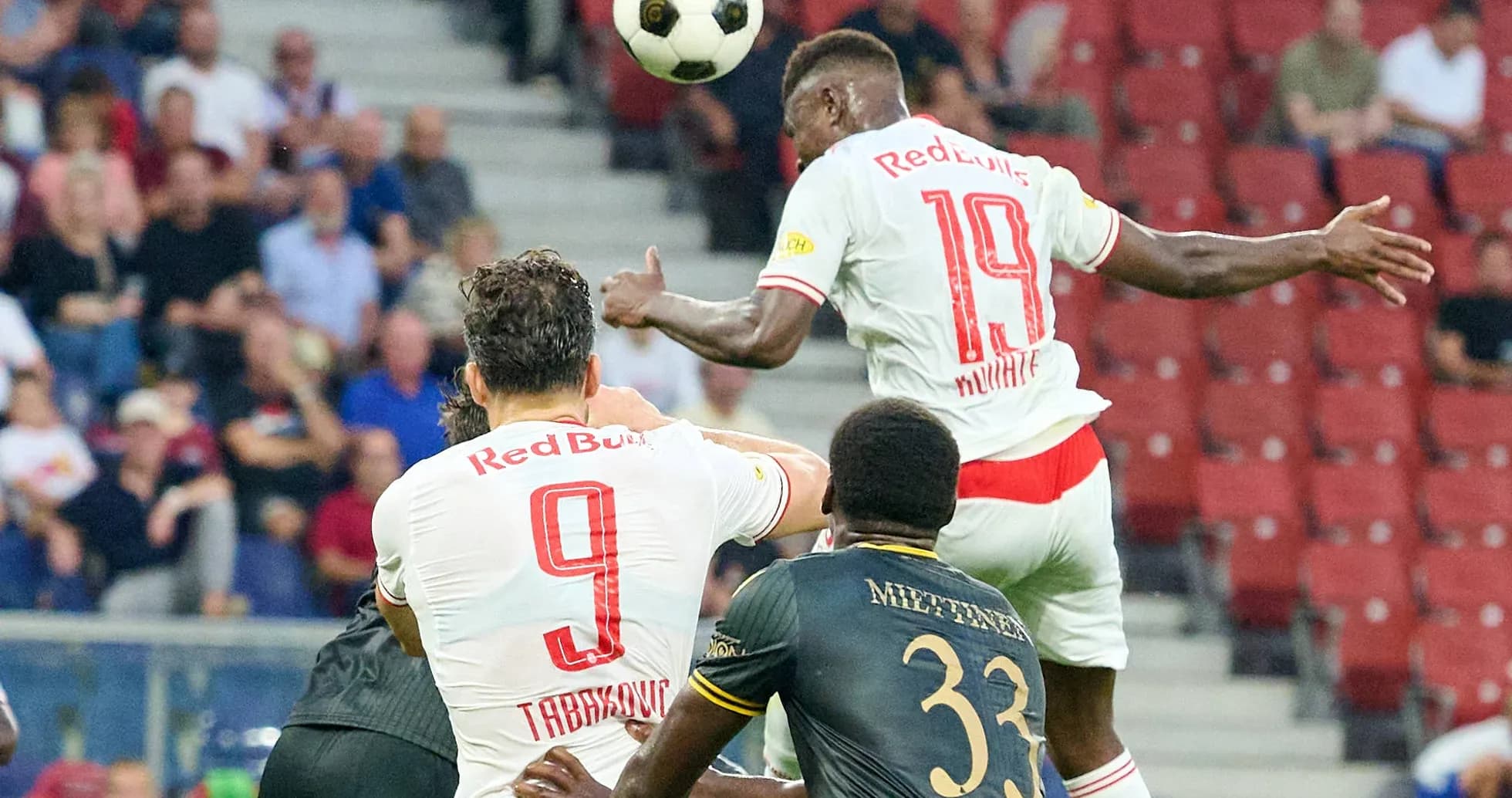
The 88' goal by H. Tabakovic crystallised the tactical trend. After Salzburg had spent most of the match compressing the pitch, rotating their attacking midfielders and centre-forward to attack the half-spaces and channels, a late-arriving substitute centre-forward finally converted. It was emblematic of a game where structure and volume gradually wore down a defence that had held firm but offered almost nothing going the other way.
Pafos' Discipline Issues
Discipline played a late, destabilising role for Pafos. David Luiz’s first-half yellow at 36' signalled the physical edge in their defending. Ken Sema was then booked at 46' shortly after coming on, and Ivan Šunjić followed with a yellow at 82'. The climax came deep into stoppage time at 90+3', when Sema received a second yellow and then a red in the same minute, leaving Pafos down to ten. Even though the dismissal arrived after the decisive goal, it encapsulated the cumulative strain of defending for long stretches without the ball.
Statistical Superiority
Statistically, Salzburg’s superiority was clear: more possession (59% to 41%), far more corners (13–0), and a 3–1 edge in shots on goal. The 4 blocked shots for Salzburg show how often Pafos were forced into last-ditch interventions in their own box. While the expected goals and goals prevented metrics are not available, the territorial and shot data align with the eye-test narrative of a home side that controlled the match and an away side that accepted a deep, reactive role.
Tactical Summary
In tactical terms, Salzburg’s 4-2-3-1 functioned as a high-possession, high-territory system that gradually squeezed Pafos into their own third. Pafos’ 3-5-2, while structurally sound defensively for long stretches, lacked a transition outlet and attacking plan to relieve pressure. Over 90 minutes, the imbalance in field position and attacking volume made a late breakthrough almost inevitable, and Rohl’s aggressive, well-timed use of his bench ensured that the decisive action came from fresh legs rather than fading starters.