PAOK vs Anderlecht: Tactical Analysis of the 4-2-3-1 and 4-3-3 Matchup
PAOK’s 4-2-3-1 against Anderlecht’s 4-3-3 produced a territorial siege at Toumba Stadium that never translated into scoreboard pressure. Despite 65% possession, more shots on goal (3 vs 2) and significantly more efforts off target (11 vs 2), PAOK were undone by a single first-minute action and then by their own structural inefficiency in the final third.
The early concession shaped everything. Anderlecht’s 4-3-3, with M. Cvetkovic flanked by J. Onia Seke and D. Sikan, struck immediately through Cvetkovic, assisted by E. Llansana at 1'. That goal allowed Vitor Bruno’s side to drop the block earlier than planned and lean into a compact, foul-heavy defensive game: 23 fouls, 3 yellow cards, and only 1 corner conceded. The midfield trio of Llansana, L. Ambros and M. Kana functioned less as playmakers and more as screeners, constantly disrupting PAOK’s attempts to find G. Konstantelias between the lines.
PAOK Structure
Alessio Lisci’s PAOK structure was clear: J. Pavlenka behind a back four of J. Kenny, P. Hatzidiakos, G. Michailidis and Jogo; a double pivot of C. Zafeiris and B. Santamaria; a creative band of A. Zivkovic, Konstantelias and Taison supporting A. Mythou. In practice, the shape tilted aggressively to the right, with Kenny and Zivkovic pushing high and Zafeiris sliding across to cover. The 5 corner kicks and 11 shots off goal underline how often PAOK reached advanced wide zones but then rushed the final action, either overhitting crosses or snatching at second balls around the box.
Anderlecht's Efficiency
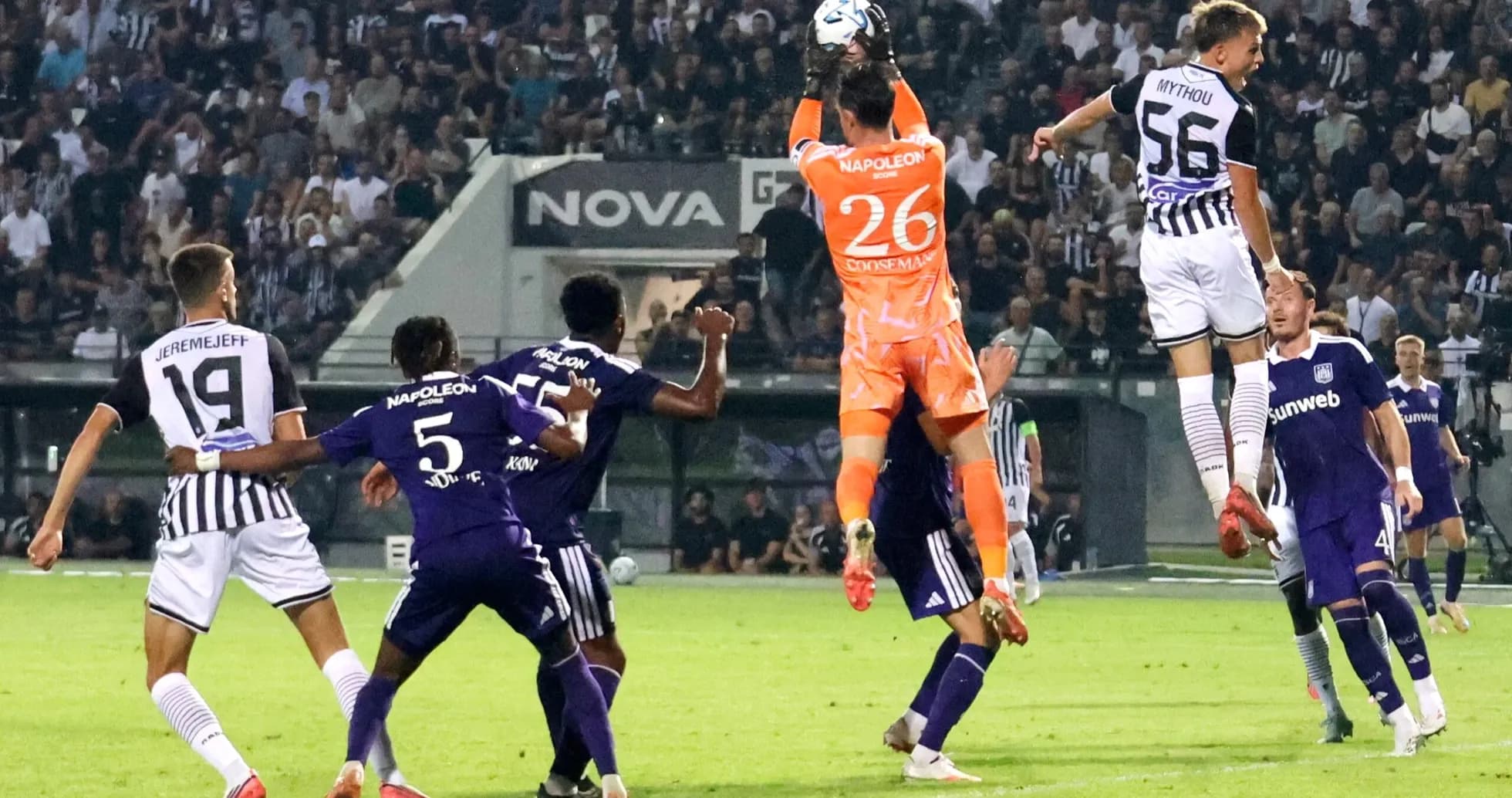
Anderlecht, by contrast, were ruthlessly economical. With only 2 shots on goal and 2 off goal, they accepted long spells without the ball, focusing on line integrity rather than transitions. The back four of A. Maamar, L. Petrot, G. Biancone and M. N’Diaye stayed narrow, inviting PAOK to cross from less dangerous angles. The absence of blocked shots (0) for Anderlecht suggests PAOK’s finishing issues were more about poor accuracy than heroic last-ditch defending; efforts were frequently off target before they could test C. Coosemans.
In-Game Management
Lisci’s in-game management tried to correct structural imbalances. The first key moment came at half-time: at 46', A. Elustondo (IN) came on for P. Hatzidiakos (OUT), a change that followed Hatzidiakos’ earlier yellow card at 38'. This was both a risk-management move and a search for more front-foot defending to compress Anderlecht in their half. Elustondo’s later booking at 86' highlighted how aggressive PAOK’s centre-backs had to become as they chased the game.
On 63', Lisci doubled down on width and crossing: A. Baba (IN) came on for Jogo (OUT), and G. Taylor (IN) replaced Santamaria (OUT). Baba’s introduction at left-back pushed Michailidis more centrally in build-up, while Taylor provided a more vertical profile from deep, aiming to speed up ball circulation into the attacking midfielders. The cumulative effect was even more territory but still limited incision; Anderlecht’s compact 4-3-3 simply retreated closer to their own box and continued to foul to break rhythm.
The 71' substitution of Taison (OUT) for A. Jeremejeff (IN) was a clear tactical pivot. PAOK moved towards a more direct reference point up front, seeking to attack crosses and second balls rather than weave intricate combinations. This also allowed Konstantelias and Zivkovic to operate as inverted creators around a central target. Yet, with only 3 shots on goal overall, PAOK never managed to turn those structural adjustments into sustained high-quality chances.
Anderlecht's Tactical Changes
Anderlecht’s changes were all about energy and maintaining defensive intensity. At 57', O. Antman (IN) replaced J. Onia Seke (OUT), giving fresher legs on the flank to chase PAOK’s full-backs and press the first pass out of defence. On 71', N. Saliba (IN) came on for Ambros (OUT), adding another midfielder with work rate to help protect the central lane, while T. Degreef (IN) replaced Cvetkovic (OUT), effectively sacrificing the original goalscorer for a more industrious presence up front. The pattern was clear: protect the 0-1 by reinforcing the block rather than chasing a second goal.
The discipline profile underlines Anderlecht’s approach. They committed 23 fouls to PAOK’s 15 and took three yellow cards (Moussa Ndiaye 56', Enric Llansana 58', Danylo Sikan 90+1'), all consistent with a strategy of tactical infringements to halt PAOK’s momentum. PAOK’s two bookings (Pantelis Hatzidiakos 38', Aritz Elustondo 86') were more reactive, stemming from defensive duels as they tried to prevent transitions or win the ball back quickly after turnovers.
Statistical Overview
Statistically, the game tells a story of territorial dominance without edge. PAOK’s 65% possession and higher shot volume did not translate into a breakthrough, in part because their attacks were too easily shepherded into low-probability shooting zones. The 11 shots off goal and 3 blocked efforts indicate a recurring pattern of rushed or forced attempts once Anderlecht’s block was set. Without data for total passes or passing accuracy, the clearest indicators of PAOK’s control are possession share and corners, but control alone was insufficient.
Anderlecht, with only 35% possession and minimal attacking output, executed a classic away-leg Europa League performance: an early goal, then a disciplined, foul-heavy defensive display to protect the advantage. The lack of recorded goalkeeper saves for either side suggests that, despite PAOK’s pressure, clear, on-target chances were rare, and Anderlecht were content to let shots sail wide rather than open central channels.
In the context of a 3rd Qualifying Round tie, Anderlecht leave Thessaloniki with a 0-1 win built more on collective defensive organisation and game management than attacking fluency, while PAOK are left to reflect on how a possession-heavy 4-2-3-1 failed to convert territorial control into genuine threat.