
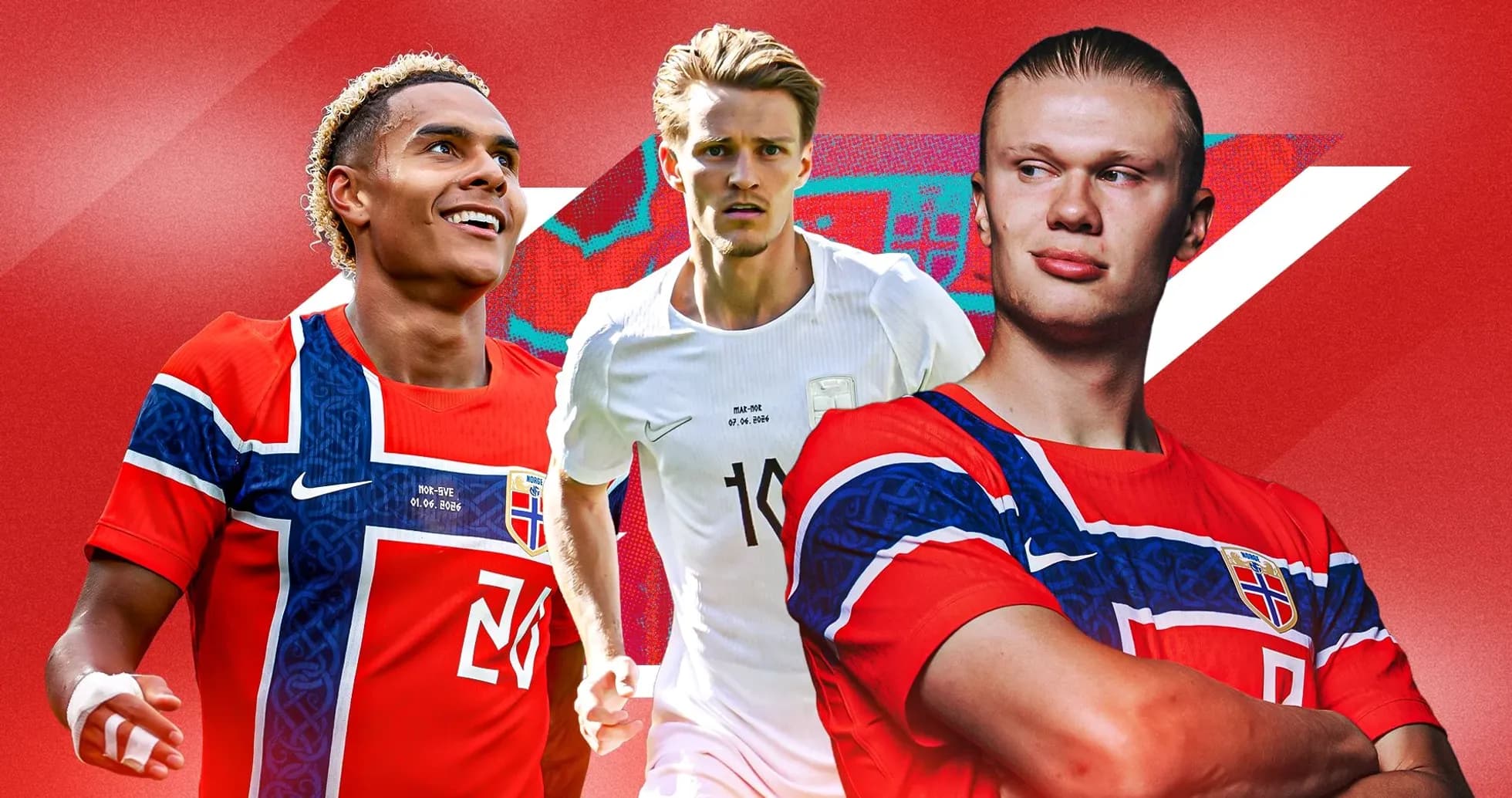
Norway's World Cup Team: Beyond Haaland's Stardom
Erling Haaland will dominate the billboards in North America, but Norway are not turning up to this World Cup as a one-man show. Stale Solbakken has built something far more intricate: a side that stretches you from the touchlines, hammers you in the air and quietly leans on one of Europe’s most productive creators in Martin Odegaard.
It is a team with edges, quirks and an unmistakable plan.
Wing craft and wide power
Start with the flanks, where the job description is simple on paper but far more layered in practice: feed Haaland, stretch the pitch, and make space for the most dangerous right-back in Europe.
On the left, Antonio Nusa looks set to keep his place. The RB Leipzig winger is only 21, but he plays with the swagger of someone who knows he can embarrass his marker at any moment. He glides past challenges, rides contact and never seems rushed in the final third. Six goal contributions in six qualifying games tell their own story, but the statement performances came against Italy: a goal and assist in a 3-0 home win, then another contribution in a 4-1 demolition away. Those nights turned him from prospect into problem.
Behind him, Andreas Schjelderup waits, and that is a luxury for Solbakken. The 22-year-old arrives off a sparkling second half of the season under Jose Mourinho at Benfica: 10 goals and assists across just 14 league matches, plus a brace against Real Madrid in the Champions League in January. He is not a locked-in starter yet, but inside Norwegian football there is a quiet certainty about where his career is heading.
The right flank is where Solbakken rips up convention. Alexander Sorloth, a 6'5" centre-forward by trade, often starts wide. On paper it looks awkward. On the pitch it makes perfect sense. When Norway have the ball, he drifts infield to stand alongside Haaland, giving centre-backs a decision they rarely enjoy: pick up one giant or the other, and hope the cross doesn’t find the spare man. Eight goal contributions in eight qualifying games from Sorloth underline how comfortable he is in this hybrid role.
Oscar Bobb gives Solbakken a different profile on that side. The Fulham man has yet to fully ignite at Craven Cottage, but he offers control and guile if Norway need to slow the tempo or work through tight spaces. Jens Petter Hauge, back in the fold after missing qualifying, forces his way into the squad on the back of sharp displays for Bodo/Glimt, including eye-catching contributions in Champions League wins over Man City and Inter. That sort of pedigree off the bench is no small thing.
Odegaard, the conductor
If Haaland is the finisher, Odegaard is the scriptwriter.
Norway’s midfield is deep, experienced and built around the Arsenal captain. Sander Berge anchors from deep, screening the defence and recycling possession with minimal fuss. Beside him, Fredrik Aursnes brings the legs and intelligence of a modern No.8, arriving in the right pockets, linking phases, plugging gaps before they become problems.
Aursnes’ presence at this tournament is a story in itself. Two years ago, the Benfica midfielder walked away from the national team, saying he wanted more time and freedom for life beyond football. In February, he reversed that decision. Now, without playing a minute of qualifying, he looks nailed on to start at the World Cup. It is a rare thing: a retirement U-turn that genuinely strengthens a side.
Behind that first-choice trio, Solbakken still has options. Patrick Berg, the composed Bodo/Glimt captain, offers a metronomic passing range. Kristian Thorstvedt and Morten Thorsby, both based in Italy, bring versatility and bite, able to shift roles depending on the game state.
Everything still bends around Odegaard. At club level, he can divide opinion: spells of brilliance interrupted by quieter nights, games that slip past him. In a Norway shirt, the balance tips more often towards influence. Even in an injury-hit qualifying campaign in which he missed three of eight matches, he still produced seven assists. No player in Europe managed more, and three of those came in a single game against Israel.
His job in North America is clear. Connect those wide threats. Find Haaland early and often. Exploit the chaos created by Sorloth’s movements and Julian Ryerson’s surges. Norway’s attack will rise or fall on his ability to control tempo and pick the right pass in the split second it appears.
Life after Haaland? Norway have a plan
Solbakken will not want to contemplate it, but the question hangs over any team built around a superstar: what if he is unavailable?
Norway, unusually for a nation of their size, have answers at centre-forward. Sorloth is the obvious first replacement. He would step in from the right and lead the line, something he has done plenty of times before. His international scoring record is solid, and he travels to the World Cup off a 20-goal season with Atletico Madrid, achieved without always being first choice. That is a serious weapon to hold in reserve when Haaland starts, and an experienced focal point if he does not.
Solbakken knows exactly what he gets from him. “Alexander brings a lot of physicality, and he's a loyal player that can play in different positions up front. Sometimes he plays together with Erling, sometimes he plays a little to the right. He's a goal threat, but he's also an assist threat. But the best thing is that he works so hard for the team, sometimes in a position that he maybe doesn't prefer,” he told FIFA recently.
Behind Sorloth stands Jorgen Strand Larsen, who has quietly built a reputation since joining Crystal Palace in 2024. The 26-year-old warmed up for the World Cup with a brace in a friendly against Sweden and also scored against Italy in qualifying. Even if Haaland plays every minute, Strand Larsen is likely to see the pitch, especially with Sorloth often stationed wide. As a pure No.9, he looks a reliable stand-in rather than a token squad option.
Ryerson, the hidden dagger
All of this talk of wingers and wide forwards misses one crucial detail: Norway’s most devastating crosser does not start in midfield at all.
He starts at right-back.
Julian Ryerson is the reason Sorloth shifts inside. When Norway have possession, the Borussia Dortmund defender charges past the winger into advanced positions, turning the right flank into a runway. With Haaland and Sorloth both attacking the box, his deliveries become a nightmare to defend.
The numbers from his club season are outrageous: 18 Bundesliga assists in 2025-26. That is not a purple patch; it is a blueprint. Many came from open-play crosses after late surges, but he is just as ruthless from dead balls. Corners, free-kicks, wide restarts – Ryerson hits them with pace and precision, and Norway flood the area with size.
He will be a problem that opponents in the so-called Group of Death cannot afford to ignore. Focus too much on Haaland and Sorloth, and Ryerson will pick you apart from the wing. Sit deep to block his crosses, and Odegaard will have room to dictate in front of the back line.
A nation finally returns
Norway’s wait has been long. Twenty-eight years without a World Cup appearance is a lifetime in football terms. Solbakken has felt that absence as player and coach, and he knows exactly what this return means.
“I think it means a lot for the whole nation, especially the common supporter,” he told FIFA. “I think it's been hard for everyone to sit home at every World Cup back to when I played in 1998. Fifty-thousand fans came to meet us [after qualification was confirmed] on a Monday in minus four [degrees], so that says it all. They have waited for this moment for so long, and now it's finally here.”
The draw has not been kind. France, Senegal and Iraq form a group that offers no soft landing, no easy path through. Solbakken is realistic about where his side stand in the global hierarchy.
“I don't think we are dark horses to get all the way. I think we are dark horses in terms of, on our day, we can maybe beat a stronger opponent. But to say that we are dark horses for the whole tournament is too far. We are in a very hard group. I think it will be very tight and hopefully we have the organisation and the match-winners to get through.”
That is the balance of this Norway team in a sentence: organisation and match-winners. A collective drilled in a clear structure, but with enough individual quality to tilt a game in a single moment.
Solbakken wants this World Cup to be more than a nostalgic return. “For Norway, this is the World Cup to express themselves – to show the world that we play, maybe, a different kind of football than what we have done before, and that we are an offensive team with good individuals that work hard for each other. My dream scenario? I won't talk about it, because my dreams are for myself. But hopefully we can get the best out of the team and on our day, then we can beat anyone.”
Haaland will draw the cameras. Odegaard will pull the strings. Ryerson will thunder forward, Nusa will twist full-backs inside out, Sorloth will bully centre-halves from awkward angles. For the first time in a generation, Norway arrive at a World Cup with genuine threats across the pitch.
In a brutal group and on football’s biggest stage, we are about to find out whether that is enough.



