
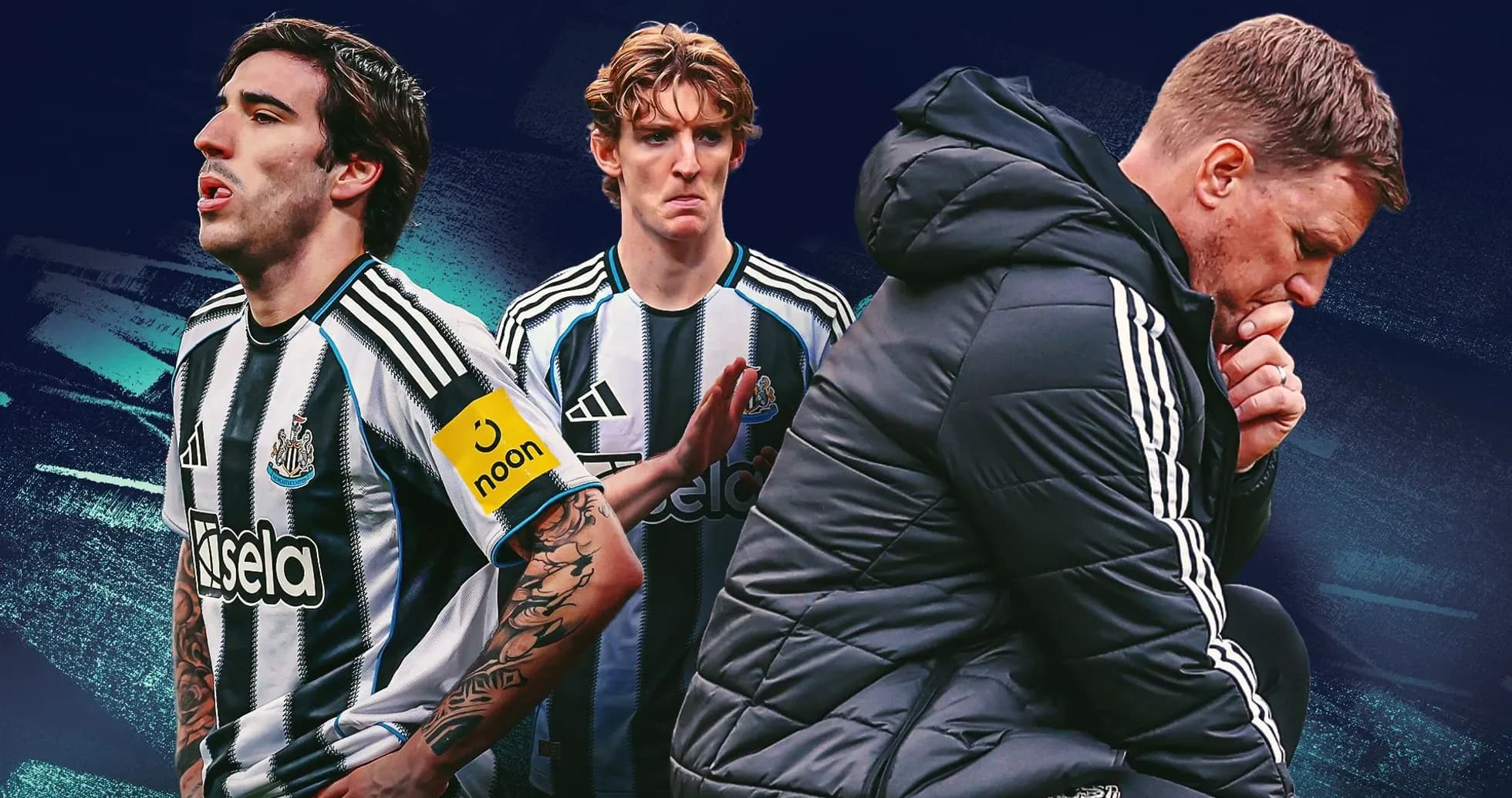
Newcastle's Collapse: From Contenders to Mediocrity
The mood on Tyneside has curdled.
What began as a blip has hardened into something far darker: a full-blown collapse that has Newcastle staring into the kind of mediocrity their new era was supposed to leave behind.
From contenders to a team in freefall
In the 2026 form table, Newcastle sit 17th. Two points above Wolves, whose relegation has already been confirmed in real life, and playing like a side flirting with the same fate in this simulation of a season gone badly wrong.
Saturday’s 2-1 defeat to Bournemouth – a third consecutive league loss by the same scoreline – was not an outlier. It was a pattern. Eight defeats in their last 11 league games. A run that includes a derby loss to Sunderland and is bettered only by Tottenham, who have somehow contrived to be worse since the turn of the year.
Cup competitions offered no sanctuary. Manchester City brushed them aside in both the FA Cup and Carabao Cup, ending their defence of the latter with ease. Barcelona then tore up what remained of their European ambitions, smashing them 7-2 at Camp Nou in the second leg of a Champions League last-16 tie. Dreams of another deep run on the continent didn’t just die; they were humiliated.
Newcastle are drifting towards their lowest league finish since relegation in 2015-16. The table says they are still just about within range of the clubs chasing European spots. The performances say something else entirely.
Howe’s credit is running out
Eddie Howe has been the architect of Newcastle’s revival. He saved them from relegation. Twice he took them into the Champions League. He ended a 70-year wait for a major trophy by beating Liverpool at Wembley in 2025. Those achievements bought him enormous goodwill and near-unanimous backing from the St. James’ Park crowd.
But the mood has shifted.
Boos rang around the stadium at the weekend. Not from a fringe, not as background noise, but as a clear verdict from a fanbase that once treated Howe as untouchable.
On The Rest is Football podcast, Alan Shearer – the club’s greatest icon and no knee-jerk pundit when it comes to Newcastle – voiced what many have started to wonder.
“As tough as it is for Eddie, I don't know what is going to happen with him,” Shearer said. He talked about watching Howe’s interview after the Bournemouth defeat, studying his body language on the touchline, and then delivered the line that will chill the manager more than any statistic: “I don't see Eddie Howe in charge of Newcastle next season, unfortunately. I look at his interview and I'm not sure the fight is there.”
Shearer stressed he would like Howe to stay “if all things are equal”, but questioned whether the head coach will feel he has the chance – or the appetite – to go again. It is a brutal question, but right now it feels unavoidable.
For the moment, the hierarchy are not pulling the trigger. Sky Sports report Howe is safe until the end of the season, with his position only set to be reviewed then. That gives him time, but not much protection.
A manager worn down by repetition
Before Bournemouth came to town, Howe insisted his “fire” for the job still burned “very, very strongly”. Ninety minutes and another limp defeat later, he sounded like a man exhausted by his own analysis.
“I am very aware that eight defeats out of 11 is not good enough,” he said. “Winning games is the very simple remedy, but it's very hard to deliver. Momentum is against us and you can feel that in the big moments in games.”
He lamented a lack of goalmouth action, admitted Newcastle “haven’t defended anywhere near well enough”, and then delivered the line that summed up his own fatigue: “We're not quite there at the moment. What's happening is systemic. I'm beginning to say the same things over and over again. That's a great frustration.”
The supporters made their feelings clear. Howe did not hide from that.
“[It's] disappointing when you are not delivering for your supporters,” he told Match of the Day. “That is the ultimate disappointment when you feel you are letting people down who come here and support us. If they are critical of us, we have to accept that as that's the game we are in.”
He spoke of the “huge global fanbase”, the intense scrutiny, the reality that he is in a results business. He insisted his internal motivation “never changes”, that he still wants to help players grow and build a winning team. The words were familiar. The conviction behind them felt thinner.
Most telling of all, when Howe was asked after the Bournemouth defeat whether his players shared that same “fire”, he paused. Seven seconds. An eternity in a press conference, and an answer in itself.
Recruitment misfires and a broken attack
If Howe looks drained, the transfer market is a big part of the story.
Newcastle lost Alexander Isak in acrimonious fashion last summer. Replacing a forward of that calibre is difficult; replacing him badly is ruinous. Howe was deeply involved in the recruitment drive that followed. The club spent around £180 million on Nick Woltemade, Yoane Wissa and Anthony Elanga. None of them have justified the outlay.
Woltemade started the season on fire. He looked like a clever piece of business, a forward who might even soften the blow of losing Isak. Then the calendar flipped, and his form fell off a cliff. His last league goals came in December, a brace against Chelsea. Since then: nothing.
Wissa missed most of the first half of the campaign with a knee injury. He has not found his rhythm since returning and has yet to score a league goal in 2026. At various points, Anthony Gordon and William Osula have been asked to lead the line instead, a clear sign of the coaching staff’s dwindling faith in their big-money forwards.
Elanga has been another disappointment. The consistency that made him such a threat for Nottingham Forest in 2024-25 has deserted him. No league goals, one assist, and a season now deep into its final stretch. Jacob Ramsey, signed to add thrust from midfield and an option on the wing, has struggled too, not helped by an ankle problem that disrupted his bedding-in period.
This is not a club simply suffering a freak run of bad luck. It is a club paying the price for a recruitment drive that has not delivered.
An end of a cycle – and a looming exodus
The problems do not stop with the players Newcastle have brought in. The ones they might lose are causing just as much anxiety.
Ahead of the Bournemouth game, Howe addressed the growing sense that this squad has reached the end of a cycle.
“There's a few players out of contract and you've got some big players who have done amazing things for the club maybe entering their final few months of their time here,” he said. “You've got possibly players leaving in the summer and that natural evolution on that side, which happens at a football club.
“So, I can understand why the [term] 'end of a cycle' might be used. What that looks like is unknown. It's always unknown. It's almost impossible to predict a summer transfer window and say, 'this will happen' or 'that will happen’.”
Those comments will not have soothed anyone. They sounded more like an acceptance that major change is coming, with no guarantee Newcastle will emerge stronger.
The list of potential departures is stark. Sandro Tonali has been heavily linked with Arsenal and Manchester United. Bruno Guimaraes is also said to be on United’s radar and is admired by Pep Guardiola at Manchester City. Tino Livramento is wanted by both Arsenal and City and is “likely” to be allowed to leave.
Anthony Gordon is the latest big name to be dragged into the rumour mill. Bayern Munich are reportedly keen on the £75m-rated England winger as competition for Luis Diaz on the left. At 25, he is said to be open to a move. Even Woltemade and Wissa, signed just last summer, are being loosely linked with exits, with Bayern and Chelsea mentioned in connection with Woltemade.
Kieran Trippier’s departure is already confirmed as he approaches the end of his contract. Fabian Schar, a stalwart of this era, could follow. What once looked like a settled, upwardly mobile squad now resembles a group preparing to scatter.
As results worsen, questions about the commitment of those eyeing the exit will only grow louder. Howe’s seven-second silence when asked about his players’ fire will not be forgotten.
Money, PSR and an owner tightening the tap
All of this churn is not just about ambition. It is about arithmetic.
Newcastle must navigate the Premier League’s Profit and Sustainability Rules. The likely sales of major assets are designed to fund another rebuild while keeping the books balanced. But this financial puzzle is playing out against a backdrop of uncertainty around the club’s owners, Saudi Arabia’s Public Investment Fund (PIF).
PIF, who bankroll Newcastle, are tightening their spending because of the Iran war and wider economic priorities, including the 2034 World Cup. Last week, chairman and PIF governor Yasir Al-Rumayyan confirmed the fund was reviewing “some deals and investments”. They have already sold a 70 per cent stake in Al-Hilal for £276m and are rumoured to be preparing to pull funding for LIV Golf, the expensive breakaway project launched in 2022.
According to the BBC, PIF remain “totally committed” to Newcastle and insist the club will be “unaffected” by this reassessment. That is the official line. The reality will be measured in transfer windows, not statements.
Newcastle are already in the eye of the storm. A team sliding down the table. A manager under strain. A squad facing an overhaul. Owners recalibrating their global portfolio.
The question now is not just whether Eddie Howe can turn this around. It is whether the club that emerges from this summer will still resemble the Newcastle that dared to believe it could crash the elite – or whether this season marks the moment that dream began to unravel.



